




London Wall Barometer
A London wall barometer tracks atmospheric pressure with precision, offering a functional instrument housed in finely worked timber.
London Wall Barometer
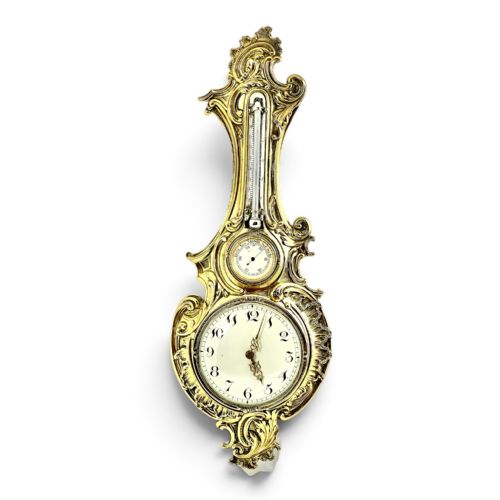
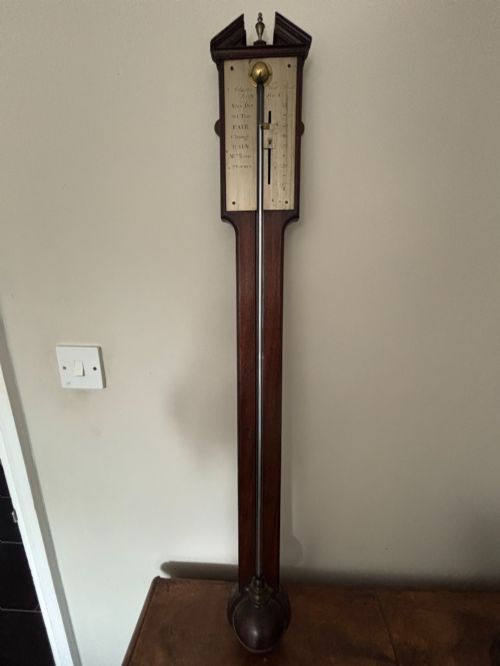
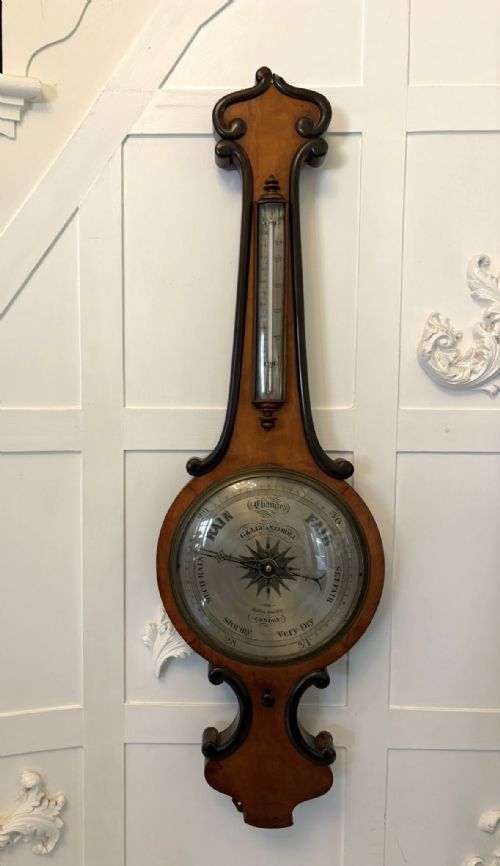
A london wall barometer is a scientific instrument designed to measure atmospheric pressure, taking the form of stick barometers, wheel barometers, and aneroid models intended for interior display. These pieces originate primarily across the Georgian, Regency, and Victorian periods, reflecting scientific advancement and domestic refinement.
The versions most commonly met on this page include mahogany, rosewood, and oak stick barometers alongside carved walnut wheel barometers. Many examples incorporate thermometers, hydrometers, or clock stations within the timber case.
Makers working in London produced these instruments for both marine and domestic use, employing mercury columns or spring-driven aneroid dials. Surviving pieces display the progression from simple mercury tubes to robust Fitzroy storm barometers and precision aneroid mechanisms.
Materials and Construction
Cases utilise dense hardwoods including mahogany, rosewood, oak, walnut, and ebonised timber, frequently finished with boxwood and ebony string inlay or carved detailing. These timbers provide the structural stability required to protect sensitive interior tubes and mechanisms.
Functional elements combine glass tubes, silvered metal scales, brass bezels, enamel dials, and bone verniers, alongside mercury or aneroid movements. Metal dials feature finely engraved numerals and calibration scales executed by specialist instrument makers.
Lion mask motifs occasionally stare down from Victorian aneroid dials, watching the weather change.
Judging Quality
Quality rests upon the precision of the scale engraving, the integrity of the timber case, and the reputation of the instrument maker inscribed on the dial. Signed examples by prominent opticians and instrument makers command particular attention.
The sophistication of the movement and the preservation of original glass, mercury columns, and ivory or bone adjustment keys distinguish superior examples from standard production pieces.
George Adams London·Elliott Brothers·Short and Mason·G and L Guanziroli·Negretti and Zambra·Dollond of London·Joseph Somalvico·James Hicks
The London Wall Barometer Glossary
- Stick barometer
- An instrument utilising a vertical glass tube filled with mercury to measure changes in atmospheric pressure. The column rises and falls against a calibrated scale.
- Wheel barometer
- A circular instrument featuring a dial where a pulley and float system translates mercury movement into the rotation of a pointer. These often incorporate a hygrometer or thermometer.
- Aneroid barometer
- A design measuring pressure through the expansion and contraction of a sealed corrugated metal box, removing the need for liquid mercury. This mechanism allows for varied case configurations.
- Sympiesometer
- A portable barometer combining a column of oil and compressed air with a thermometer to indicate atmospheric changes. It provides a sensitive reading for marine and domestic settings.
- Vernier scale
- A auxiliary sliding scale used to read fractional parts of the main subdivisions on the barometer plate. It permits precise readings of pressure fluctuations.
London Wall Barometer: Frequently Asked Questions
How do stick barometers work?
A stick barometer balances the weight of a mercury column against atmospheric pressure acting on an exposed reservoir. When pressure increases, the mercury is pushed higher up the vertical glass tube.
Changes in weather correspond directly to the height of this column, allowing observers to track incoming atmospheric shifts by reading the calibrated scale.
Where should I hang a wall barometer?
These instruments require placement on an interior wall away from direct sunlight, central heating radiators, and drafts. Stable ambient temperatures ensure the internal mechanism functions accurately.
Securing the heavy timber case to a solid wall stud using appropriate fixings protects the delicate glass tubes and wooden framing from accidental impact.
What is an aneroid barometer?
An aneroid barometer measures atmospheric pressure using a sealed, flexible metal capsule that expands or contracts as pressure alters. A system of levers connects this capsule to the indicator needle on the dial.
This design avoids liquid mercury, making the instrument robust and suitable for a wider variety of wall-mounted domestic and marine cases.
How do I date a barometer?
Dating relies on the casing style, the materials used, and the signature of the maker engraved on the metal plate. Georgian examples often feature understated mahogany or rosewood stick cases with vernier scales.
Victorian pieces frequently display heavier carved oak or walnut frames, ornate dials, and diverse mechanisms like the Fitzroy storm barometer or aneroid movements.