


London River Scene Art
London river scene art captures the historic capital's waterways, bridges, and maritime trade through oil and watercolour.
London River Scene Art
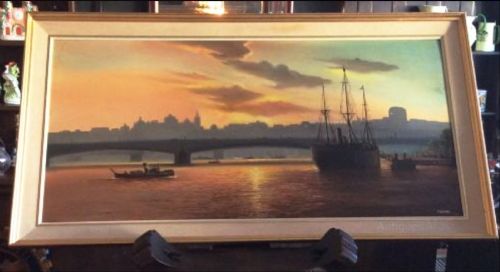
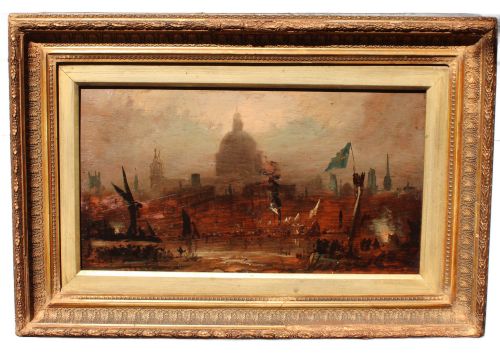
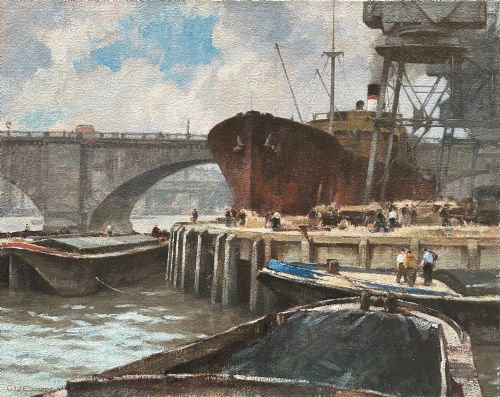
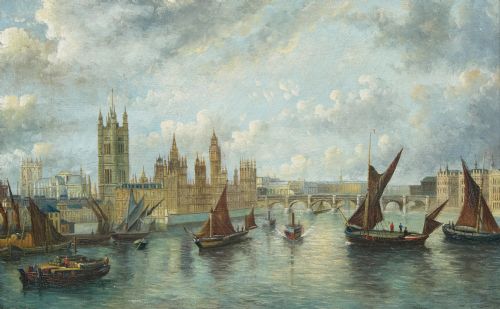
London river scene art depicts the River Thames, featuring landmarks such as Waterloo Bridge, London Bridge, Tower Bridge, and the Houses of Parliament. These works document the bustling maritime activity, shipping, and civic processions that defined the capital across the centuries.
The pieces available here span from the 19th century through the Edwardian era and into the 20th century, encompassing styles from Romanticism and Victorian British Impressionism to British Realism. Buyers will find both detailed watercolours and substantial oil paintings capturing atmospheric views of the Thames pools.
Compositions range from panoramic watercolours of St Paul's Cathedral in the background to focused oil studies of shipping barges and the Lord Mayor's procession. Each piece offers a specific window into the changing architecture and working life of the London waterfront.
Materials and methods
Artists working on these river scenes relied primarily on oil on canvas and watercolour on paper, frequently framing the works in wood with gold leaf details. Oil paints allowed for rich, textured depictions of water and sky, while watercolour suited the luminous, atmospheric conditions of the Thames.
Techniques varied from rapid oil studies capturing transient light on the water to highly detailed topographical watercolours documenting specific river viewpoints and architectural facades.
Materials documented across the artworks include paper, watercolour, oil on canvas, wood, canvas, oil, gold leaf, and oil paint.
Distinctions in quality
Quality in these river scenes rests upon the artist's handling of atmospheric perspective and light, which conveys the damp, hazy air characteristic of the Thames. Superior works demonstrate a confident command of medium, whether through fluid watercolour washes or substantial, textured brushwork in oil.
The strength of a piece also depends on the compositional balance between the architectural landmarks, such as St Paul's Cathedral or the Houses of Parliament, and the lively shipping activity on the river below.
Cyril Walduck Edwards·John Macvicar Anderson·A. G. Hayward·Walter Duncan·Frank W. Scarborough·Lieutenant Harold E Frecker·Edward Fletcher·Herbert John Finn·Francis Moltino
The London River Scene Art Glossary
- Watercolour
- A painting method in which the paints are made of pigments suspended in a water-based solution. This technique often produces translucent washes well-suited to capturing river mists and open skies.
- Oil on canvas
- Pigments bound in a medium of drying oil applied to stretched fabric. This durable combination permitted artists to build rich surface textures and deep tonal ranges.
- Topographical watercolour
- A detailed work focused on accurately recording specific places, buildings, and landscapes. These pieces serve as historical records of London's evolving urban topography.
- Maritime art
- Works depicting ships, shipping, and maritime environments. In the context of the Thames, this encompasses commercial barges, sailing vessels, and bustling river pools.
London River Scene Art: Frequently Asked Questions
What periods do these river scenes cover?
The works span the 19th century, the Victorian and Edwardian eras, and into the 1920s and 1960s.
This broad chronological spread reflects changing artistic interpretations of the Thames over more than a century.
Which materials are most common?
Painters utilised oil on canvas and watercolour on paper, often encased in wood and gold leaf frames.
Both mediums were favoured for capturing the shifting light and weather conditions along the river.
How were these artworks used historically?
These paintings and watercolours were created to adorn domestic interiors, celebrating the grandeur and bustling commerce of the capital.
Many captured specific civic events or familiar London landmarks for contemporary collectors.
How do I identify different styles?
Styles range from the atmospheric approaches of Victorian British Impressionism to the precise detail of topographical works.
Examining brushwork, colour palette, and the treatment of light helps distinguish between Romanticism and British Realism.