



Locking Drawer Desk
A locking drawer desk brings together secure storage and a compact writing surface, offering clever mechanisms for private correspondence.
Locking Drawer Desk
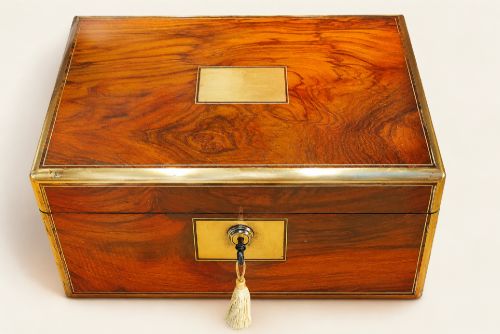
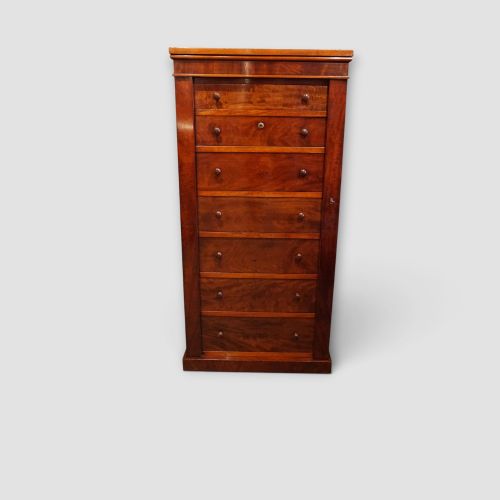
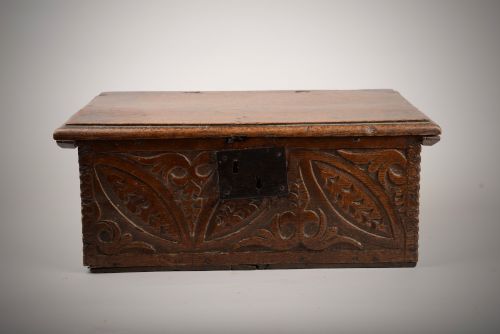
A locking drawer desk encompasses compact writing slopes and tall secretaire chests designed for secure storage and correspondence. These pieces range from seventeenth-century table boxes to nineteenth-century Wellington chests and portable slopes.
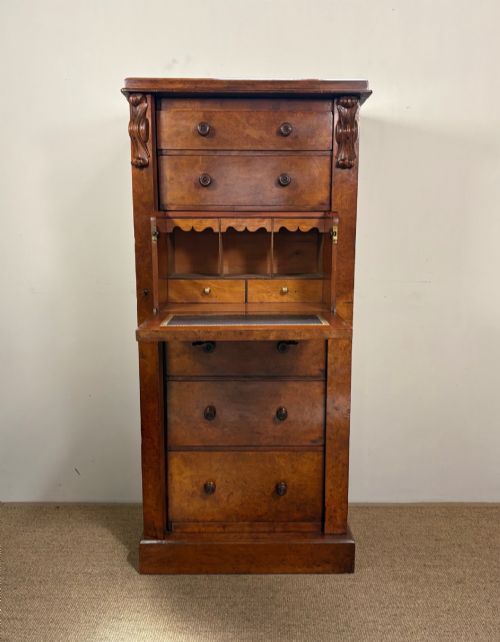
The version most commonly met on this page is the Victorian secretaire Wellington chest, typically tall and narrow with a locking flap that secures the entire drawer stack. These pieces often incorporate a fitted writing compartment alongside standard drawers.
Portability and hidden compartments define many examples, with table boxes and writing slopes featuring internal drawers and specialised locks. The forms span multiple periods, including the Regency era, Victorian period, and seventeenth century.
How they were made
Cabinetmakers utilised dense timbers such as mahogany, walnut, rosewood, and oak, frequently applying flame mahogany veneer to primary surfaces for visual depth. Brass mounts, corner braces, and escutcheons provided structural reinforcement and decorative contrast.
Advanced security mechanisms, notably Bramah locks operated by specialised keys, were integrated into drawers and writing flaps to protect confidential papers. Secondary elements included leather writing surfaces and internal secret drawers concealed within the wooden framework.
Locking Drawer Desk Retail Price Guide 2026
Typical asking prices for locking drawer desk among the pieces listed under this phrase on Sellingantiques today, from the lower quarter to the upper quarter. They describe what is for sale here now, not the wider market.
Some nineteenth-century writing slopes include tiny hidden release buttons that require a fingernail press to reveal compartments.
What varies in quality
The refinement of the timber selection distinguishes finer examples, particularly where figured walnut or matched flame mahogany veneer covers the surface. Superior construction shows in the precision of the internal fittings, secret compartments, and secondary drawer linings.
The complexity and originality of the hardware, especially working Bramah locks supplied with matching keys, elevate a piece. The crispness of carved details, structural stability of the tall Wellington chests, and integrity of the leather writing inserts mark the upper tier of the range.
Druce & Co.
The Locking Drawer Desk Glossary
- Secretaire
- A desk or chest of drawers featuring a pull-down flap or drawer front that reveals a writing surface and small compartments. This form allows a tall case piece to serve double duty as a writing desk.
- Wellington chest
- A tall, narrow chest of drawers secured by a hinged vertical locking flap on one side that fastens with a key. The design originated in the nineteenth century and maximises storage in a compact footprint.
- Writing slope
- A portable box with a slanted hinged lid that opens to reveal a desk surface and stationery storage. Many examples contain secret drawers and pen trays.
- Bramah lock
- A high-security cylindrical lock patented in the eighteenth century, valued by collectors for its intricate mechanism. These locks require a cylindrical slotted key to operate.
- Flame mahogany veneer
- A sliced layer of mahogany wood displaying a fiery, undulating grain pattern applied to a stable core. Cabinetmakers used this technique to achieve striking visual symmetry on drawer fronts.
Locking Drawer Desk: Frequently Asked Questions
How do locking mechanisms work on these desks?
Many nineteenth-century pieces utilise a side locking bar on Wellington chests that engages pins on every drawer simultaneously when locked with a key. Writing slopes rely on mortise locks or Bramah cylinder locks secured into the fall-front lid.
These systems were designed to keep private papers secure from casual inspection. The key must typically be turned in a specific direction to release the vertical flap or internal catches.
Where were these writing pieces used?
These items served merchants, gentlemen, and travellers who required a private, secure place to write letters and manage accounts. Tall chests stood in libraries or bedrooms, while portable slopes travelled on carriages and ships.
The compact footprint allowed them to function in restricted spaces before dedicated study rooms became standard in larger homes.
What is the difference between a slope and a Wellington chest?
A writing slope is a portable box placed on a table, featuring a hinged lid that opens to form an angled desk surface. A Wellington chest is a tall, stationary floor-standing piece with multiple horizontal drawers secured by a locking side stile.
While both offer secure storage, the Wellington chest provides substantial vertical capacity for clothing or papers rather than portable writing facilities.