
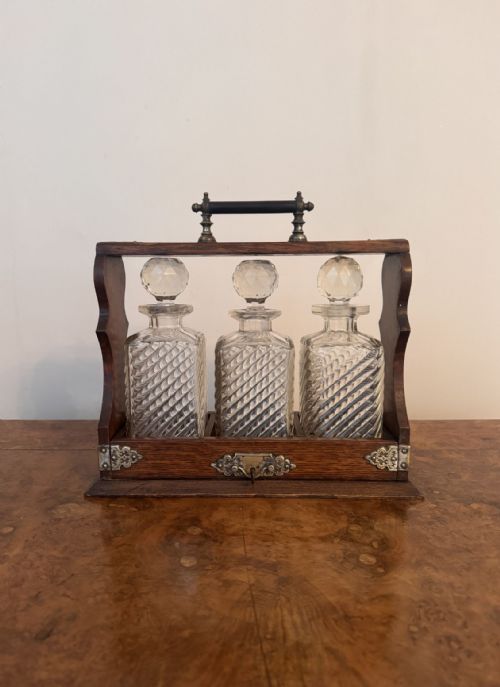


Lockable Decanter Frame
These lockable decanter frame pieces combine secure storage with fine presentation, offering period craftsmanship in oak, walnut, and silver plate.
Lockable Decanter Frame
A lockable decanter frame, commonly known as a tantalus, is designed to secure spirits away from servants or guests while displaying the bottles through a wooden or metal framework.
The versions most frequently met on this page date from the late nineteenth century into the Edwardian period, constructed primarily as oak or walnut cases fitted with silver plated mounts.
Most examples house either two or three cut glass or crystal decanters, held firmly within a locking mechanism that requires a key to release the bottles.
How They Were Made
Cabinetmakers utilised hardwoods such as oak, walnut, and coromandel, occasionally incorporating marquetry inlay to enrich the exterior surfaces of the frames.
Metal components typically consist of cast and polished silver plate or chrome, forming the locking handle, swing bars, and protective corner mounts.
What Varies in Quality
Quality rests upon the weight and density of the hardwood carcass, alongside the crispness of the glass cutting and the sturdiness of the metal locking mechanism.
Subtleties in craftsmanship appear in the execution of marquetry inlay, the thickness of the silver plating, and the integration of maker-marked components.
The Goldsmith Co.·Philip Ashberry
The Lockable Decanter Frame Glossary
- Tantalus
- A locking drink cabinet that holds decanters securely in place while leaving them visible. The name derives from Greek mythology, as the bottles remain visible yet unreachable without the key.
- Silver Plate
- A thin layer of silver fused to a base metal such as copper or brass. This technique provided the appearance of solid silver at a lower production cost.
- Marquetry
- Decorative woodwork where small pieces of veneer are fitted together to form geometric or floral designs. It appears on the surfaces of Victorian and Edwardian frames.
- Coromandel
- A dense, dark exotic timber with contrasting streaks, highly prized for luxury nineteenth-century boxes and frames. It provides exceptional durability and a rich grain.
- Cut Crystal
- Glass containing lead oxide, which increases brilliance and weight, decorated with deep geometric incisions. This material catches candlelight and reflects illumination across the barware.
Lockable Decanter Frame: Frequently Asked Questions
What is a lockable decanter frame?
A lockable decanter frame is a secure housing unit designed to hold glass decanters of spirits. The locking mechanism prevents unauthorized access to the contents.
These pieces gained popularity in Victorian and Edwardian dining rooms and smoking rooms for safeguarding expensive imported liquors.
How do you open the locking mechanism?
Most frames operate via a metal bar that swings down or lifts when a key is turned in the integrated lock. When unlocked, the bar clears the necks of the decanters.
Without the key, the handle remains upright and locked, keeping the stoppers trapped inside the metal collar.
Were these frames used in homes?
Households utilised these frames in drawing rooms, dining rooms, and studies. They allowed hosts to display fine hospitality while controlling access to the alcohol.
Servants could prepare the room without having direct access to the contents of the decanters.
How do I identify the period of a frame?
Dating relies on the combination of timber choice, metal plating techniques, and the style of glass cutting. Victorian examples often feature heavy oak or walnut with elaborate silver plate.
Later Edwardian and Art Deco pieces display simpler lines, sometimes incorporating chrome instead of traditional silver plate.