


Lighthouse Maritime Painting
A lighthouse maritime painting captures coastal navigation and marine architecture through oils and watercolours spanning the nineteenth and twentieth centuries.
Lighthouse Maritime Painting
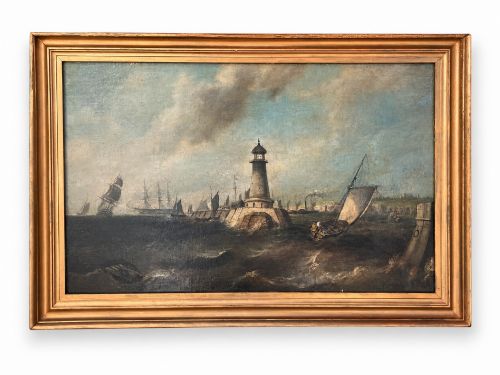
When searching for a lighthouse maritime painting, you encounter works depicting coastal beacons, rocky outcrops, and marine traffic from periods such as the Victorian era, the Edwardian years, and the mid-twentieth century. These depictions range from detailed realism documenting specific locations like Plymouth Breakwater or Eddystone Lighthouse to imaginative coastal scenes.
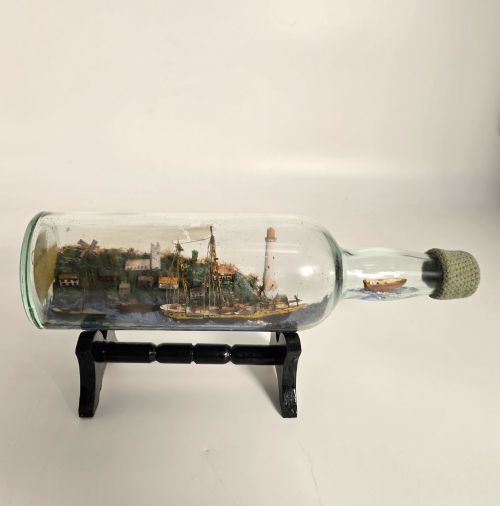
The most common versions on this page include nineteenth-century oils and watercolours, alongside early twentieth-century depictions of British and European shores. Alongside flat canvas and paper works, the selection encompasses three-dimensional maritime dioramas and folk art ship models.
Works frequently identify specific coastal landmarks, from Cornish harbours to Portuguese headlands, placing the maritime structure at the heart of the composition. Buyers examine these pieces for their historical record of coastal navigation and maritime heritage.
Materials and techniques
Artists utilise oil paint on canvas or wood panels, alongside watercolour pigment on paper, to capture the shifting light and atmosphere of the sea. Canvas works allow for rich impasto and deep tonal gradations, while watercolours rely on the luminous white of the paper beneath translucent washes.
Framed artwork and shadowbox dioramas incorporate mixed media, utilising wood, glass, and paper to construct layered maritime scenes. Support structures often feature traditional framing methods appropriate to the Victorian and Edwardian periods.
Materials represented across the selection include wood, paper, glass, canvas, and various paint formulations.
Evaluating quality
Quality rests upon the artist's handling of light, maritime atmosphere, and architectural precision in rendering the coastal structure against the sea. Stronger examples demonstrate confident brushwork and a convincing sense of scale between vessels and shoreline.
The degree of historical documentation and topographical accuracy distinguishes professional marine art from simpler folk art interpretations. Condition of the canvas or paper surface, coupled with period-appropriate framing, further defines the standing of each piece.
Nicholas Condy·George F Pennington·Ernest F Hill·Arthur Wilde Parsons·John Callow·Joseph Heard·R I Barrow
The Lighthouse Maritime Painting Glossary
- Maritime realism
- A style of painting focused on accurate depictions of ships, coastal architecture, and sea conditions. This approach relies on careful observation of maritime environments.
- Folk art
- Self-taught artistic production that often emphasises direct expression over academic convention. In this context, it includes scratch-built models and vernacular coastal scenes.
- Diorama
- A three-dimensional display enclosing miniature models within a cased setting. These pieces often combine painted backgrounds with physical ship and lighthouse elements.
- Seascape
- A work of art depicting the sea, coastal views, or marine activity. It forms the primary genre for lighthouse paintings.
- Watercolour
- A painting method where water-soluble pigments are applied to paper. This technique yields translucent effects suited to coastal light.
Lighthouse Maritime Painting: Frequently Asked Questions
How do I date a lighthouse painting?
Dating relies upon stylistic cues, artist signatures, framing methods, and the depicted maritime architecture or vessel types. Documentary evidence within the title or provenance provides the clearest chronological anchor.
Changes in painting techniques and materials across the nineteenth and twentieth centuries also help narrow the period of creation.
Where should I hang marine art?
Marine art suits rooms with stable environmental conditions, away from direct sunlight and excessive moisture that might damage canvas or paper. Proper placement ensures the artwork remains protected while serving as a focal point.
Pairing oil paintings and watercolours with traditional interior schemes enhances their historical character.
What is the difference between oils and watercolours here?
Oil paintings utilise suspended pigments in drying oils on canvas or wood, offering rich textures and deep colour saturation. Watercolours employ water-based pigments on paper, presenting a lighter, more transparent quality.
Both mediums were widely used across the Victorian and Edwardian periods to record coastal scenes.
Are dioramas considered paintings?
Dioramas are three-dimensional cased constructions rather than flat paintings, though they frequently incorporate painted backdrops. They represent a distinct branch of maritime folk art.
Collectors often group them with marine paintings due to their shared subject matter of ships and coastal navigation.