



Leather Room Divider
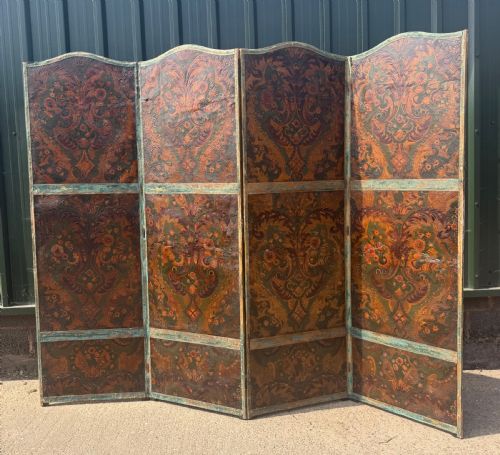
These leather room divider pieces are folding partitions that bring rich texture and hand-painted decoration to an interior, shaped by centuries of European craftsmanship.
Leather Room Divider
When you search for a leather room divider, you encounter multi-fold screens designed to segment living space with decorative weight. The examples appearing here span the eighteenth and nineteenth centuries, including French, Dutch, Spanish, and Victorian pieces.
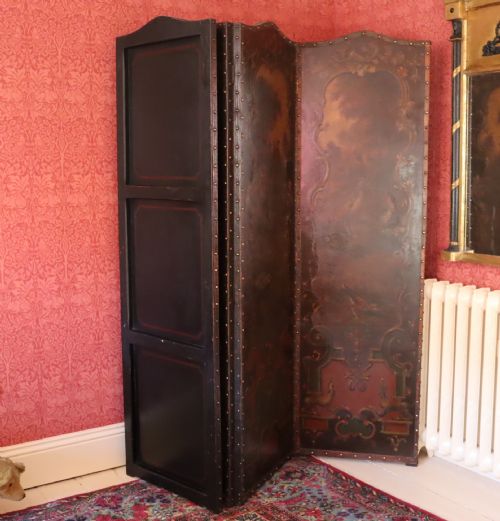
Most items on this page take the form of three-fold or four-fold folding screens. They employ materials such as painted leather, canvas, wood frames, and brass hinges to create substantial movable partitions.
Origins stretch from continental workshops influenced by Baroque and Chinoiserie styles to British country-house interpretations. You find both tall architectural dividers and lower dressing screens.
How they were made
The foundation rests on timber frames, often utilising oak or mahogany to support the weight of the panels. Brass hardware connects the folds, allowing the screens to articulate smoothly.
Surfaces combine leather, canvas, and oil paint, frequently enhanced with gold leaf and gilt embossing. Artisans applied polychrome decoration by hand, sometimes tooling the leather to create raised patterns before painting.
Leather Room Divider Retail Price Guide 2026
Typical asking prices for leather room divider among the pieces listed under this phrase on Sellingantiques today, from the lower quarter to the upper quarter. They describe what is for sale here now, not the wider market.
Keep your screen flexible so it can hide a rogue pile of laundry at a moment's notice.
What varies in quality
Quality rests in the depth of the hand-painted detail and the crispness of the gilt embossing on the leather or canvas panels. Finer examples display intricate Chinoiserie motifs or carefully rendered polychrome scenes rather than plain surfaces.
The structural integrity of the wood frame and the quality of the original brass hinges distinguish superior partitions. Leather panels that retain their suppleness and rich colour without excessive cracking indicate better preservation.
The Leather Room Divider Glossary
- Cordoban
- Leather originating from Córdoba in Spain, known for its rich embossing and use in luxurious wall hangings and screens. It provides a heavy, durable surface for intricate decoration.
- Chinoiserie
- European artistic style reflecting Chinese motifs and decorative arts, popular in screens and furniture during the eighteenth century. It employs whimsical landscapes and figures.
- Polychrome
- Decorated in multiple colours, often applied by hand to leather, canvas, or wood. This technique creates vibrant surfaces on panels and folding screens.
- Gilt embossed
- Stamped with raised patterns and finished with gold leaf or gold paint. This method adds reflective depth to leather room dividers.
- Draught-screen
- A historical term for a folding partition used to block cold air currents in large rooms. These pieces double as decorative room dividers.
Leather Room Divider: Frequently Asked Questions
How do I place a folding screen in a modern room?
Position the screen against a plain wall to display its painted panels as artwork, or use it to define a seating area within a larger open-plan space.
Ensure the folds are angled slightly to provide stability, allowing the piece to stand securely without wall fixings.
How do I clean antique painted leather?
Dust the surface gently with a soft, dry cloth to remove surface particles without disturbing the aged paint layers. Avoid using water, saddle soap, or chemical cleaners on antique painted or gilt leather.
Consult a professional restorer if the leather requires conditioning or conservation work to stabilise flaking paint.
What is the difference between a dressing screen and a room divider?
Dressing screens traditionally functioned as private partitions for changing clothes in bedrooms, tending to be slightly lower in height. Room dividers were generally taller architectural pieces meant to segment larger reception rooms.
Both types utilise folding panels hinged together, though surviving examples share similar decorative treatments.
How do I tell an 18th century screen from a 19th century one?
Eighteenth-century examples often feature heavy Cordoban leather with deep gilt embossing or distinct Dutch chinoiserie work. Nineteenth-century pieces frequently incorporate Victorian polychrome decoration or oak and mahogany framing.
Examine the construction of the wood frames and the wear on the brass hinges for clues regarding the period of manufacture.