



Lead Crystal Centrepiece Bowl
A lead crystal centrepiece bowl dominates a table with weight, clarity and deep prismatic facets.
Lead Crystal Centrepiece Bowl
A lead crystal centrepiece bowl serves as the focal point of a table or sideboard, designed to hold fruit, flowers or simply catch the light. When searching for a lead crystal centrepiece bowl, buyers encounter robust Victorian pedestal forms alongside refined Edwardian fruit dishes and Georgian oval serving pieces.
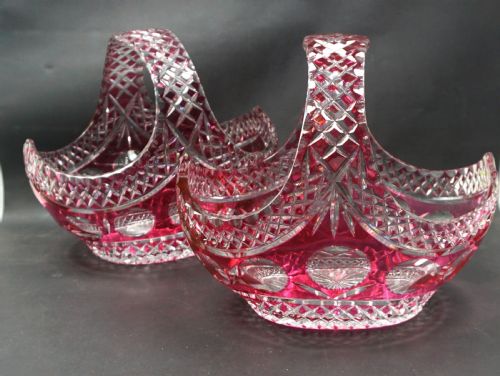
The selection ranges from heavy nineteenth-century cut glass to colourful twentieth-century Belgian over crystal pieces and traditional Irish crystal. These items manifest as large fruit bowls, standing tazza stands, handled baskets and deep decorative bowls spanning several decades.
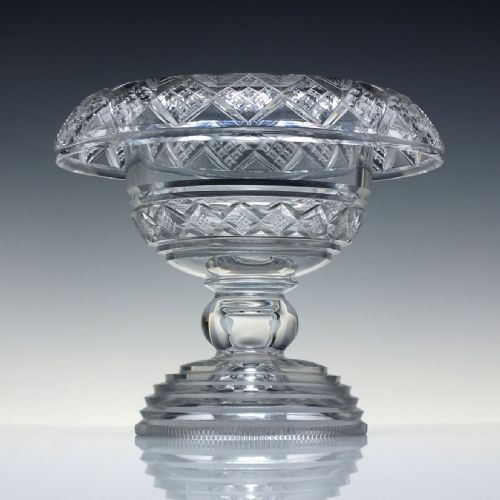
Victorian and Edwardian examples dominate the offerings, often featuring deep hand-cut patterns and pedestal bases. Georgian items bring early nineteenth-century oval proportions and heavy bases to the table.
How they were made
Makers shaped these heavy vessels from lead crystal and clear glass, frequently applying coloured overlayers such as red or blue glass before cutting through the surface to reveal the clear metal beneath. Artisans utilised wheel-cutting techniques to carve geometric hobnail patterns, flutes and intricate etchings into the thick material.
Traditional Irish crystal and Belgian production methods relied on heavy blank moulding followed by extensive hand polishing. The inclusion of lead oxide within the glass composition increased both the weight and the refractive index, giving each bowl its characteristic brilliance.
Early glassblowers likely tested their lung capacity on these heavy pieces, resulting in sturdy bowls that have outlived generations of dining tables.
What varies in quality
The distinction between standard vessels and superior pieces rests on the crispness of the cutting and the depth of the polish. Sharp, clean facets that catch the light without softness indicate skilled hand-workmanship.
Thickness of metal, clarity of the glass without internal cloudiness, and stability of pedestal bases separate ordinary utility wares from the finest decorative centrepieces.
Val St. Lambert·Waterford
The Lead Crystal Centrepiece Bowl Glossary
- Lead crystal
- Glass containing a significant percentage of lead oxide, which adds weight, brilliance and softness for easier cutting. This material allows artisans to produce deep, sharp prismatic facets.
- Hobnail pattern
- A raised diamond or conical surface texture resembling the hobnails used on heavy boots. It creates intense light refraction across the body of the bowl.
- Tazza
- An Italian term for an ornamental cup or shallow bowl raised on a high foot or pedestal. Victorian examples frequently served as elevated centrepieces.
- Over crystal
- A technique where a layer of coloured glass is fused over a clear crystal base. Cutting away portions of the outer colour reveals the contrasting clear glass underneath.
- Pedestal bowl
- A vessel elevated on a distinct foot or stem rather than resting directly on its base. This form lifts the centrepiece into the line of sight.
Lead Crystal Centrepiece Bowl: Frequently Asked Questions
How do I clean an antique lead crystal bowl?
Wash the bowl gently by hand in lukewarm water using a mild detergent, placing a towel at the bottom of the sink to prevent chipping.
Dry the vessel immediately with a lint-free cloth to maintain the clarity and sparkle of the cut facets.
Can I use these bowls for serving food?
These vessels are suitable for serving dry foods, fruit and confectionery during dining occasions.
Avoid serving acidic foods or liquids for extended periods to protect the historic glass surface.
How do I tell a Georgian bowl from a Victorian one?
Georgian bowls often feature heavy oval proportions and distinctive pontil marks on the unpolished base. Their cutting tends to be broader and less dense than later Victorian work.
Victorian pieces frequently display sharper, more complex hobnail patterns and taller pedestal feet.
Why are some bowls coloured instead of clear?
Coloured pieces usually employ an overlayer technique where a skin of ruby or blue glass covers a clear crystal core. Cutters then slice through the colour to create a striking contrast.