
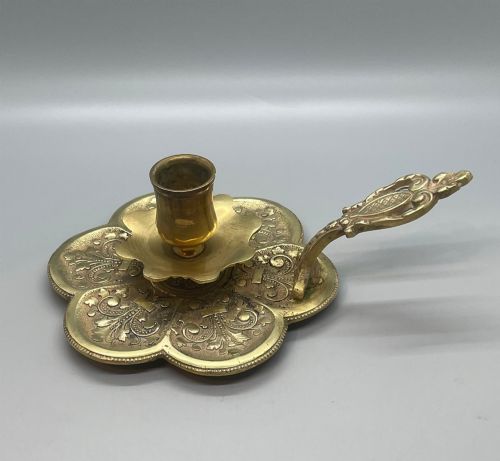


Late Victorian Taper Holder
These late victorian taper holder examples bring distinct period character and practical charm to any table, offering genuine historical appeal for everyday use.
Late Victorian Taper Holder
A late victorian taper holder search brings up domestic lighting items and small stands spanning the late nineteenth century, predominantly featuring candlesticks and candleholders alongside related pedestal forms. You will frequently encounter matched pairs dating from the eighteen eighties and nineties, capturing the eclectic taste of the Victorian period.
The selection ranges from simple domestic brass and pewter items to elaborate sterling silver, silver plate, and gilded bronze pieces. Distinct stylistic revivals and early modern motifs appear across the inventory, reflecting both traditional domestic manufacture and continental design influences.
How they were made
Metals dominate the construction of these items, utilising cast and turned brass, sterling silver, electroplated nickel silver, pewter, and gilded bronze or ormolu. Artisans employed traditional casting, plating, and chasing techniques to achieve both structural solidity and decorative surface detail.
Organic materials also feature in specific forms, notably through the use of solid oak in rustic pedestal stands. These pieces combine turned timber elements with metal mounts, demonstrating diverse workshop capabilities of the era.
Listings feature items spanning the eighteen eighties to nineteen ten, executed in brass, silver, pewter, and oak.
What varies in quality
The standard of execution in metalwork sets apart the finer examples, particularly where chasing, surface finishing, and figural detailing display high proficiency. Crisp casting lines and well-balanced proportions distinguish workshop output intended for formal display from standard utilitarian production.
Material choice similarly influences the standing of a piece, with heavy gauge sterling silver and fire-gilded bronze representing superior tier manufacturing compared to standard plated wares or simpler base metals.
WMF·Frederick J Smith and Co·WM Tonks and Sons
The Late Victorian Taper Holder Glossary
- Electroplated Nickel Silver
- A base metal alloy of copper, nickel, and zinc coated with a layer of pure silver through an electrolytic process. This technique became widespread during the Victorian era as an economical alternative to solid silver.
- Gilded Bronze
- Bronze metal coated with a thin layer of gold using mercury amalgamation or electrochemical methods to produce a rich metallic lustre. Also known as ormolu, it was frequently utilised on decorative French items.
- Art Nouveau
- An international style of art and design that flourished around nineteen hundred, characterised by flowing organic lines and natural motifs. Pieces in this style move away from historic revivalism toward more sinuous, plant-inspired forms.
- Pewter
- A malleable metal alloy consisting primarily of tin, traditionally combined with copper and antimony. It offers a dull grey finish well suited to domestic vessels and decorative objects.
Late Victorian Taper Holder: Frequently Asked Questions
What is a taper holder?
A taper holder is a small candleholder specifically designed to support a thin wax taper rather than a thick household candle. These items were traditionally used for melting sealing wax on letters or for carrying a small flame from room to room.
Most examples from this era measure compactly and feature a narrow nozzle or socket. They often incorporate a small saucer base to catch melting wax during use.
How do I date a Victorian candleholder?
Dating these items relies on examining registration marks, maker stamps, and stylistic cues present on the metal or wood. Pieces often bear specific period motifs ranging from French rococo revival to early art nouveau.
Materials also provide clues, as electroplated nickel silver and specific pewter alloys gained prominence during the later decades of the nineteenth century. Hallmarks on silver items offer the most precise chronological indicator.
Are these pieces made of solid silver?
The inventory includes a mix of materials, ranging from sterling silver to silver plate, electroplated nickel silver, brass, and pewter. Hallmarks stamped into the metal confirm whether a piece is solid sterling silver.
Items described as silver-plated or electroplated consist of a base metal coated in a thin layer of silver. These alternative metals provided an accessible luxury for Victorian households.