

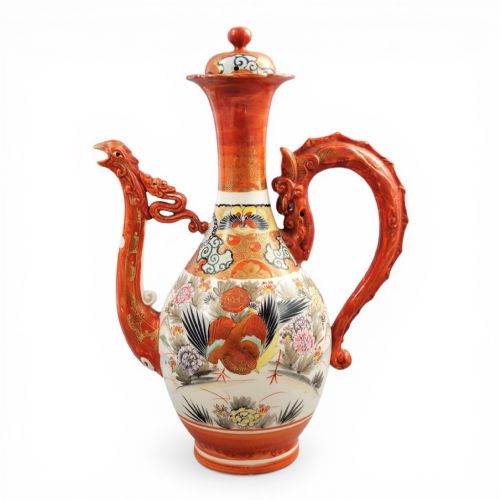


Late Victorian Porcelain Pitcher
A late victorian porcelain pitcher brings distinct late nineteenth century ceramic design to a table or washstand, prized for its hand-painted details and sculptural form.
Late Victorian Porcelain Pitcher
A late victorian porcelain pitcher is typically encountered as an ewer, jug, or part of a washstand set from the later decades of the nineteenth century and the turn of the twentieth century. These vessels range from functional toilet ware to highly decorative cabinet pieces designed for display.
The selections on this page span British potteries alongside Japanese and European pieces dating from the Victorian era into the early twentieth century. Makers embraced diverse global influences, resulting in forms that draw on Japanese Meiji design, Persian ornament, and neoclassical revivalism.
Buyers will find individual wine ewers, matched pairs, and larger pitcher and bowl combinations. The forms often feature elaborate handles, pedestal bases, and spout designs shaped like mythological creatures or stylised birds.
How they were made
These pieces rely on porcelain or fine earthenware bodies shaped through moulding and throwing before receiving detailed hand-finishing. Potters applied fluid glazes, including blush ivory finishes, to provide a smooth canvas for subsequent decoration.
Decoration often combined overglaze enamels with raised gold leaf, gilding, and gold gilt accents. Artisans painted floral motifs and intricate patterns by hand, fixing the pigments through high-temperature firing.
Late Victorian Porcelain Pitcher Retail Price Guide 2026
Typical asking prices for late victorian porcelain pitcher among the pieces listed under this phrase on Sellingantiques today, from the lower quarter to the upper quarter. They describe what is for sale here now, not the wider market.
Some ewers feature dragons serving as handles and phoenixes forming spouts, proving the Victorian imagination knew no bounds.
What varies in quality
Quality in these pitchers is determined by the crispness of the moulded relief and the precision of the hand-painted enamel work. Superior examples exhibit finely rendered brushwork and securely applied gilding that retains its bright metallic lustre.
The overall harmony of the form, particularly the balance of the handle and spout relative to the body, separates standard production wares from exceptional studio and factory pieces. Elaborate reticulated piercing and complex multi-part forms also indicate higher craftsmanship.
Royal Worcester·Grainger Worcester·Doulton Burslem·Royal Crown Derby·Vienna
The Late Victorian Porcelain Pitcher Glossary
- Ewer
- A large jug with a wide spout and a handle, traditionally used for holding water or wine but frequently produced as a purely decorative object in the nineteenth century.
- Blush Ivory
- A specialised porcelain finish developed by potteries like Royal Worcester, featuring a soft, matte cream ground that imitates the look of unbleached ivory.
- Reticulated
- Decorated with an openwork pattern formed by cutting or piercing clay before firing, creating a lace-like ceramic grille.
- Overglaze Enamel
- Coloured glass decoration applied on top of a fired glaze and fixed with a second, lower-temperature firing.
- Gilding
- The application of gold leaf or powdered gold suspended in a medium onto the surface of the ceramic to accent handles, rims, and motifs.
Late Victorian Porcelain Pitcher: Frequently Asked Questions
How do I care for a porcelain pitcher with gilding?
These vessels require gentle handling and should be cleaned only with a dry or lightly damp soft cloth. Avoid using commercial cleaners, abrasives, or soaking them in water, as overglaze enamels and gold leaf can wear away over time.
Display the pitcher away from direct sunlight and areas prone to heavy temperature fluctuations to protect the ceramic body and surface glazes from stress.
What is blush ivory porcelain?
Blush ivory is a distinctive ceramic finish developed during the late Victorian period, characterised by a warm, matte cream background that resembles natural elephant ivory. Potteries used this surface as a base for delicate hand-painted floral decoration.
Pieces with this finish often feature substantial gilding to contrast against the soft, non-reflective ivory tone.
How can I tell the period of a ceramic ewer?
Dating relies on maker marks, factory ciphers stamped or painted on the base, and stylistic indicators such as colour palettes and finishing techniques. Victorian pieces often utilise aesthetic movement motifs or neoclassical revival shapes.
Consulting factory registration numbers or specialised reference guides helps narrow down the specific decade of production.