
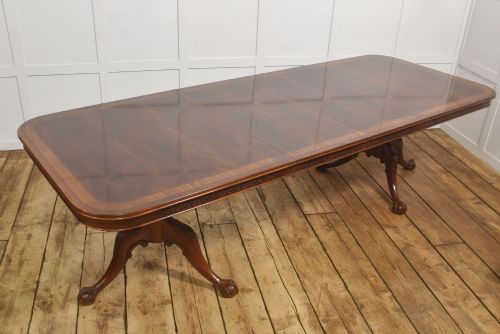
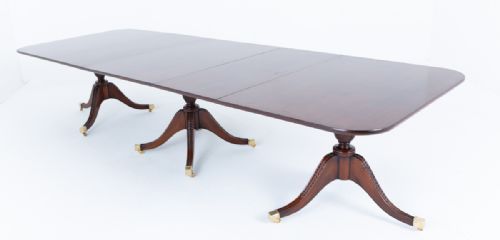


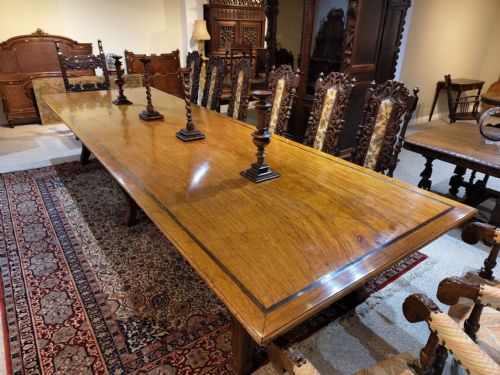


Large Wooden Boardroom Table
A large wooden boardroom table brings commanding presence and enduring utility to any interior, built from rich timbers to seat gatherings large and small.

Large Wooden Boardroom Table
When you search for a large wooden boardroom table, you encounter substantial dining and centre tables adapted or built for expansive seating. These pieces originate primarily across the nineteenth and early twentieth centuries, spanning periods from George III and Regency through to Victorian, Edwardian, and Art Deco eras.
The versions most commonly met on this page are multi-pedestal extending tables and refectory forms designed to accommodate ten to sixteen diners or more. They appear in styles ranging from Chippendale and Regency revivals to English country house oak and clean-lined walnut.
Constructed on a grand scale, these items serve as the focal point of a room, combining architectural presence with practical utility. Their forms reflect the craftsmanship of periods when furniture was built to anchor a substantial interior.
How they were made
Cabinet makers utilised dense hardwoods such as mahogany, Cuban mahogany, satinwood, oak, and walnut to construct these substantial frames. Timber selection prioritised durability and striking grain patterns, often enhanced through burr walnut veneer or figured surfaces.
Construction techniques involve multi-pillar pedestal bases or sturdy trestle supports designed to bear considerable weight across long expanses. Brass fittings and extending mechanisms allow sections to separate smoothly, accommodating extra leaves for larger gatherings.
Listings feature timbers including mahogany, Cuban mahogany, walnut, burr walnut veneer, satinwood, and oak across the nineteenth and twentieth centuries.
What varies in quality
The distinction between tiers of quality rests upon the selection of timber and the precision of the construction. Superior examples display carefully matched Cuban flame mahogany or figured grain across extended surfaces, whilst simpler pieces utilise standard domestic timber.
The engineering of the pedestal supports and extending mechanism dictates the structural integrity of the table. Finely carved pillars, robust brass castors, and well-fitted leaves demonstrate superior workshop output compared to heavier, more utilitarian builds.
Whytock & Reid
The Large Wooden Boardroom Table Glossary
- Pedestal table
- A table supported by one or more central columns rather than four corner legs. This design provides maximum legroom around the perimeter for seating guests.
- Extending table
- A dining table equipped with a mechanism or loose leaves to lengthen the top surface. It allows the furniture to adapt between daily use and large gatherings.
- Cuban mahogany
- A dense, dark timber harvested in the Caribbean and prized for cabinet making. It displays deep colouration and fine grain patterns favoured in Georgian and Regency furniture.
- Veneer
- A thin layer of figured wood applied over a secondary timber base. This technique showcases decorative grains without requiring the entire piece to be built from scarce solid wood.
Large Wooden Boardroom Table: Frequently Asked Questions
How do I measure for a boardroom table?
Measure your room dimensions carefully, ensuring adequate clearance around the perimeter for chairs to pull out comfortably. Account for the maximum extended length if the table includes removable leaves.
Allow at least one metre of free space between the edge of the table and surrounding walls or furniture. This ensures guests can circulate freely without crowding the interior.
Can these tables be shortened?
Professional cabinet makers can sometimes reduce the length of a solid wood table by removing a central section. However, altering multi-pedestal or extending tables disrupts the balance of the base proportions.
It is generally preferable to source a table matching your required dimensions rather than modifying an existing antique. Alterations can affect the structural integrity and historical character of the piece.
What seating capacity do I need?
Calculate required seating by allowing approximately sixty centimetres of linear edge space per person. A table measuring three metres or longer typically accommodates ten to twelve diners comfortably.
Consider the placement of pedestal bases or table legs when planning seating arrangements. Central pillars can occasionally restrict legroom if too many chairs are squeezed along the sides.