

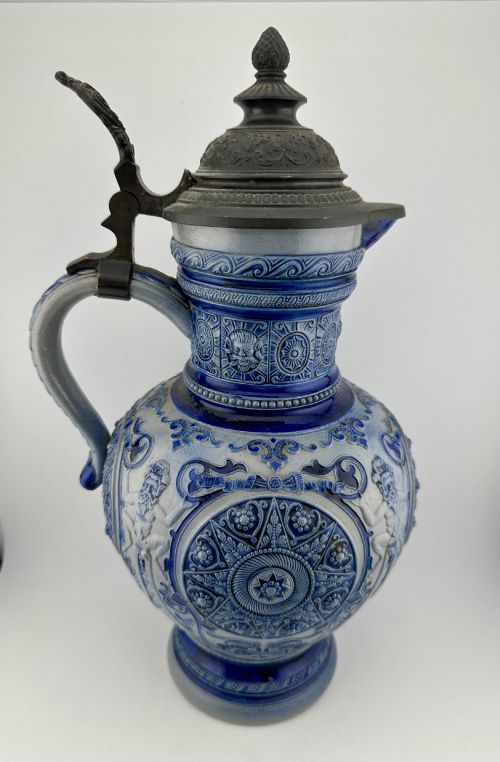



Large Stoneware Jug
A large stoneware jug is a heavy, robust vessel built for hearty service, offering enduring utility and earthy character for the home.
Large Stoneware Jug
A large stoneware jug brings a substantial, functional presence into any room, originating primarily from the Victorian era and the late nineteenth century. These vessels appear in forms such as pitchers, flagons, ewers, and harvest jugs, often displaying deep historical roots stretching back to earlier centuries.
The versions most frequently met on this page span the nineteenth century, including specific pieces from makers like Doulton Lambeth and Charles Meigh. Collectors encounter robust salt-glazed bodies, relief-moulded designs, and occasional pewter or silver mounts that elevate their utility to decorative display.
Buyers seeking a large stoneware jug will find examples ranging from German Westerwald blue and grey imports to English majolica and salt-glazed flagons. Each piece carries the distinct weight and impermeable body characteristic of fired ceramic built for heavy daily use.
Materials and construction
The fundamental body of these vessels is dense stoneware fired at high temperatures to achieve a vitrified, waterproof finish. Salt glaze is often introduced during the firing process to create a characteristic orange-peel texture over the ceramic surface.
Decoration is achieved through cobalt oxide pigments applied under the glaze, alongside intricate relief-moulded figures and mask motifs. Many pieces are completed with fitted pewter or silver rims and lids, adding structural reinforcement and refined metalwork to the ceramic form.
Large Stoneware Jug Retail Price Guide 2026
Typical asking prices for large stoneware jug among the pieces listed under this phrase on Sellingantiques today, from the lower quarter to the upper quarter. They describe what is for sale here now, not the wider market.
Listings feature nineteenth-century stoneware alongside seventeenth-century salt-glazed flagons, showcasing materials like cobalt oxide and pewter.
Assessing quality and craftsmanship
The distinction between standard utility vessels and finer display pieces rests in the crispness of the relief moulding and the control of the cobalt oxide decoration. Sharper details on moulded scenes and even, lustrous salt glaze surfaces separate exceptional examples from simpler utilitarian wares.
The integration of metal mounts, such as silver rims or pewter lids, influences the overall character and finish of the jug. Well-fitted mounts that complement the heavy stoneware body indicate careful workshop production and higher status.
Doulton Lambeth·Charles Meigh·Ridgway and Sons·Minton
The Large Stoneware Jug Glossary
- Stoneware
- A robust ceramic category fired at high temperatures until the clay body becomes vitrified and non-porous. This material resists liquids naturally without requiring an inner glaze.
- Salt glaze
- A vitreous coating formed by throwing common salt into the kiln during high-temperature firing, creating a slightly textured surface. This finish is durable and chemically resistant.
- Cobalt oxide
- A metallic colorant used to produce deep blue tones under the glaze, frequently seen on German Westerwald imports. It remains stable at high kiln temperatures.
- Relief-moulded
- A technique where decorative patterns and figures are raised in low relief from the surface of the jug using a prepared mould. This method allows for consistent, detailed narrative scenes.
- Ewer
- A large jug featuring a wide spout and an ornate handle, historically designed for pouring water rather than storing liquids. These decorative forms often display sculptural qualities.
Large Stoneware Jug: Frequently Asked Questions
How were these jugs used historically?
These vessels served practical roles in domestic and tavern settings for pouring ale, water, or cider. Larger examples like harvest jugs were designed to transport liquids to workers in the fields.
Over time, many transitioned into decorative display items, particularly those featuring elaborate relief moulding or precious metal rims. Their robust nature made them central to daily hospitality.
How do I style a large stoneware jug at home?
A large stoneware jug works effectively as a standalone decorative object on a sideboard, mantelpiece, or heavy wooden table. Its earthy tones and textured glaze complement rustic, traditional, and eclectic interiors.
These pieces also function well as containers for dried botanicals or tall stems. Their strong vertical presence adds height and architectural interest to a room.
How can I tell different periods apart?
Distinguishing periods relies on observing stylistic markers, glazing techniques, and maker marks stamped into the ceramic body. Nineteenth-century pieces often feature sharp relief-moulded scenes and maker attributions, while earlier examples display simpler salt glaze or Westerwald blue and grey patterns.
The presence of pewter or silver mounts can also suggest specific eras, such as Victorian adaptations or German Renaissance Revival styles. Examining the base and interior finish provides further clues to age.