

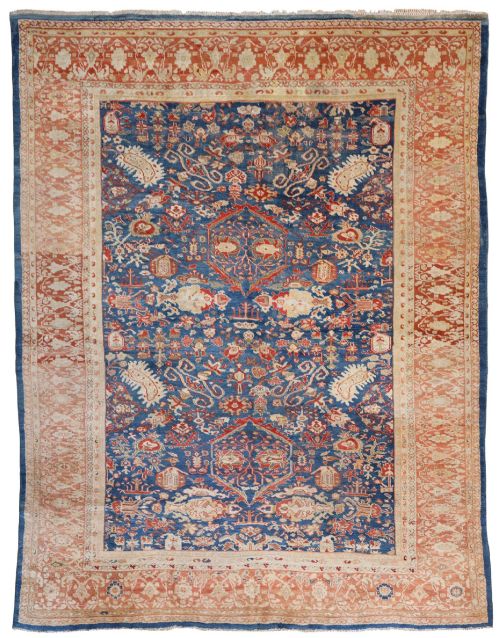

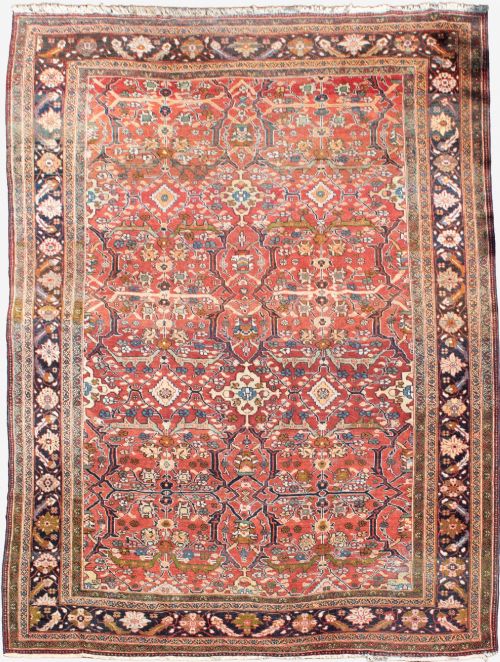


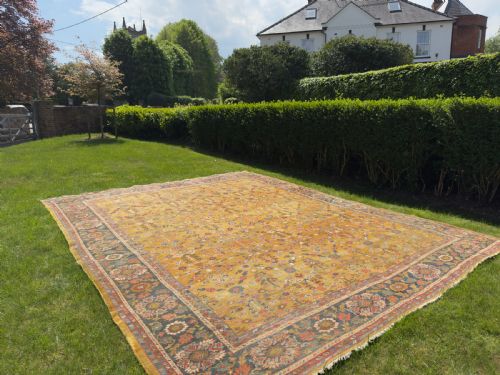
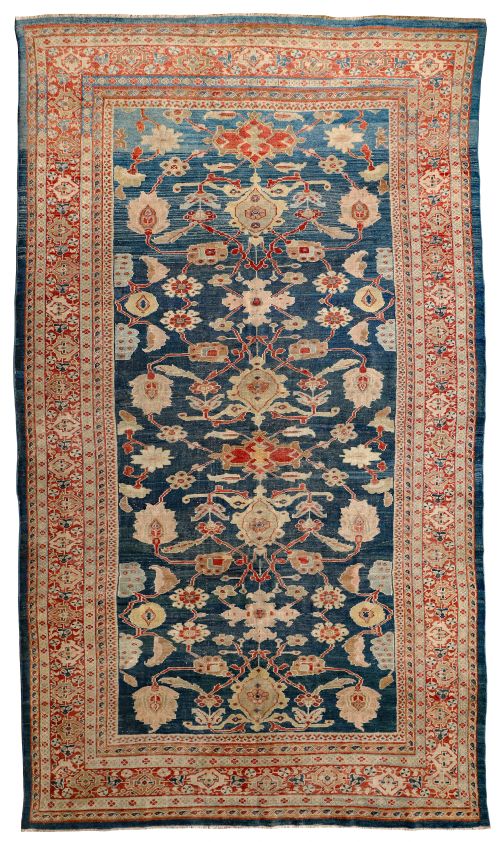

Large Persian Ziegler Rug
A large persian ziegler rug brings nineteenth-century decorative weaving into a room, offering large-scale floral designs that anchor a grand interior.
Large Persian Ziegler Rug
A large persian ziegler rug belongs to a distinct group of nineteenth-century floor coverings produced in Persia, often associated with the firm Ziegler and Company. These pieces span the late nineteenth century, including carpets dated around 1880, 1890, and 1900, alongside broader nineteenth-century examples.
The primary forms found here are large carpets and rugs, including palace-size and country house examples such as an antique Mahal carpet, antique Sultanabad carpet, and Fereghan Ziegler carpet. These grand formats display expansive room-size proportions suited to large spaces.
Buyers seeking this style encounter names linked to Persian production centres like Sultanabad and Mahal alongside specific Ziegler attributions. The material evidence shows woven floor coverings created from wool and cotton.
How they were made
These carpets and rugs utilise natural fibres, combining wool for the pile and cotton for the structural foundation of the weave. This combination provides both the soft surface texture required for footfall and the stable grid needed for large formats.
The production methods rely on traditional hand-knotting techniques executed across Persian workshops during the late nineteenth century. Weavers built these large-scale patterns thread by thread onto cotton warps using resilient wool yarns.
Large Persian Ziegler Rug Retail Price Guide 2026
Typical asking prices for large persian ziegler rug among the pieces listed under this phrase on Sellingantiques today, from the lower quarter to the upper quarter. They describe what is for sale here now, not the wider market.
Some nineteenth-century weavers managed to coordinate sprawling floral fields across floors the size of tennis courts without losing the plot.
What varies in quality
The standard of a large persian ziegler rug depends upon the finesse of the weave and the clarity of the large-scale floral design. Finer knotting allows intricate drawing within the expansive fields and broad borders.
Condition and scale also differentiate examples, particularly palace-size or country house carpets that retain their original proportions and structural integrity. The visual impact relies on how well the wool pile preserves the intended palette and pattern definition over large areas.
Ziegler and Co
The Large Persian Ziegler Rug Glossary
- Ziegler and Company
- A nineteenth-century firm that established production in Persia to export carpets tailored to Western decorative tastes. Their pieces typically feature muted palettes and oversized floral motifs.
- Sultanabad
- A Persian city and carpet-producing region known for large-scale, decorative room-size carpets created in the nineteenth century. These rugs often share design traits with Ziegler productions.
- Mahal
- A term applied to nineteenth-century Persian carpets from the same general district as Sultanabad, often featuring rustic or large-scale floral patterns. They serve as durable country house floor coverings.
- Fereghan
- A style of nineteenth-century Persian weaving associated with refined execution and classic medallion or all-over field patterns. When combined with Ziegler, it denotes a specific aesthetic lineage.
- Pile
- The upright yarn loop surface of a carpet that forms the soft texture and visible design. In these antiques, wool pile sits upon a cotton foundation.
Large Persian Ziegler Rug: Frequently Asked Questions
What is a Ziegler carpet?
A Ziegler carpet is a nineteenth-century Persian floor covering produced or influenced by the Manchester-based firm Ziegler and Company for Western markets. These pieces typically feature muted colours and expansive floral designs.
They were designed to suit large European and American drawing rooms, offering grand scale without the intense coloration of some earlier tribal rugs.
How do Sultanabad and Ziegler rugs differ?
Sultanabad rugs originate from the Persian region of that name and encompass nineteenth-century commercial carpet production. Ziegler rugs specifically relate to carpets commissioned or distributed by Ziegler and Company.
In practice, the terms often overlap because Ziegler organised much of the production within the Sultanabad district.
Where were these large carpets used?
These large nineteenth-century carpets were originally woven for grand country houses, drawing rooms, and substantial reception spaces. Their generous dimensions provided warmth and visual grounding for expansive wooden floors.
Today, they continue to serve the same function in large modern interiors, anchoring furniture groupings in living rooms or dining halls.
What materials make up these antique rugs?
These rugs are constructed using wool for the soft upper pile and cotton for the underlying warp and weft threads. This pairing gave the weavers a sturdy, stable foundation while maintaining a comfortable surface texture.
The wool also held natural dyes well, contributing to the characteristic faded elegance seen in nineteenth-century Persian weaving.
How can I date a nineteenth-century carpet?
Dating relies on stylistic markers, construction methods, structural materials, and documented periods associated with specific workshops. Nineteenth-century examples often display specific regional dyeing traditions and wool qualities.
Expert attributions look at the style of the floral drawing, the weave density on the cotton foundation, and historical ties to firms active around 1880 to 1900.