
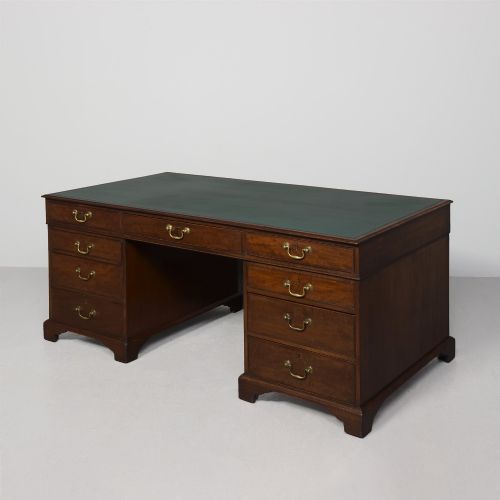
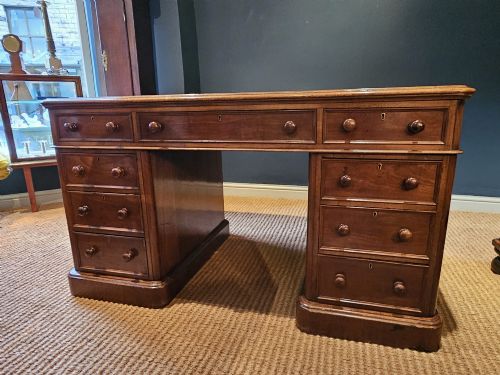
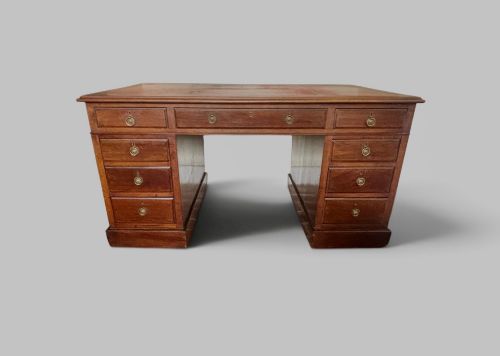
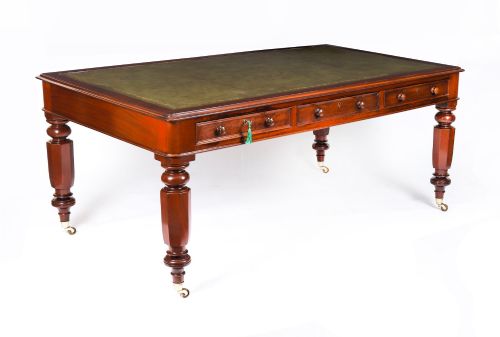
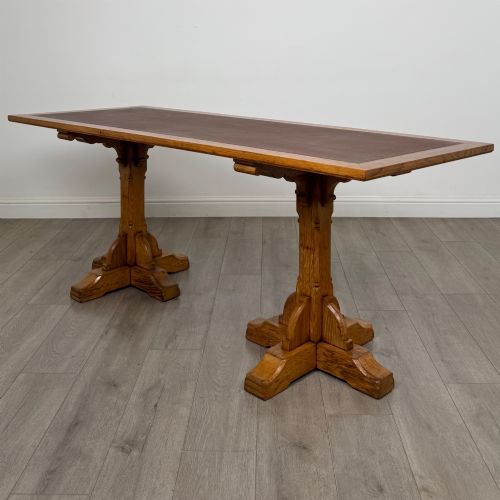
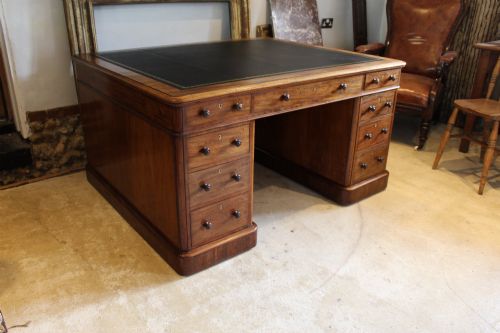
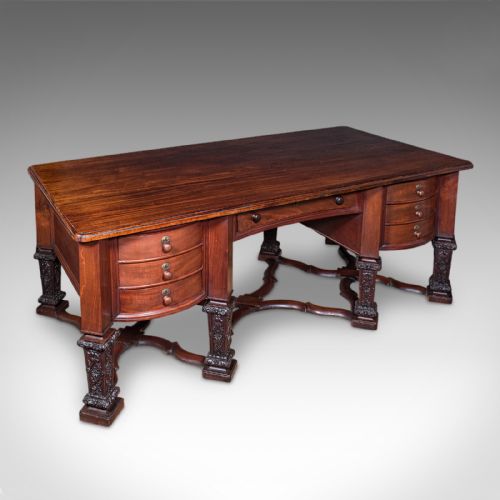
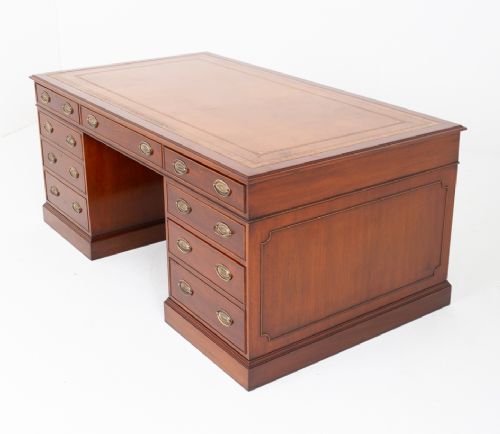
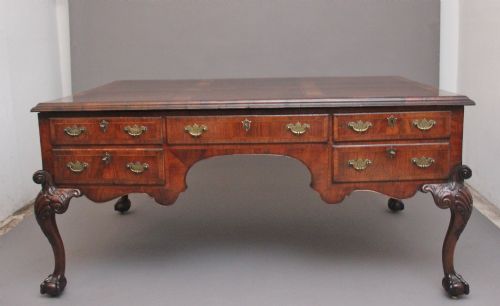
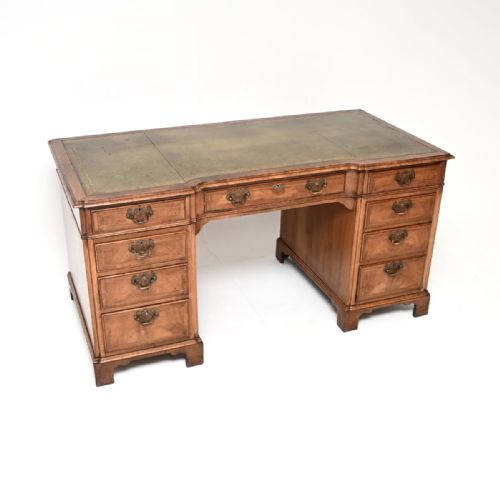
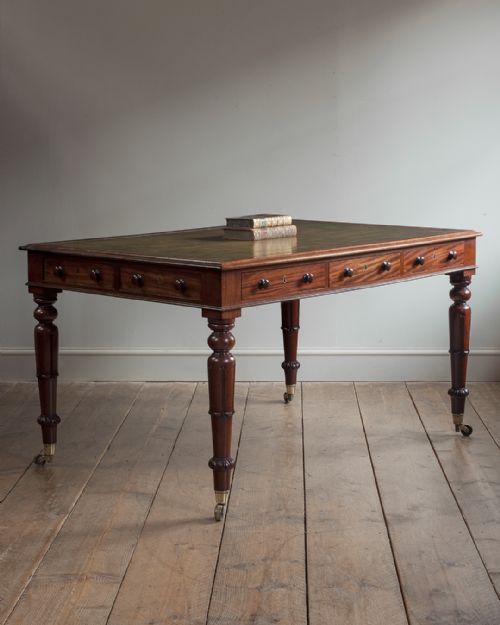

Large Partners Desk
A large partners desk provides dual workspaces on opposite sides, combining generous proportions with traditional storage for shared studies or libraries.
Large Partners Desk
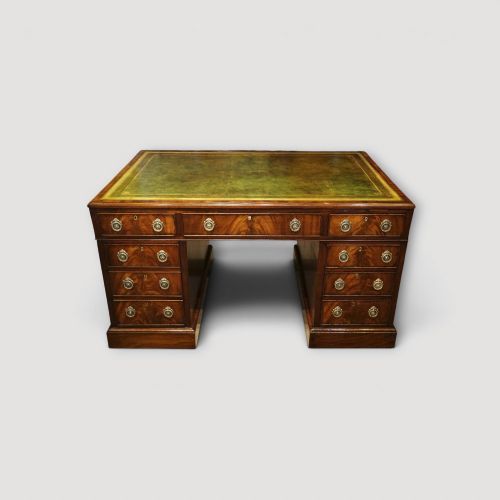
A large partners desk is designed for two people to work opposite one another, featuring matching banks of drawers or cupboards on both sides. These substantial pieces emerge predominantly from the 18th century, Victorian, Edwardian and Regency periods, reflecting formal study and office traditions.
Mahogany remains the dominant wood found across these items, often presented as flame mahogany or curl mahogany alongside oak, walnut and pine. Styles range from Georgian and Chippendale to later Jacobean and Louis XIV revivals.
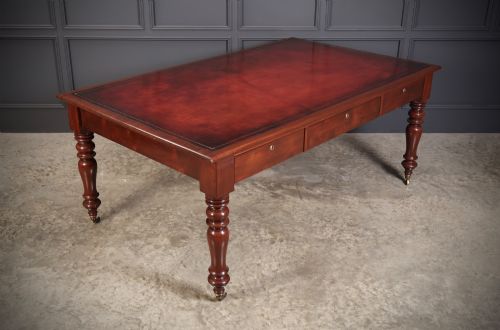
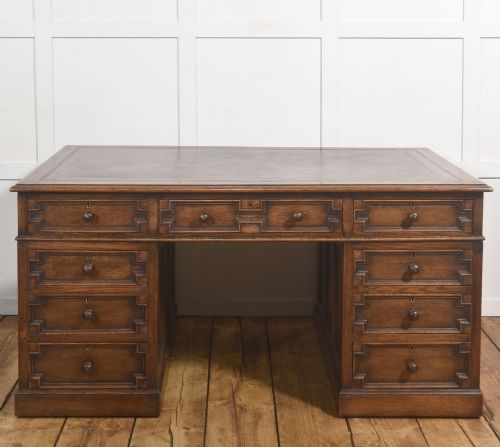
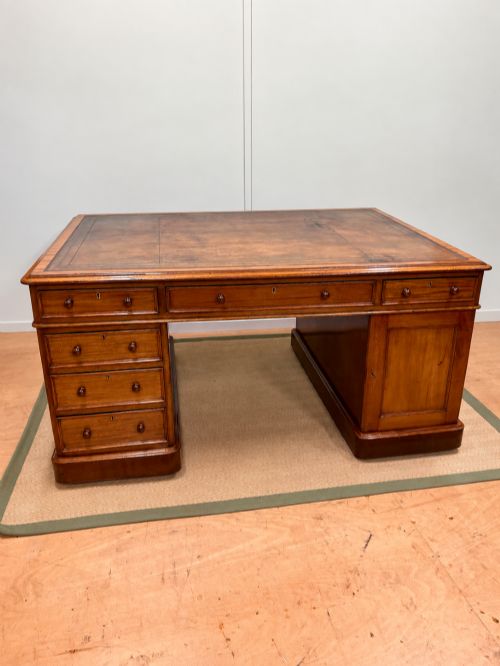
Most examples function as freestanding pedestals or library tables measuring substantial lengths, frequently fitted with inset leather writing surfaces. The double-sided arrangement distinguishes them from standard single-sided pedestal desks.
Materials and construction methods
Cabinet makers utilised dense hardwoods such as mahogany, oak and walnut for the primary structure, frequently selecting figured veneers like burr walnut or flame mahogany for the exterior surfaces. These timbers provide the structural rigidity necessary for heavy freestanding double-sided furniture.
Writing surfaces are typically inset with tooled leather, bordered by blind or gilt tooling, while drawers utilise traditional dovetail joinery. Brass handles, escutcheons and occasional ormolu mounts complete the hardware details across various revival styles.
Materials recorded across current items include mahogany, flame mahogany, burr walnut, oak, pine and brass.
Evaluating craftsmanship and execution
The degree of refinement in the timber selection and carving dictates the standard of a desk, with figured veneers and carved mouldings appearing on superior examples. Plain oak or pine versions prioritise utility over decorative enrichment.
Proportion and symmetry between the opposing sides demonstrate the skill of the maker, particularly in freestanding library placements where all angles remain visible. Original hardware and undisturbed patination elevate the standing of an individual piece.
Charles Andrea Nosotti·Cookes of Finsbury London
The Large Partners Desk Glossary
- Pedestal desk
- A form comprising two banks of drawers supporting a top, designed to stand against a wall or free in a room.
- Partners desk
- A double-sided writing table with drawers or cupboards accessible from both front and reverse.
- Flame mahogany
- Timber cut from the fork of the mahogany tree, producing a distinctive flame-like grain pattern.
- Library table
- A large freestanding table used for reading and writing, often sharing proportions with partners desks.
- Tooled leather
- Leather decorated with blind or gold-leaf impressions around the perimeter of a writing surface.
Large Partners Desk: Frequently Asked Questions
What is a partners desk?
A partners desk is a large double-sided writing table built to accommodate two people working simultaneously opposite each other. The design incorporates matching drawers or cupboards on both the front and the reverse.
These pieces typically feature an inset leather writing surface and heavy timber construction. They were originally utilised in professional offices, libraries and grand country houses.
How do I date a partners desk?
Dating relies on observing the combination of timber, construction methods and prevailing style periods such as Georgian, Victorian or Edwardian. Mahogany and oak dominate earlier pieces, while specific revival styles offer clues to the era of manufacture.
Secondary woods inside drawers and the style of brass hardware also assist in determining the period. Cabinet making techniques evolved from hand-cut dovetails towards more standardised machinery methods by the early 20th century.
Where should I place a partners desk?
A partners desk is designed as a freestanding piece meant to sit proudly in the centre of a room rather than against a wall. Because both sides feature finished drawers or cabinets, the desk looks correct from any angle.
Ensure adequate surrounding floor space to allow chairs to pull out comfortably on both sides. The generous dimensions require a suitably proportioned study, library or open-plan living area.
Are partners desks modular?
Traditional partners desks are constructed in multiple sections to facilitate moving and installation. They typically separate into two pedestal drawer units and a heavy top section.
This modular breakdown allows these substantial pieces of furniture to be transported through doorways and up staircases. Reassembly involves securing the top to the pedestals with internal brackets or screws.