

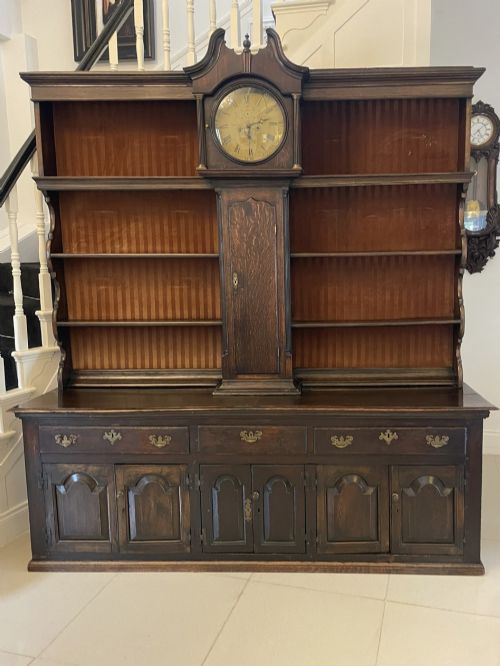


Large Oak Kitchen Sideboard
These large oak kitchen sideboard pieces bring solid storage and honest timber into daily family life.
Large Oak Kitchen Sideboard
When you search for a large oak kitchen sideboard, you are looking at sturdy utilitarian furniture designed for heavy domestic service. The pieces on this page span the eighteenth century, the nineteenth century, and the early twentieth century, showing both English and French country origins.
The selection includes substantial dressers with racks, housekeepers cupboards, workbench forms, serving tables, and dresser bases. Most examples you meet here lean towards vernacular country styles and formal Georgian proportions rather than delicate parlour furniture.
Makers and builders constructed these items to organise food, crockery, and household stores in busy kitchens and estate rooms. Their generous proportions provide practical storage while anchoring a room with traditional timber character.
How they were made
Joiners and country carpenters built these items using solid oak, sometimes bleached or left in its natural dark state, combined with iron, brass, and glass fittings. Construction relies on traditional framing methods designed to withstand heavy everyday demands.
Surfaces show the marks of hand planing and jointing, giving each piece a tactile honesty that reflects rural and domestic workshop practices. Metal hardware such as hinges and drop handles provide functional contrast to the warm grain of the wood.
Large Oak Kitchen Sideboard Retail Price Guide 2026
Typical asking prices for large oak kitchen sideboard among the pieces listed under this phrase on Sellingantiques today, from the lower quarter to the upper quarter. They describe what is for sale here now, not the wider market.
The listings show pieces spanning the eighteenth century, nineteenth century, and early twentieth century, including Georgian and Victorian periods.
What varies in quality
Quality in these pieces rests on the balance of proportions, the integrity of the timber, and the restraint of the carving. Superior examples display thoughtful timber selection where board widths match harmoniously across doors and tabletops.
Finer items retain their original brass or iron hardware and uncompromised structural depth. The best specimens combine practical utility with confident vernacular design, rather than excessive ornamentation tacked onto a basic frame.
The Large Oak Kitchen Sideboard Glossary
- Dresser base
- The lower section of a dresser featuring drawers and cupboards, usable independently as a serving table or sideboard.
- Housekeepers cupboard
- A tall, large storage cabinet used in great houses for linen, dry goods, and kitchen provisions.
- Welsh dresser
- A traditional kitchen storage unit combining base cupboards or drawers with an open plate rack on top.
- Bleached oak
- Oak timber treated to lighten its natural colour, producing a softer, more neutral surface tone.
Large Oak Kitchen Sideboard: Frequently Asked Questions
What rooms suit a large oak kitchen sideboard?
These substantial items suit large kitchens, dining rooms, and open living spaces where generous storage and strong timber presence are required. Their depth and width demand adequate floor space to breathe.
In daily use, they serve effectively as servers during meals or as everyday storage for crockery, linen, and kitchen provisions.
How do I care for old oak furniture?
Maintain old oak surfaces with gentle dusting and occasional application of appropriate natural waxes to nourish the grain. Avoid placing timber pieces near direct heat sources to prevent splitting.
Keep humidity levels stable in the room to protect the historical joints and prevent movement in the solid wood panels.
What is the difference between a dresser and a sideboard?
A dresser typically includes an upper plate rack for displaying ceramics above the lower storage base. A sideboard consists purely of the lower cabinet or table structure.
Both forms provide substantial surface area and storage, but dressers introduce greater vertical presence in a room.
How do I identify a Georgian piece?
Georgian furniture often displays formal classical proportions, precise joinery, and restrained decorative carving influenced by the architectural styles of the period. The timber selection tends toward well-figured oak with neat brass drop handles.
Construction details on these items reveal traditional hand tool methods characteristic of eighteenth-century workshops.