
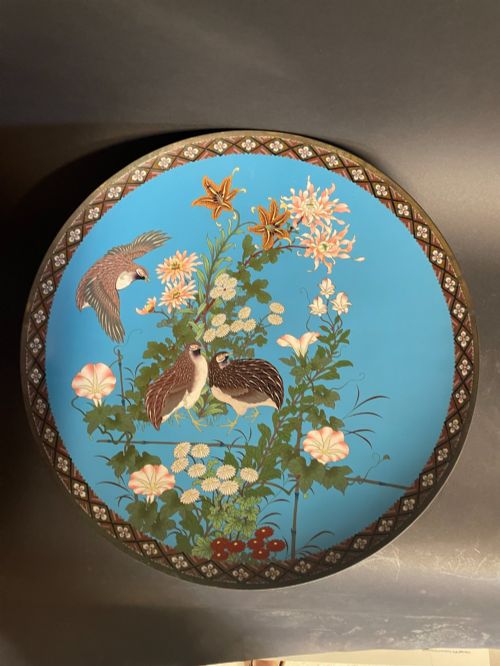


Large Enamel Plaque
These large enamel plaque pieces are substantial decorative works spanning nineteenth-century Japanese cloisonne to early twentieth-century advertising signs, offering striking visual impact for any interior.
Large Enamel Plaque
When searching for a large enamel plaque, a buyer encounters a diverse group of works dominated by nineteenth-century Japanese cloisonne chargers, alongside Limoges copper paintings, Chinese plaques, Syrian copper panels, Vienna porcelain, and early twentieth-century advertising signs. These items function primarily as wall art or decorative chargers, serving as focal points within a room due to their substantial physical scale.
The Japanese examples, originating from the Edo and Meiji periods, frequently depict natural subjects such as birds, branches, bamboo, single dragons, and leaping koi. Alongside these Asian works, European pieces appear from the nineteenth century onward, including French enamel paintings on copper, Middle Eastern enamelled copper panels, and British pictorial advertising signs.
Most items on this page manifest as round chargers or flat panels rather than three-dimensional vessels. Their surfaces present vibrant vitreous enamels fused to metal or porcelain bases, often utilising copper, brass, or iron supports.
How they were made
The construction of cloisonne works involves soldering fine metal wires, such as brass wire, onto a base of copper or iron to form cells, known as cloisons. These compartments are then filled with coloured enamel paste before firing in a kiln and polishing.
Enamel paintings on copper, such as those from Limoges, require the direct application of opaque and translucent vitreous enamels onto a metal plate, followed by multiple firings to achieve depth and tonal gradation. Advertising signs utilise heavy iron bases coated in vitreous enamel through industrial stencil and firing methods to withstand outdoor elements.
Porcelain chargers undergo traditional ceramic shaping and high-temperature firing before receiving detailed painted enamel decoration on the glazed surface. Metal panels from Syria employ traditional enamelling techniques on beaten copper supports to create intricate geometric and floral designs.
Palethorps sausages found immortality through vibrant vitreous enamel, proving that even breakfast meats deserve a magnificent pictorial sign.
What varies in quality
The sophistication of the wirework and the control of the firing process dictate the refinement of cloisonne pieces, where tighter compartments and smoother polished surfaces demonstrate superior craftsmanship. Intricacy of subject matter, such as detailed avian plumage or expressive dragon scales, separates standard decorative production from masterwork execution.
In painted enamels and porcelain chargers, the precision of the brushwork and the depth of the tonal palette govern visual success. Pictorial advertising signs depend on the clarity of the lithographic or stencilled transfer and the preservation of the glossy vitreous surface against industrial wear.
The ambition of the composition, the weight of the underlying metal or ceramic body, and the presence of signature marks contribute significantly to the standing of an individual piece within its respective tradition.
The Large Enamel Plaque Glossary
- Cloisonne
- A decorative metalwork technique where fine wire is soldered to a metal base to create cells filled with enamel paste. These cells keep different coloured enamels separated during the firing process.
- Charger
- A large decorative plate or dish intended for display on a wall or sideboard rather than for practical table service. These items form a major category among large enamel plaque options.
- Totai Shippo
- A Japanese technique involving transparent enamel applied over a textured ground, such as carved tree bark, allowing the tactile pattern underneath to show through. This method creates realistic surface textures in floral and arboreal subjects.
- Limoges
- A French city renowned for its production of enamels on copper and fine porcelain. Pieces from this centre often feature painted pictorial scenes executed with exceptional tonal subtlety.
- Vitreous Enamel
- A material made by fusing powdered glass to a substrate by firing, usually at high temperatures. The resulting coating provides a glossy, durable coloured surface.
Large Enamel Plaque: Frequently Asked Questions
How do I hang a large enamel plaque safely?
Heavy chargers and panels require robust wall fixings rated for their specific weight, often utilising specialised bracket hangers that support the entire rim without placing stress on the central body.
For copper panels and advertising signs with mounting holes, secure fasteners directly into wall studs or employ appropriate cavity anchors to ensure stable long-term display.
Were these pieces meant for walls or tables?
Most large chargers and decorative trays were manufactured specifically for display on walls, cabinet plate stands, or sideboards, functioning as pure art objects rather than functional tableware.
Advertising signs and architectural panels were designed for permanent wall mounting indoors or outdoors to communicate brand identity or decorate interior spaces.
How do I clean an antique enamel surface?
Dust enamel surfaces regularly with a soft, dry cloth to prevent particulate accumulation. Avoid harsh chemical cleaners, abrasive pads, or excessive moisture, particularly around exposed metal wires or aged iron edges.
For stubborn grime on vitreous surfaces, a slightly damp cloth with mild soap can be used gently, followed immediately by thorough drying with a lint-free cloth.
How can I tell Japanese Meiji period cloisonne apart from earlier work?
Meiji period pieces often exhibit extreme technical perfection, featuring finer brass wires and more naturalistic pictorial designs following the opening of Japan to Western trade. Earlier Edo period and mid-nineteenth-century works tend to display heavier wirework, simpler stylized motifs, and deeper, more varied enamel colours.
Examining the reverse of the charger often reveals differing base metal treatments and signature styles characteristic of specific manufacturing decades.