

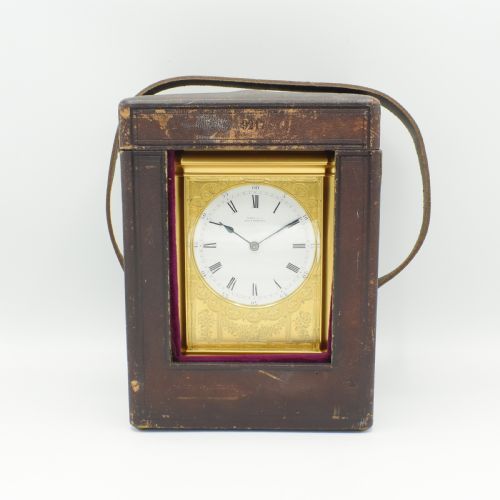


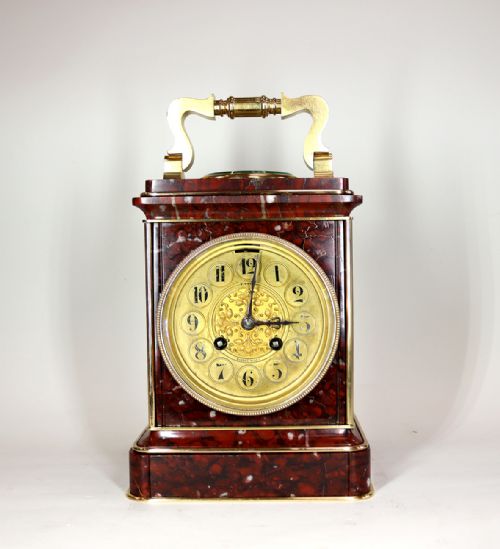


Large Carriage Clock
A large carriage clock brings heavy brass and glass into a room, offering mechanical presence and steady timekeeping.
Large Carriage Clock
A large carriage clock is a portable timekeeper designed for travel and domestic use, housed in a substantial metal framework with glazed panels. These substantial pieces emerge from the nineteenth and twentieth centuries, spanning Victorian, Edwardian, and later twentieth-century periods.
The selections available here feature prominent examples in gilt brass, gilt bronze, sterling silver, and marble, often equipped with striking mechanisms, repeating functions, moon phases, or date work. Forms range from traditional French gorge cases and architectural designs to giant models and oval shapes.
Buyers encounter French and English pieces, including specific works by makers such as L Epee, Henry Matthews, and Richard & Co Paris. Alongside the clocks themselves, the selection encompasses related items like a large glass display dome.
How they were made
Construction relies on heavy cast and forged brass frameworks, frequently gilded to provide a bright surface finish that catches the light. Glass panels fit snugly into the metal frames to protect the internal escapement while allowing an unobstructed view of the moving components.
Large Carriage Clock Retail Price Guide 2026
Typical asking prices for large carriage clock among the pieces listed under this phrase on Sellingantiques today, from the lower quarter to the upper quarter. They describe what is for sale here now, not the wider market.
Listings feature brass, gilt bronze, sterling silver, and marble materials across Victorian and Edwardian periods.
What varies in quality
Quality rests in the weight of the metal casing, the crispness of cast ornament, and the complexity of the internal movement. Plain brass boxes sit at one end, while heavy gilt bronze architectural cases or models with moon phases and striking trains occupy the other.
The integration of original boxes and paperwork, along with the complexity of complications like date work and repeating mechanisms, elevates a piece. Finer examples show meticulous finishing on the inner gears and precise enamel work on the dials.
L Epee·Henry Matthews·Richard & Co Paris
The Large Carriage Clock Glossary
- Carriage clock
- A portable spring-driven clock developed for travellers, featuring a rectangular glazed brass case with a top handle.
- Gilt brass
- Brass coated with a thin layer of gold or a gold-coloured wash to improve appearance and prevent tarnishing.
- Gorge case
- A specific style of carriage clock case characterised by stepped mouldings at the top and bottom of the frame.
- Repeating mechanism
- A complication that sounds the last hour or quarter-hour when a button or cord on the case is pressed.
- Timepiece
- A clock that tells the time without any striking or chiming mechanism to sound the hours.
- Display dome
- A blown glass cover mounted on a base, used to protect and showcase delicate objects like clocks.
Large Carriage Clock: Frequently Asked Questions
How do I wind a large carriage clock?
Winding requires a dedicated key inserted into the arbours located on the underside or back plate of the movement. Turn the key gently until resistance indicates the mainspring is fully tensioned.
Care must be taken not to overwind the mechanism, as this can damage the spring. Ensure the clock is placed on a stable, level surface before winding.
What is the difference between a timepiece and a striking clock?
A timepiece simply indicates the hours and minutes without making any sound. It contains a simpler gear train focused entirely on timekeeping.
A striking clock includes an additional gear train and hammer mechanism that sounds on a bell or gong to announce the hours or quarters. These require more internal components and regular adjustment of the strike sequence.
How do I read a gorge case?
A gorge case refers specifically to the architectural framing style of the brass enclosure, marked by distinct stepped profiles on the top and bottom rails. It represents a classic French format from the nineteenth century.
Recognising this case style helps identify traditional manufacturing origins and aesthetic periods without needing to open the movement.
Where were these clocks placed in a home?
Historically, these clocks sat on mantelpieces, desks, or bedside tables where their portable nature allowed owners to move them between rooms. Their heavy metal frames and glass panels provided both stability and visibility.
Today, they function well on prominent surfaces in living rooms or studies, where their mechanical movement remains visible.