



Large Bronze Horses
Large bronze horses bring presence to a room, cast in solid metal across the nineteenth and twentieth centuries.
Large Bronze Horses
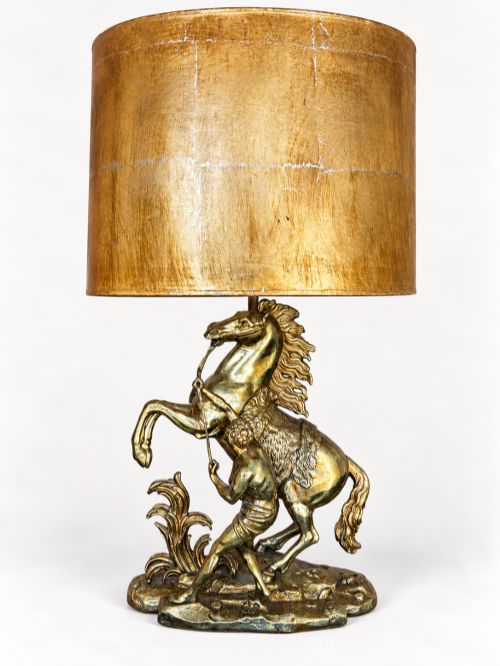
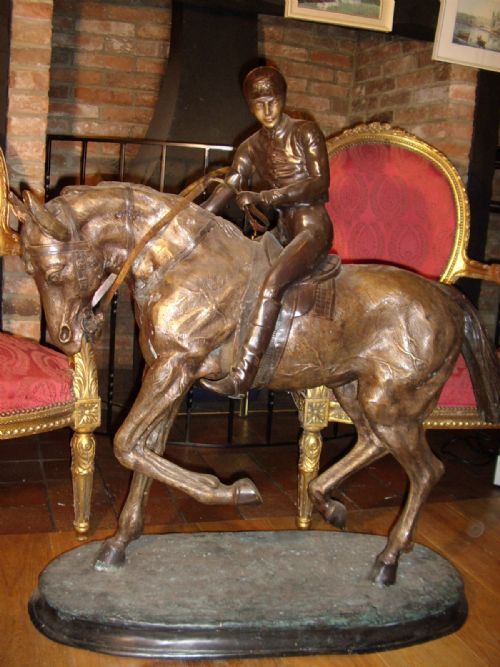
Large bronze horses span French animalier work, Western American cowboy subjects, and Asian casting traditions found on this page. Pieces range from Victorian interpretations of classical Marly sculptures to twentieth-century depictions of jockeys and bucking bronchos.
Makers and foundries of this scale utilised robust metalwork to capture movement, whether in a racehorse poised for a sprint or a quarryman's cart horse pulling hard against the traces.
Marble bases appear frequently beneath these heavy figures, providing a stable footing and a dark contrast to the patinated metal above.
How they were made
Foundries cast these heavy sculptures using bronze, often finishing the metal with rich patination ranging from deep brown to warm verdigris. Several pieces incorporate solid marble bases to anchor the substantial weight of the equine figures.
Casting techniques reflect both European academic traditions and Asian foundry practices, resulting in sharply rendered musculature and fine bridle details.
Large Bronze Horses Retail Price Guide 2026
Typical asking prices for large bronze horses among the pieces listed under this phrase on Sellingantiques today, from the lower quarter to the upper quarter. They describe what is for sale here now, not the wider market.
Even a bronze horse needs a firm footing, which is why so many proudly stand upon heavy marble.
What varies in quality
The sophistication of the casting determines much of the quality, separating crisp muscle definition and clean rein work from softer, more generalised forms. A well-executed piece captures the tension in the animal's stride and the accurate proportions of the rider.
The quality of the patination and the integration with the marble base also distinguish finer workshop output from simpler commercial production.
Pierre Jules Meme·Franz Bergman·E. Drouot
The Large Bronze Horses Glossary
- Animalier
- Art depicting animals, particularly popular in nineteenth-century France. Sculptors focused on anatomical precision and natural behaviour.
- Patina
- The surface colour and texture developed by bronze over time or applied by the foundry. This finish protects the metal and defines the visual depth.
- Equine
- Pertaining to horses. This term often appears in descriptions of statues and sculptural studies.
- Marly Horse
- A monumental sculptural design originating in France, typically depicting a rearing horse restrained by a handler. Several versions replicate this classical composition.
Large Bronze Horses: Frequently Asked Questions
How heavy are large bronze horses?
These sculptures carry considerable weight due to the solid metal construction and often feature dense marble bases. Some recorded examples weigh several kilograms.
Buyers should ensure the supporting surface is sturdy enough to bear the load safely.
Where were these bronze sculptures made?
The pieces originate from diverse workshops across France, Austria, China, Japan, and Africa. Each region applied distinct aesthetic traditions to the equine subject matter.
European foundries often favoured classical or animalier realism, while Asian pieces reflect traditional local casting methods.
How do I clean a bronze horse?
Dust the metal gently with a soft, dry cloth to prevent grime accumulation. Avoid harsh chemical polishes that can strip the original patina.
Preserving the surface finish maintains both the visual character and the historical integrity of the piece.
What periods do these horses come from?
The selection spans the nineteenth century through the mid-twentieth century. Pieces reflect Victorian tastes, Art Deco styling, and later twentieth-century casting revivals.
Dates range from the 1870s up to the 1950s across various global workshops.