
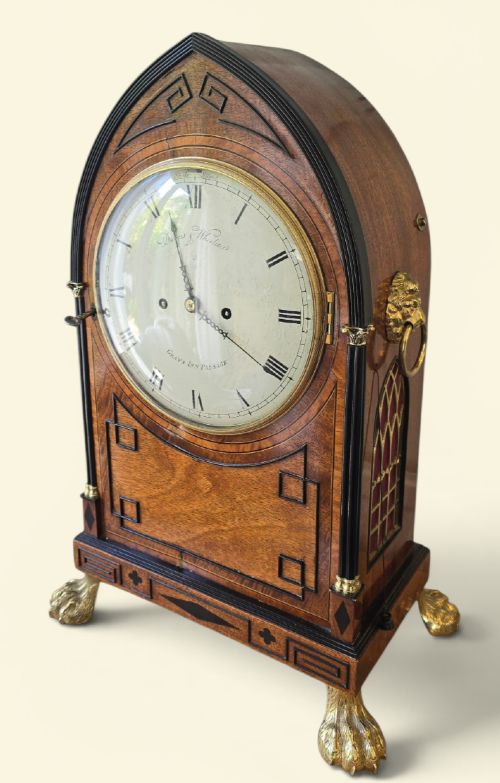


Lancet Bracket Clock
These lancet bracket clock examples combine architectural pointed arches with precise table movements, offering traditional timekeeping alongside distinct aesthetic presence.

Lancet Bracket Clock
A lancet bracket clock takes its name from the pointed Gothic arch shape of its timber case, resembling a church window. These upright mantel and table clocks appear frequently in mahogany, often housing fusee or striking movements.
The selection ranges from early Georgian and Regency specimens down to Edwardian and Victorian iterations. Makers from London feature prominently alongside provincial English and Scottish examples.
How they were made
Cabinetmakers constructed the architectural cases chiefly from mahogany, sometimes employing oak or ebonised wood, and enriched surfaces with boxwood and satinwood inlay. Brass details such as side sound frets, feet, and bezel rings complement the timber frames.
Mechanically, these timepieces rely on brass gear trains, with single fusee movements regulating the pull of the mainspring via a chain or gut line. Enamel dials carry the numerals, protected behind bevelled or curved glass bezels.
Mahogany is the dominant timber across the recorded pieces, frequently augmented by satinwood and boxwood stringing.
What varies in quality
Superior examples distinguish themselves through crispness of cabinet carpentry and the refinement of brass inlay work around the arched dial aperture. The proportion between the slender pointed top and the wider base dictates the visual balance of the case.
Movement execution marks the primary division in worth, where signed London makers utilise meticulously finished plates and intricate striking or chiming trains. Secondary factors include the clarity of the white enamel dial and the preservation of original wood finishes.
Desbois & Wheeler·Cording of London·W. Burton·Wilkinson Leicester·W&H·Ganthony of London·James McCabe·John Thwaites·Parkinson & Frodsham
The Lancet Bracket Clock Glossary
- Fusee
- A conical pulley designed to equalise the declining power of the mainspring as it unwinds. This mechanism ensures even driving force to the gear train throughout the duration of the wind.
- Lancet top
- An architectural case silhouette defined by a sharply pointed Gothic arch at the summit. The profile echoes medieval church window geometry popularised during the Georgian and Regency eras.
- Striking
- A secondary mechanical train that sounds the hours on a bell or gong. Some variations include ting-tang mechanisms or Westminster chimes.
- Bracket clock
- A portable table clock originally built to sit on a matching wall bracket or table surface. Over time, the term broadened to describe larger mantel clocks of similar architectural form.
Lancet Bracket Clock: Frequently Asked Questions
Where should a lancet bracket clock go?
These clocks suit flat mantelpieces, sideboards, or dedicated tables where the upright arched case has sufficient vertical clearance. Placing them away from direct sunlight and heat sources protects the timber and internal oils.
Because many rely on pendulum regulation, level surfaces matter for proper operation. A steady table prevents the beat from becoming uneven.
How do I wind the clock?
Winding requires inserting the appropriate key into the dial holes and turning it gently until resistance stops the barrel. Care must be taken not to overwind the mainspring.
For fusee movements, the chain or line must be handled with appropriate knowledge of the mechanism. Consulting a professional horologist for initial setup prevents damage to older gear trains.
How do I identify the period?
Cabinet style and wood choice provide the clearest indicators of age. Georgian and Regency pieces typically show dense mahogany, subtle brass inlay, and refined proportions.
Later Victorian and Edwardian examples often introduce different chime options, heavier construction, or alternative woods like oak. Maker signatures on the dial or movement backplate offer definitive dating clues.
Are these clocks suitable for daily use?
Many mechanical movements from the eighteenth and nineteenth centuries remain fully functional for regular timekeeping. Routine servicing by a qualified clockmaker keeps the brass gears and pivots operating smoothly.
Running an older striking movement requires proper synchronisation of the hands and strike train. Gentle handling ensures these mechanisms continue working reliably.