
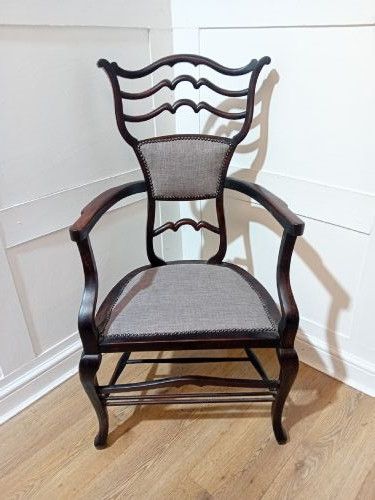
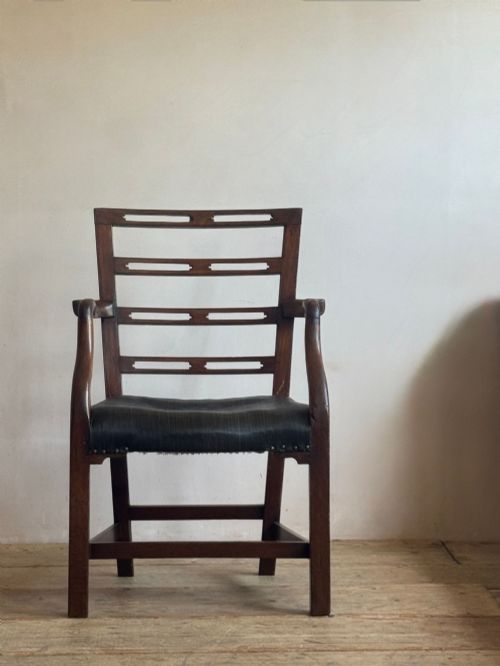


Ladder Back Open Armchair
These ladder back open armchair examples are honest seating from past centuries, offering sturdy timber frames and woven or upholstered seats for everyday sitting.
Ladder Back Open Armchair
A ladder back open armchair brings together horizontal back rails, open arms, and traditional timber construction across periods from the eighteenth century to the twentieth century.
You are most likely to meet English Country, Georgian, and Victorian examples on this page, often built from oak, mahogany, or elm.
These chairs serve equally well as occasional seating or desk chairs, carrying straightforward utility alongside regional vernacular style.
How they were made
Frames rely on native hardwoods such as oak, elm, mahogany, and beech, shaped with turned supports and joined by traditional methods.
Seats are finished with rush, woven materials, leather, or upholstered pads secured with brass upholstery studs.
Backrests incorporate curved or straight horizontal rails spanning between upright posts to form the characteristic ladder profile.
Listings feature woods spanning oak, mahogany, elm, and beech across the eighteenth, nineteenth, and twentieth centuries.
What varies in quality
Quality rests in the crispness of the timber turning, the tightness of the joinery, and the integrity of the original rush or upholstery.
Better examples maintain balanced proportions and uncompromised structural timbers, whereas lower grades show heavy timber replacement or loose joints.
Age and original surface patination distinguish superior vernacular and formal pieces from later utilitarian reproductions.
Dicon Nance
The Ladder Back Open Armchair Glossary
- Ladder back
- A chair back featuring multiple horizontal wooden slats or rails between the vertical uprights. This design developed in regional vernacular furniture before adoption in formal styles.
- Carver
- An armchair, frequently designed to match a set of dining chairs for the head of the table. These pieces feature open arms to accommodate wider clothing.
- Rush
- Dried marsh grass woven into tight cords to form traditional basket-weave chair seats. It provides a flexible yet durable surface.
- Vernacular
- Everyday furniture built by regional makers for local use rather than following strict metropolitan taste. These objects prioritise functional design and local timbers.
- Patina
- The surface texture, sheen, and depth developed by timber over years of handling, polishing, and exposure to light. It serves as an indicator of genuine age.
Ladder Back Open Armchair: Frequently Asked Questions
Are ladder back chairs comfortable?
These chairs offer upright support suited to dining or working at a desk. The open arms provide a resting place without enclosing the sitter.
Adding a loose cushion can adjust the seat height and comfort level for prolonged sitting.
How do I date a ladder back armchair?
Dating relies on timber species, turning style, and construction details like pegging and joint wear. Eighteenth-century examples often display finer proportions and aged patination.
Later nineteenth and twentieth-century versions incorporate machine-turned components or different joining techniques.
What is a carver chair?
A carver is an armchair designed to match a set of single dining chairs. It was traditionally placed at the head of the dining table.
The open arms allowed enough room for bulky historical garments.
Can I use these chairs daily?
Sound timber frames and sturdy joints handle regular daily use in modern homes. Checking the stability of the legs and arm joints ensures safe seating.
Rush or upholstered seats benefit from sensible weight distribution and gentle cleaning.