

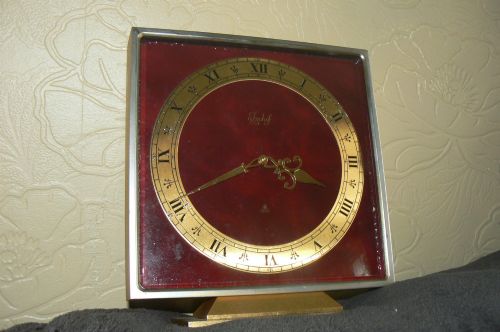
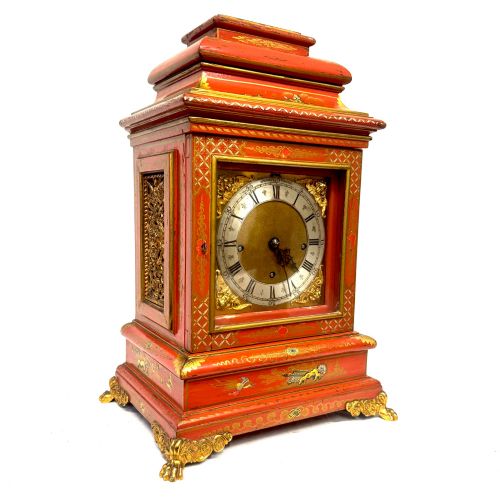
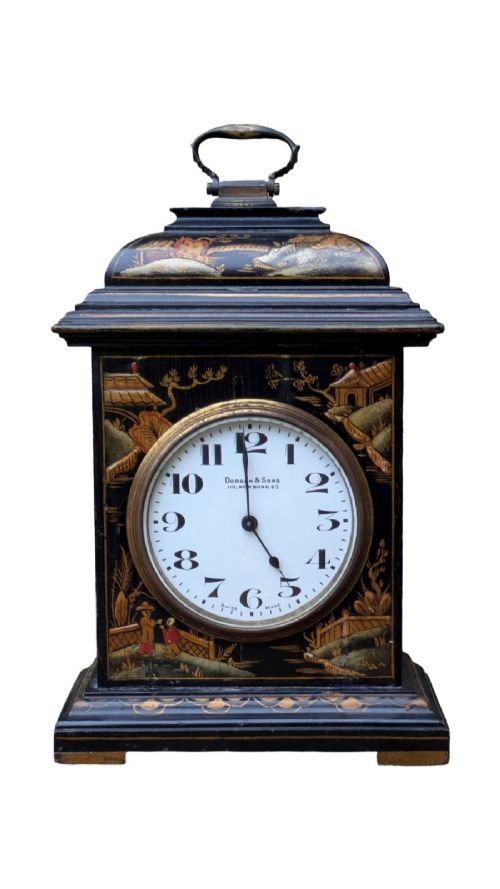
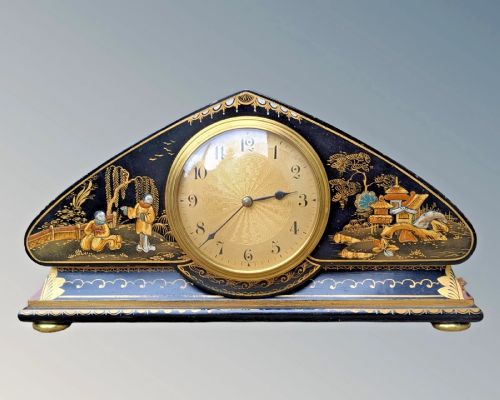
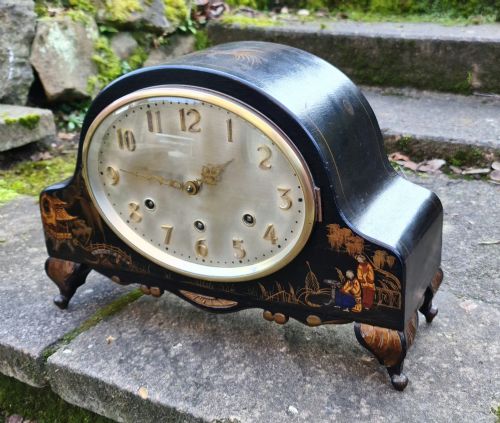


Lacquered Table Clock
These lacquered table clock pieces bring hand-painted Chinoiserie charm and polished brass details to any room.
Lacquered Table Clock
When you search for a lacquered table clock, you encounter mantel and bracket clocks finished in black, green, cream, red, and faux tortoiseshell surfaces. These pieces range from eighteenth-century English bracket clocks by makers such as James Smith and Chater & Son to twentieth-century Chinoiserie mantel designs.
You are most likely to meet twentieth-century Chinoiserie mantel clocks featuring decorated wood cases alongside earlier bracket clocks with brass and silvered metal dials. The selection spans styles from Georgian and Edwardian Chinoiserie to seventeenth-century revival pieces housing French movements.
How they were made
Makers built the structural cases using wood, applying layers of lacquer in black, green, red, or cream finishes often embellished with gold details. Faux tortoiseshell surfaces also appear among the listed examples.
The internal mechanics rely on brass components, complemented by glass viewing panels and silvered metal dials with enamel markings. Movements range from standard timepieces to complex three-train musical mechanisms and striking systems with alarms.
Lacquered Table Clock Retail Price Guide 2026
Typical asking prices for lacquered table clock among the pieces listed under this phrase on Sellingantiques today, from the lower quarter to the upper quarter. They describe what is for sale here now, not the wider market.
The listings span periods from the eighteenth century through the 1930s and 1960s, utilising wood, brass, glass, and lacquer.
What varies in quality
Quality separates through the execution of the painted Chinoiserie decoration on the lacquered wood case and the sophistication of the clock movement inside. Eighteenth-century London bracket clocks by recorded makers represent a different tier of craftsmanship compared to later twentieth-century decorative mantel pieces.
The integration of complex mechanisms, such as three-train musical trains or striking systems with alarms, distinguishes more elaborate bracket clocks from simpler mantel timepieces. The refinement of brass fittings and silvered metal dials further defines the grade of each piece.
James Smith London·Chater Son London·Elliott London
The Lacquered Table Clock Glossary
- Chinoiserie
- European decorative style reflecting Chinese artistic influences, frequently seen in the painted lacquer motifs of these clocks.
- Bracket Clock
- A portable mechanical clock originally designed to sit on a wall bracket or table surface.
- Mantel Clock
- A small clock designed to stand on the mantelpiece above a fireplace.
- Three Train
- A clock movement with three separate gear trains for timekeeping, striking, and playing music or chiming.
- Silvered Metal
- A metallic dial surface treated with a silver finish to display the clock numerals clearly.
Lacquered Table Clock: Frequently Asked Questions
What is a lacquered table clock?
A lacquered table clock is a timepiece housed in a wooden case finished with lacquer, often featuring Chinoiserie decoration in black, green, red, or cream. These objects function as mantel or bracket clocks.
They combine decorative painted surfaces with brass mechanical movements, ranging from simple twentieth-century mantel pieces to eighteenth-century London bracket designs.
How do I date a lacquered table clock?
Dating relies on stylistic clues in the Chinoiserie decoration, the materials used, and the signature of the maker on the dial or movement. Eighteenth-century pieces often take the form of bracket clocks with London signatures.
Twentieth-century examples present distinct mantel clock forms influenced by Edwardian and later interpretations of earlier styles. Examining the movement type also helps establish the period.
Where should I place a bracket clock?
Bracket clocks suit flat surfaces such as mantelpieces, sideboards, or dedicated wall brackets designed to support their weight. They require a stable, level spot to keep the pendulum or balance wheel running accurately.
Keep them away from direct sunlight and damp environments to protect the lacquered wood finish and painted Chinoiserie details.
What is the difference between bracket and mantel clocks?
Bracket clocks historically originated as portable spring-driven clocks placed on a wooden wall bracket or table, often featuring sophisticated striking or musical movements. Mantel clocks evolved primarily for placement on fireplace mantels.
While both terms describe table clocks in modern listings, earlier bracket clocks frequently exhibit more complex internal mechanisms by named makers.