


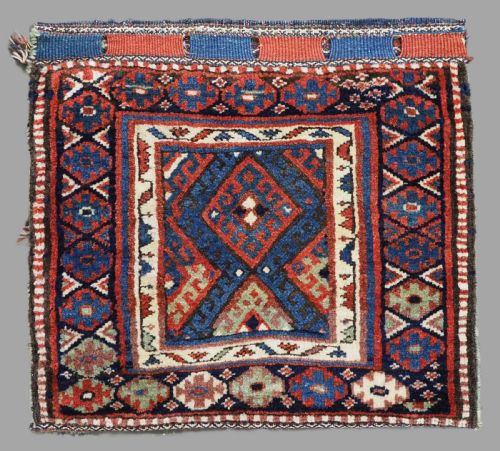


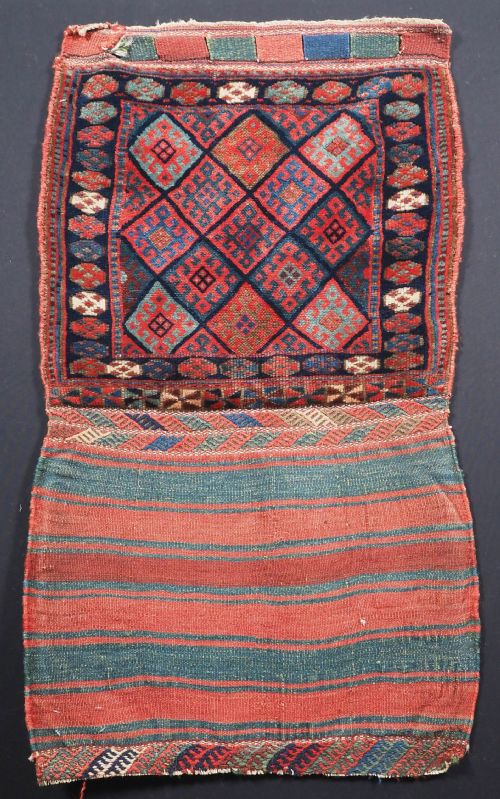


Kurdish Woven Bag
These Kurdish woven bag examples are resilient nomadic textiles combining wool and goat hair to form durable containers crafted by tribal makers.
Kurdish Woven Bag
A kurdish woven bag brings functional tribal artistry into the home through utilitarian forms designed for nomadic life. These pieces encompass various functional iterations including complete bags, bag faces, saddlebags, grain sacks, and cushions.
The objects stem from distinct tribal traditions linked to the Kurdish, Bakhtiari, and Lor groups across Western Persia and Anatolia. Examples range from compact chantehs to larger juvals and saddlebag faces produced across several decades spanning the late nineteenth and early twentieth centuries.
The selection here concentrates heavily on Jaf Kurd productions alongside broader Kurdish tribal pieces. Buyers encounter both fragmentary bag faces meant for display and complete examples featuring plain weave backs.
Construction and materials
Makers utilised hand-spun wool as the primary medium for the patterned faces, yielding dense pile and flat weave structures. Goat hair frequently reinforced structural edges and backs for added durability during nomadic travel.
Cotton appears alongside wool within the structural foundations of these textiles. Natural dye traditions supplied the palette for the geometric and tribal motifs woven by these makers.
Kurdish Woven Bag Retail Price Guide 2026
Typical asking prices for kurdish woven bag among the pieces listed under this phrase on Sellingantiques today, from the lower quarter to the upper quarter. They describe what is for sale here now, not the wider market.
Listings span four distinct decades from the late nineteenth century to the early twentieth century, specifically featuring pieces dated to 1880, 1890, 1900, and 1920.
Judging quality in tribal textiles
Quality rests upon the tightness of the weave and the clarity of the tribal patterns executed across the surface. Finer knotting and well-preserved plain weave backs elevate an example within its category.
Condition varies according to the survival of original borders and structural integrity. Intact pile and minimal restoration distinguish superior pieces from heavily worn fragments.
The Kurdish Woven Bag Glossary
- Chanteh
- A small traditional tribal bag or vanity pouch used by nomads for carrying personal items. These pieces often feature fine geometric weaving on the face.
- Juval
- A large storage bag utilised within tribal tents for bedding and household possessions. They typically display wide horizontal formats.
- Plain weave
- A simple unpotted textile construction technique used for the backs of bags. This method reduces weight and bulk while maintaining structural strength.
- Saddlebag
- A paired container joined by a central web designed for transport over pack animals. Surviving examples are frequently divided into individual bag faces.
- Tasheh
- A specific regional term for a wheat sack or grain container woven for agricultural storage. These utilitarian objects showcase robust tribal designs.
Kurdish Woven Bag: Frequently Asked Questions
What is a kurdish woven bag?
These are utilitarian containers produced by nomadic tribes for storage and transport during the nineteenth and early twentieth centuries. They combine practical function with distinct regional tribal artistry.
The inventory includes complete bags with plain weave backs alongside individual bag faces and cushions. Each piece reflects the specific weaving traditions of Kurdish and related tribal groups.
How were these bags used originally?
Nomadic communities utilised these textiles for storing grain, bedding, clothing, and personal possessions inside tents. Saddlebags additionally served to transport goods across pack animals during seasonal migrations.
Over time, many paired saddlebags were separated into individual bag faces for easier handling or trade. Today, surviving examples transition from nomadic tools into decorative furnishings.
How do I care for a antique bag?
Protect these wool and goat hair textiles by keeping them out of direct sunlight to prevent fading. Gentle vacuuming without a beater bar removes trapped dust effectively.
Avoid placing heavy furniture directly on floor displays to preserve the pile and structure. Professional textile cleaning is recommended when deeper maintenance becomes necessary.
How can I date a tribal bag?
Dating relies on examining material characteristics, dye palettes, and structural wear consistent with nineteenth and early twentieth-century production. Hand-spun wool and traditional regional motifs provide key chronological indicators.
Comparative analysis with documented examples helps place pieces within decades such as the 1880s, 1900s, or 1920s. Subtle variations in tribal design often point to specific periods of manufacture.