
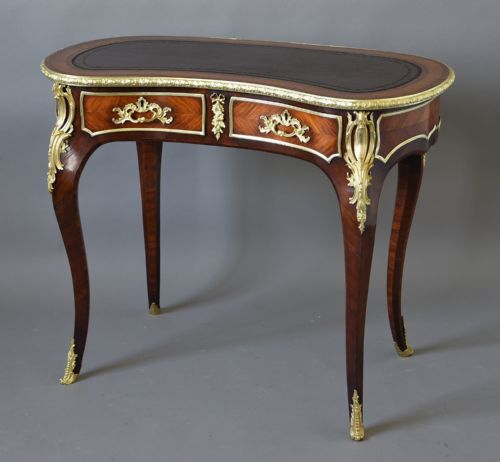
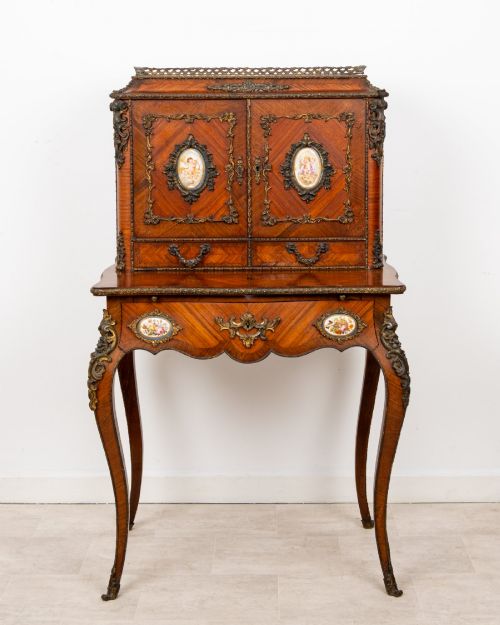


Kingwood Ladies Desk
A kingwood ladies desk combines delicate proportions with rich veneering, offering a refined writing surface for a boudoir or study.
Kingwood Ladies Desk
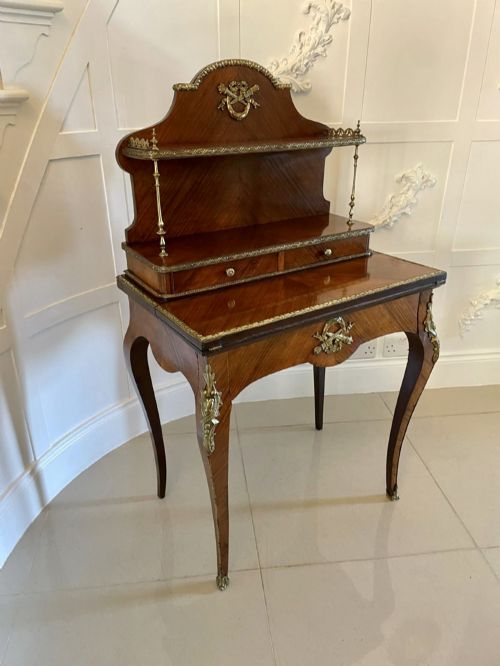
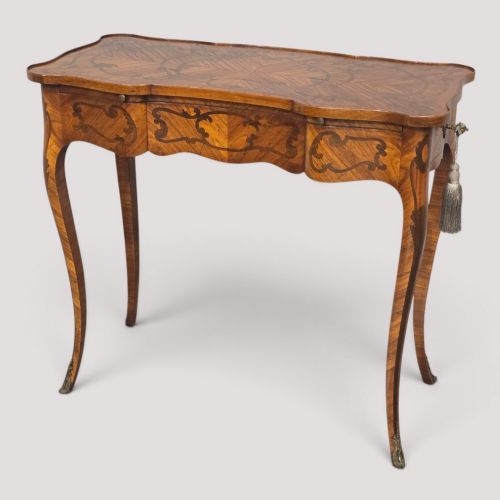
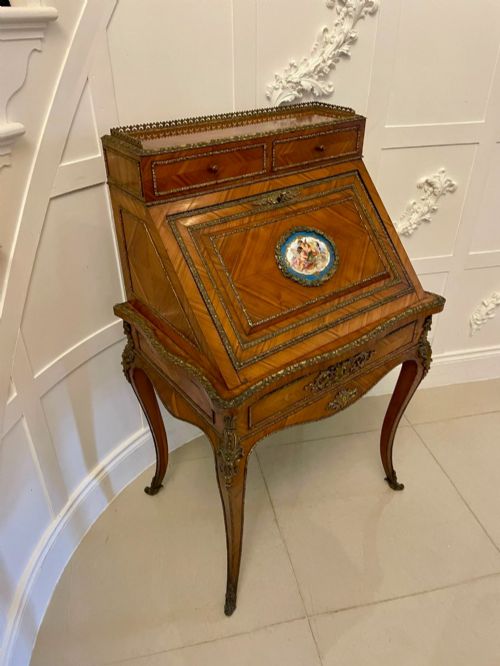
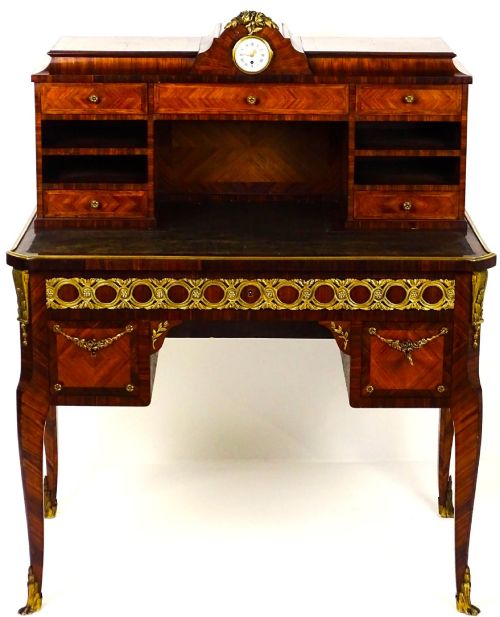
A kingwood ladies desk encompasses refined writing furniture designed with compact proportions, frequently taking the form of a bonheur du jour, a bureau de dame, or a kidney-shaped writing table. These pieces emerge predominantly from nineteenth-century French workshops, though eighteenth-century examples and Edwardian English interpretations also appear.
The most common variants on this page are French nineteenth-century bonheur du jour desks and writing tables. These forms typically incorporate tiered compartments, small drawers, and fitted writing surfaces overlaid with leather.
Makers and cabinetmakers of the period drew heavily on Louis XV and Louis XVI revival styles, incorporating curved cabriole legs, serpentine outlines, and symmetrical parquetry. Their primary purpose was personal correspondence and light administrative tasks, tailored specifically to the domestic spaces of well-to-do households.
How they were made
Cabinetmakers constructed these desks using native carcases of oak or pine, onto which they applied finely sliced veneers of kingwood in geometric parquetry or floral marquetry patterns. Crossbanding in contrasting timbers such as satinwood or rosewood frequently framed these decorative panels.
Gilt bronze and ormolu mounts were cast and chased to accentuate the curves of the carcase, protecting vulnerable corners and framing porcelain plaques or Vernis Martin painted panels. Writing surfaces were typically inset with tooled leather, while drawer linings utilised secondary hardwoods like oak.
Listings span the eighteenth, nineteenth, and early twentieth centuries, with a strong concentration of Victorian French revival pieces incorporating ormolu and marquetry.
What varies in quality
The distinction between standard commercial output and exhibition-grade pieces rests in the crispness of the ormolu mounts and the intricacy of the veneer work. Superior desks display hand-chased gilt bronze mounts that fit the contours of the wood precisely, whereas lesser examples rely on cast fittings with softer detail and visible seams.
Marquetry and parquetry execution also separates the tiers of quality, with finer pieces exhibiting tight, perfectly matched grain alignments and subtle shading in the wood. The sophistication of the internal fittings, such as secret drawers, fire-gilded hinges, and hand-painted Sevres porcelain plaques, further indicates the standing of the original maker.
Paul Sormani·Edwards and Roberts·Robert Strachan and Co
The Kingwood Ladies Desk Glossary
- Kingwood
- A dense Brazilian timber featuring rich violet-brown colouring with darker grain stripes. It gained widespread favour among Parisian cabinetmakers for decorative veneering during the eighteenth and nineteenth centuries.
- Bonheur du jour
- A small, light writing desk featuring a tiered cabinet or superstructure with shelves and small drawers above the main writing surface. It became fashionable in France during the mid-eighteenth century and saw a major revival in the Victorian era.
- Ormolu
- Gilt bronze ornamentation applied to furniture and decorative arts. The technique involves creating an amalgam of gold and mercury applied to cast bronze, which is then heated to drive off the mercury.
- Bureau de dame
- A feminine slope-front desk or writing cabinet. These pieces typically feature a fall-front writing flap enclosing small compartments and drawers.
- Vernis Martin
- A type of simulated Japanese lacquer developed in France by the Martin brothers during the eighteenth century. It employs successive layers of varnish to create translucent painted panels depicting pastoral or exotic scenes.
- Parquetry
- Geometric wood mosaic work formed by fitting small veneer tiles together in repeating patterns. Cabinetmakers utilised this technique to create cube, diamond, and chevron designs across desk surfaces.
Kingwood Ladies Desk: Frequently Asked Questions
What is a bonheur du jour?
A bonheur du jour is a small, elegant writing desk featuring a raised superstructure of compartments, shelves, or small drawers above the writing surface. The form emerged in France to serve as a convenient and decorative piece for reading and letter writing.
These desks often incorporate porcelain plaques and ormolu mounts, making them as much ornamental cabinets as functional writing spaces. Their compact dimensions allowed them to sit comfortably in private sitting rooms and boudoirs.
How do you maintain a kingwood surface?
Maintaining kingwood requires keeping the timber away from direct sunlight and sudden temperature changes, which can cause the underlying veneers to lift or split. Regular dusting with a soft, dry cloth preserves the finish without the need for heavy chemical polishes.
Applying microcrystalline wax occasionally helps protect the polished surface and nourishes the wood. Care should also be taken to protect leather writing inserts from moisture and ink spills during use.
Where were these desks used?
These desks were designed for private domestic interiors, specifically ladies' boudoirs, drawing rooms, and personal dressing spaces. They provided a designated place for managing correspondence, keeping personal journals, and storing small valuables.
Because of their decorative finish on all sides, they were frequently placed in prominent positions within a room rather than pushed directly against a wall. This allowed the marquetry and ormolu mounts to be admired from every angle.
Are these desks strictly French?
While the majority of these desks follow French design traditions and originated in France during the nineteenth-century revival periods, English cabinetmakers also produced them. Workshops in London drew direct inspiration from French styles, often adapting them for the Edwardian market.
Distinguishing between them often relies on examining secondary woods, construction methods, and lock mechanisms, though the aesthetic vocabulary remains heavily continental. Many English examples incorporate native satinwood alongside kingwood veneers.