

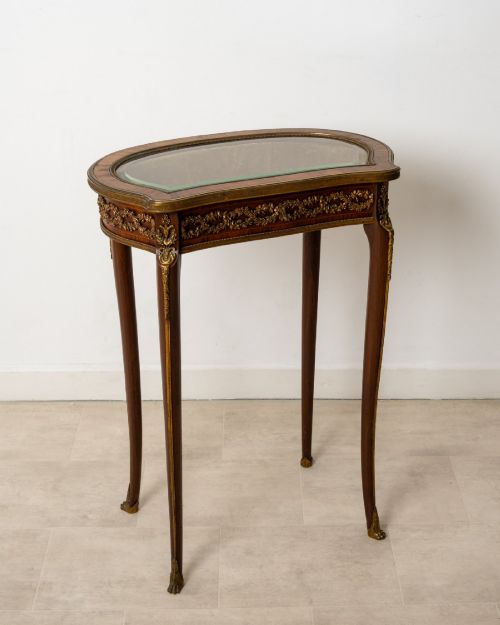
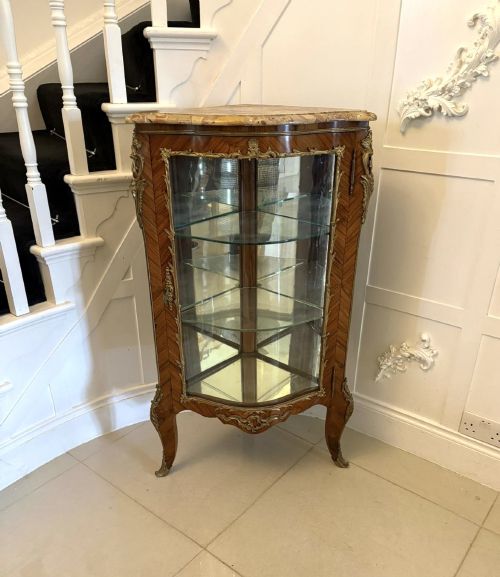
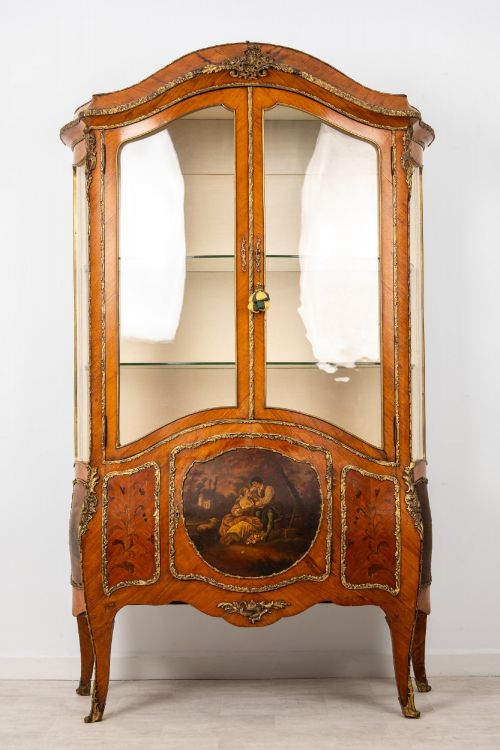


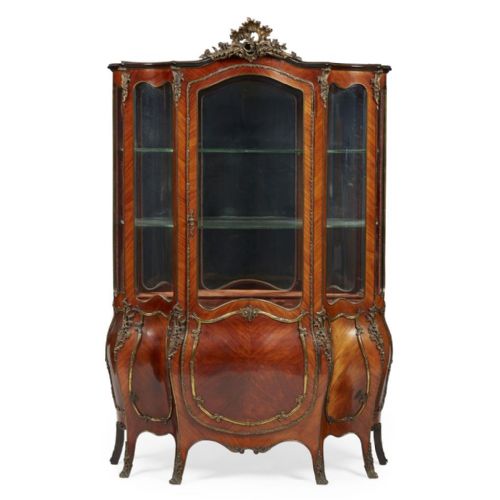

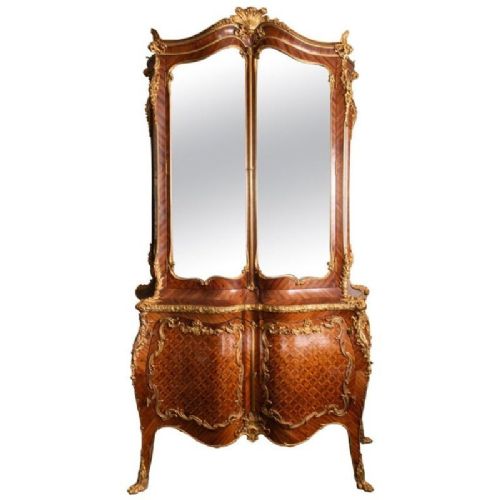

Kingwood Curved Vitrine
A kingwood curved vitrine brings French revival cabinet-making into a room, framing porcelain and glass behind sweeping glazed doors.
Kingwood Curved Vitrine
A kingwood curved vitrine is a display cabinet designed to showcase precious objects through glass panels while demonstrating fine timber selection. The pieces seen here span the nineteenth century and the early twentieth century, drawing heavily on French Rococo Revival, Louis XV style, and Louis XVI style vocabularies.
Buyers meet serpentine fronts, bombé profiles, and corner display formats constructed in kingwood. These cabinets frequently incorporate marble tops, painted panels, and marquetry inlay alongside glass shelving.
Originating predominantly from French workshops of the 1860s through to the 1910s, these vitrines combine display utility with elaborate cabinet work. The form serves to elevate drawing rooms and salons by reflecting light through curved glass windows.
Materials and construction
Cabinet-makers built these vitrines using kingwood veneers laid over a sturdy carcase, often accented with rosewood and marquetry inlay. The timber provides a rich, figured grain that responds well to polishing.
Cast ormolu and gilt bronze mounts frame the glazed doors, corners, and feet, adding architectural definition and sculptural weight. Painted panels in the Vernis Martin technique frequently occupy the lower sections below the main display area.
Curved glass panels require specialised hot-bending techniques to fit the serpentine and bombé frames precisely. Marble tops, sourced in various colours, cap the upper surfaces of the cabinets to provide a durable and decorative finish.
Kingwood Curved Vitrine Retail Price Guide 2026
Typical asking prices for kingwood curved vitrine among the pieces listed under this phrase on Sellingantiques today, from the lower quarter to the upper quarter. They describe what is for sale here now, not the wider market.
Some nineteenth-century makers curved their glass by hand over hot sand, holding their breath while the brittle sheets took their final sweep.
Judging quality
Quality rests upon the crispness of the gilt bronze or ormolu mounts and the precision with which they follow the timber contours. Superior examples display hand-chased metalwork rather than cast repetition.
The complexity of the timber work defines the upper tiers, seen in balanced marquetry and the fluid sweep of bombé or serpentine curves. Cabinets associated with master makers or specific workshops command attention through structural confidence and fine proportions.
Painted panels executed in the Vernis Martin tradition vary from simple decorative motifs to detailed figural scenes that require high artistic skill. The integration of marble tops and the clarity of the curved glass further separate standard production from exhibition pieces.
Francois Linke
The Kingwood Curved Vitrine Glossary
- Kingwood
- A dense, richly figured Brazilian timber utilised for decorative veneer work in high-end cabinet-making. It yields deep brown tones with golden-yellow streaks.
- Ormolu
- Gilt bronze mounts applied to furniture edges and corners to highlight the form and protect vulnerable timber. The metal is cast and then gilded with gold leaf or mercury gilt.
- Vernis Martin
- A simulated Japanese lacquer technique developed in eighteenth-century France and revived later. It employs multiple resin layers to produce translucent painted panels.
- Bombé
- A swelling, outward-curving profile on the front and sides of a cabinet. This curved form demands advanced woodworking skill to maintain structural integrity.
- Marquetry
- The art of applying small pieces of veneer to form decorative pictures or geometric patterns on a carcase. It requires exact cutting and fitting of diverse timbers.
Kingwood Curved Vitrine: Frequently Asked Questions
What is a kingwood curved vitrine?
A kingwood curved vitrine is a nineteenth-century display cabinet featuring bent glass panels and veneered timber surfaces. These cabinets were designed to hold porcelain and small decorative objects in formal rooms.
Cabinet-makers constructed them using French revival styles, incorporating gilt bronze mounts and sometimes painted panels. The curved glass allows light to enter from multiple angles, illuminating the collection inside.
How do I style a vitrine at home?
Place a vitrine against a solid wall where natural light can strike the glass panels without causing direct fading to fragile items. Keep the interior lighting balanced and avoid overcrowding the shelves so the curved wood and ormolu mounts remain visible.
Allow the cabinet to anchor a reception room by pairing it with traditional seating and complementary timber furniture. Group similar items together on the glass shelves to maintain a curated appearance.
How do I tell Louis XV and Louis XVI styles apart?
Louis XV style cabinets rely on asymmetrical curves, serpentine lines, and exuberant rococo ormolu mounts. The overall movement is fluid, with bombé fronts and naturalistic floral marquetry.
Louis XVI style pieces shift towards strict symmetry, straight fluted lines, and neoclassical restraint. You will notice rectangular proportions, classical bronze motifs, and architectural dignity in place of sweeping curves.
What is Vernis Martin?
Vernis Martin is a decorative lacquer technique created to mimic Asian lacquerware using European resin varnishes. It produces a glossy, translucent surface often decorated with pastoral scenes or figures.
On these cabinets, you usually find Vernis Martin panels on the lower doors beneath the main glass display section. The technique adds colour and narrative depth to the timber carcase.