

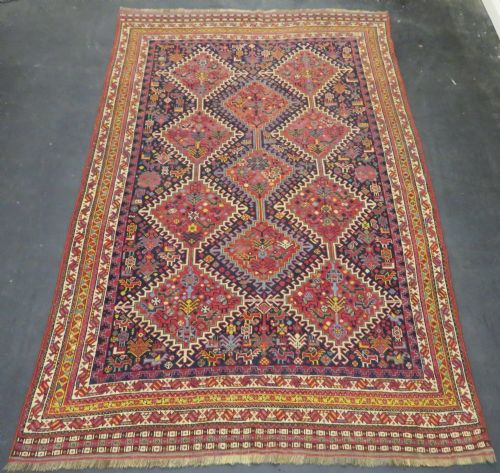
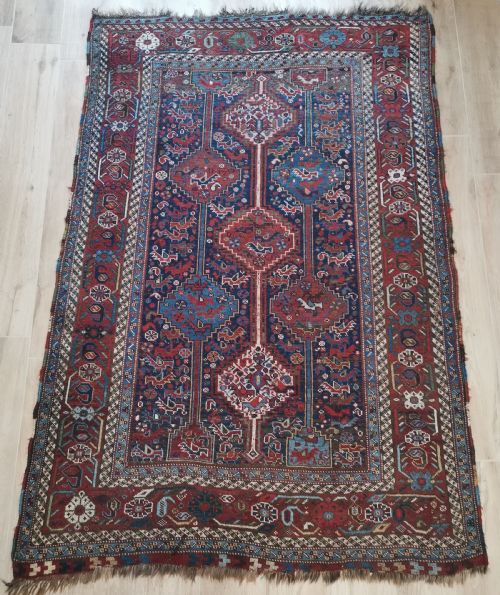

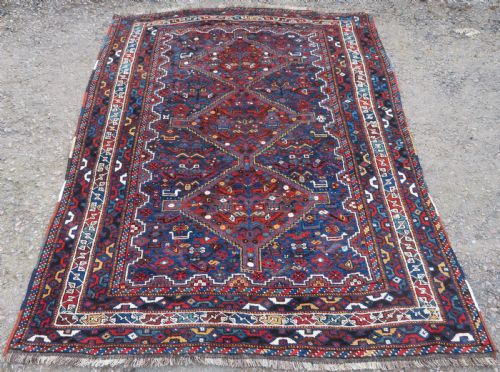


Khamseh Bird Rug
A Khamseh bird rug is a South Persian tribal weaving defined by geometric birds and pecking chickens, prized for its village character.
Khamseh Bird Rug
When you search for a khamseh bird rug, you are looking at tribal and nomadic floor coverings from South West Persia. These pieces date from the late nineteenth century up to the early twentieth century, spanning decades of traditional weaving.
You are most likely to meet room-sized carpets, smaller area rugs, or the occasional saddle bag face on this page. The designs frequently incorporate motifs of pecking chickens, birds, and animals set against traditional tribal fields.
How they were made
These weavings rely on natural dyes applied to handspun wool. Artisans worked with wool foundations and cotton elements to build robust structures meant for daily nomadic use.
The construction reflects South Persian tribal traditions, where weavers drew upon generational patterns without rigid factory cartoons.
Khamseh Bird Rug Retail Price Guide 2026
Typical asking prices for khamseh bird rug among the pieces listed under this phrase on Sellingantiques today, from the lower quarter to the upper quarter. They describe what is for sale here now, not the wider market.
The listings span periods from the eighteen-seventies through to nineteen-ten, utilising natural dyes, wool, and cotton.
What varies in quality
Quality rests in the clarity of the natural dyes and the precision of the tribal motifs. Stronger chromatic contrast and well-rendered animal figures elevate certain examples above simpler village productions.
The integrity of the wool foundation and the balance of the overall composition also determine the standing of each individual piece.
The Khamseh Bird Rug Glossary
- Khamseh
- A confederation of pastoral tribes in South West Persia known for distinctive dark wools and geometric designs.
- Khorjin
- A traditional saddle bag woven in pairs for transport on animals, often surviving today as separate bag face panels.
- Morghi
- A Persian term associated with bird or chicken motifs found in tribal carpets.
- Main carpet
- A large-scale floor covering traditionally reserved for primary living spaces within tribal or village settings.
Khamseh Bird Rug: Frequently Asked Questions
What is a khamseh bird rug?
A khamseh bird rug is a tribal weaving from South West Persia created by nomadic and confederation weavers. These pieces are distinguished by stylized depictions of birds, pecking chickens, and animals.
The rugs date from the late nineteenth century to the early twentieth century and utilise durable wool construction with natural dyes.
How were these rugs used?
These textiles served practical functions as floor coverings, sitting areas, and heavy blankets in nomadic or village tents. Smaller formats like saddle bag faces were utilised for practical transport on animals.
Over time, these utility items gained recognition for their artistic merit and folkloric imagery.
How do I live with a tribal rug?
Living with these textiles involves placing them in low-to-moderate traffic areas to preserve the antique wool foundation. Using a proper underlay prevents slipping and cushions the weave against hard floors.
Regular gentle vacuuming without a beater bar keeps the natural wool pile clean and free of abrasive grit.
How are different periods told apart?
Earlier pieces from the mid-to-late nineteenth century often display deeper saturation in natural dyes and denser, finer wool manipulation. Later examples moving into the twentieth century may show slight shifts in palette and scale.
Examining the handling of the wool and the structure of the foundation helps establish the chronological span of each weave.