



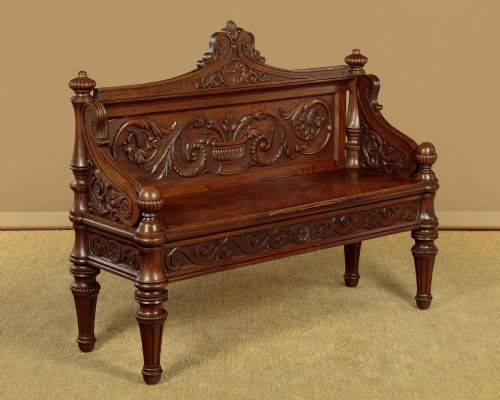
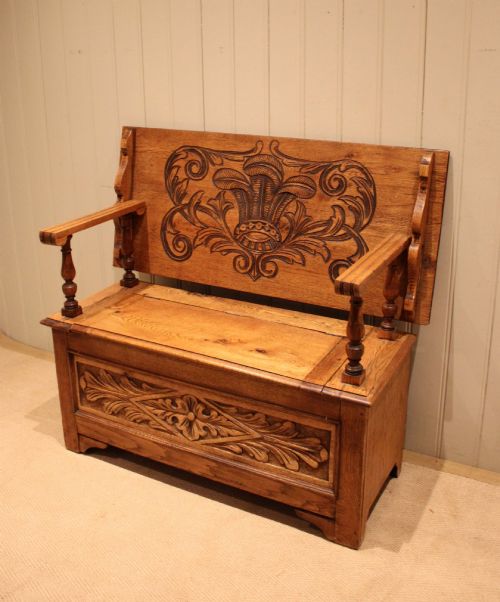
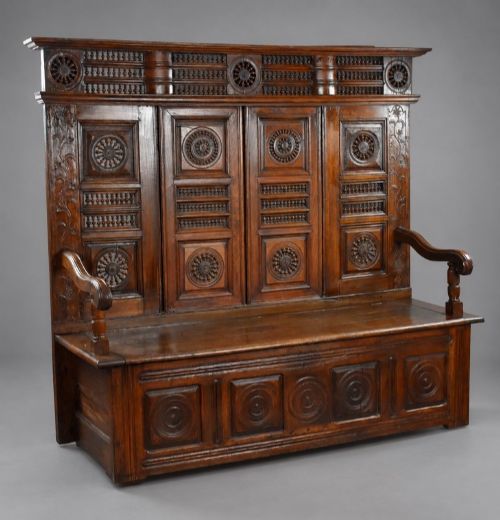


Jacobean Style Hall Bench
A jacobean style hall bench brings heavy timber presence and historic craft into an entranceway, offering robust seating with practical storage.
Jacobean Style Hall Bench
When you search for a jacobean style hall bench, you are looking at sturdy wooden seating designed for corridors, boot rooms, and entrance spaces. The versions you are most likely to meet on this page span the Victorian era, the Edwardian period, and the nineteen-twenties, though genuine seventeenth-century pieces also appear among the listings.
These items take various forms, including traditional settle designs with high panelled backs, box settles with hinged seats for storage, and convertible monks benches that transform into tables. They function as both practical furniture and architectural statements within a hallway.
Materials and construction methods
Solid oak serves as the primary material for these pieces, supplemented occasionally by fruitwood and metal hardware like iron hinges. Workshops relied on traditional joinery techniques, using panelled construction and pegged mortise and tenon joints to build robust frames.
Carving defines the surface decoration across the styles, utilising strapwork, fluting, and geometric motifs to echo seventeenth-century joinery. Finishes range from dark polished patinas to stripped golden oak and limed surfaces, reflecting the preferences of different periods.
Jacobean Style Hall Bench Retail Price Guide 2026
Typical asking prices for jacobean style hall bench among the pieces listed under this phrase on Sellingantiques today, from the lower quarter to the upper quarter. They describe what is for sale here now, not the wider market.
Some monks benches double as tables, ready to host an impromptu meal after you finish taking off your muddy boots.
Distinctions in standard and execution
The standard of a jacobean style hall bench depends on the depth and crispness of the hand-carving on the panels and backrests. Pieces with sharply defined geometric patterns and fluid relief work stand apart from simpler, more mechanically produced later interpretations.
Proportion and timber selection also drive differences in quality, with tight-grained solid oak boards and well-balanced frames commanding greater appreciation. The integrity of the original construction, including heavy panelled backs and sturdy box compartments, marks the better examples.
The Jacobean Style Hall Bench Glossary
- Settle
- A wooden bench with a high back, solid arms, and often a closed base or storage box beneath the seat. This form protected sitters from draughts in entrance halls.
- Monks Bench
- A versatile furniture form featuring a hinged back that folds down flat over the arms to convert the seat into a table. It combines two functions in a single timber piece.
- Box Settle
- A seat design incorporating a lidded compartment under the squab for storing boots, blankets, or household goods. The enclosed base keeps items hidden away from dust.
- Strapwork
- A decorative carving motif resembling interlaced bands or ribbons, frequently seen on seventeenth-century panels and revival woodwork. It creates a flat, geometric pattern across the timber.
- Limed Oak
- Wood treated with a white pigment or lime composition to highlight the open grain and lighten the overall colour. This finish appeared on revival pieces to create a lighter aesthetic.
Jacobean Style Hall Bench: Frequently Asked Questions
How do I use a hall bench today?
These pieces fit naturally into entrance halls and boot rooms to provide a sturdy seat when putting on shoes. Box versions and settlers offer concealed storage for outdoor gear, scarves, and umbrellas.
Convertible table designs also suit smaller dining spaces or studies where dual-purpose furniture saves floor area. Their heavy timber presence anchors an empty hallway corridor.
Are these benches comfortable to sit on?
Most historic wooden benches feature rigid timber backs and flat seats designed for upright posture rather than lounging. Adding a loose squab cushion or textile pad provides extra comfort for daily use.
The high wooden backs serve primarily to block cold draughts in open entranceways rather than offering cushioned support.
How do I tell an original 17th-century piece apart?
Seventeenth-century examples show hand-riven timber, irregular tool marks, and traditional peg construction without modern metal screws. The wear patterns on the seat and arms reflect centuries of handling and natural wood movement.
Revival pieces from the Victorian and Edwardian periods often feature more uniform machine-sawn timber and crisper, standardised carving styles.
Does limed oak mean a piece is modern?
Liming finishes gained popularity during the late nineteenth and early twentieth centuries as part of the arts and crafts and revival movements. Finding a limed surface usually points towards a Victorian, Edwardian, or nineteen-twenties interpretation rather than the seventeen-hundreds.
The technique highlights the grain of solid oak while giving the timber a distinct pale tone.