
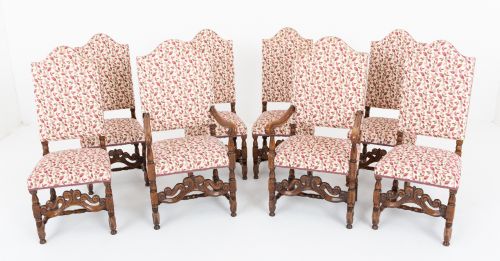
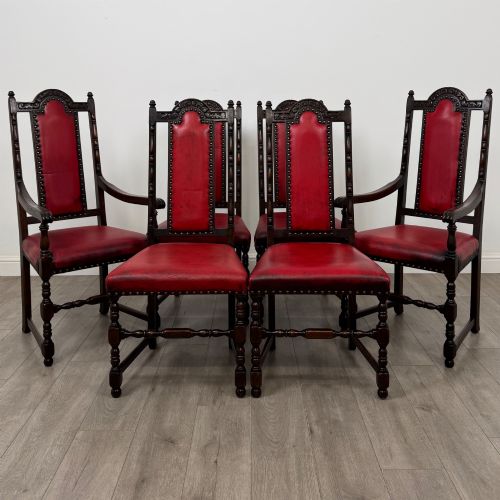
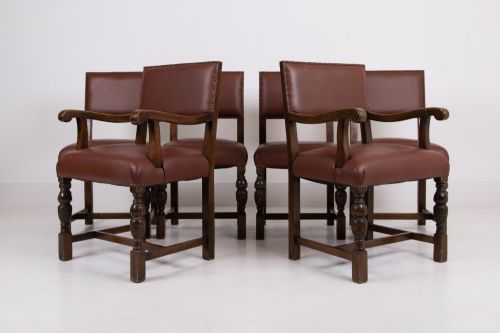
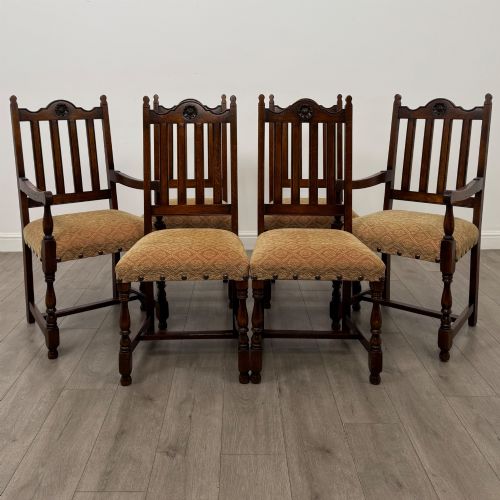






Jacobean Revival Seat Set
A jacobean revival seat set brings substantial timber and historic presence into a room, offering matching seating for a dining table.
Jacobean Revival Seat Set
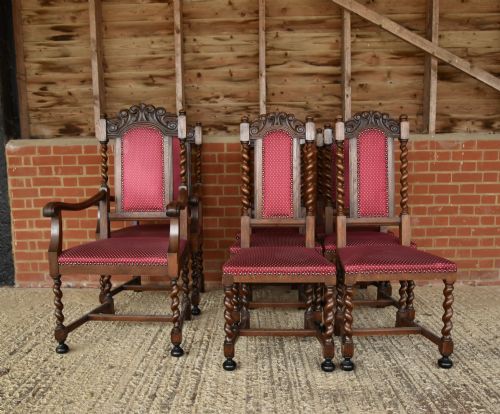
A jacobean revival seat set comprises matching dining chairs and armchairs produced largely across the nineteenth and twentieth centuries, spanning the Edwardian era through to the 1930s. These collections draw heavily on seventeenth-century forms, offering sets of four, six, eight, or ten matching pieces for larger dining spaces.
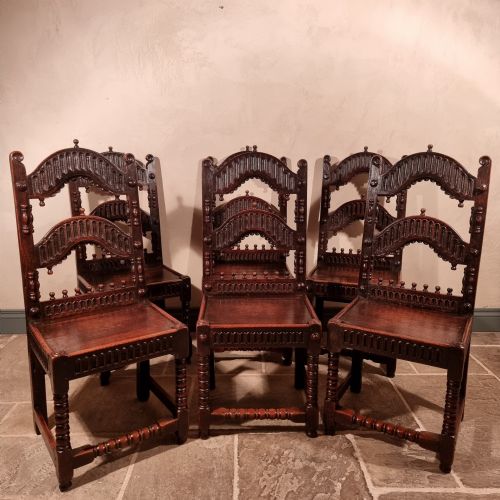
The most common forms on this page include dining chairs and armchairs featuring high backs, carved woodwork, and turned supports. Alongside strict Jacobean revival designs, buyers encounter pieces incorporating Victorian Gothic, Queen Anne, Derbyshire, and Arts and Crafts revival influences.
Originating predominantly from British cabinet-making traditions of the Victorian and Edwardian periods, these sets replicate earlier heavy timber furniture for modern domestic use. They provide uniform seating arrangements that anchor a dining room with traditional craft elements.
Materials and Construction
Oak forms the structural foundation of these sets, utilised extensively for frames, legs, and carved back panels. Artisans shaped this dense timber using traditional joinery and carved surface ornament.
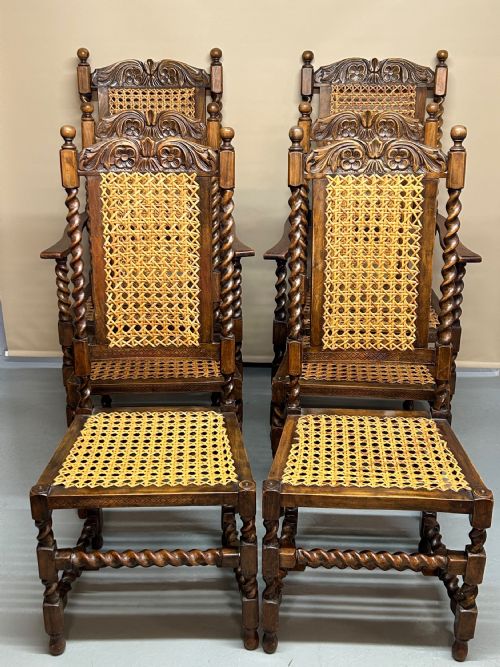
Upholstery materials such as leather, fabric, velvet, and cane provide the seating surfaces and backrests. Brass fittings and studs frequently secure these coverings to the wooden frames.
Turning techniques produce structural elements like barley twist legs and supports. Carving chisels decorate the crest rails and splats with geometric and floral motifs.
Materials recorded across the inventory include solid oak, leather, velvet, fabric, brass, and cane.
Qualities of Construction and Design
The depth and crispness of the timber carving separate standard production from superior examples. Finely executed relief work on crest rails and stiles demands greater skill than shallow machine stamping.
Timber selection and matching across an entire set dictate overall cohesion and visual weight. Sets that maintain consistent grain patterns and uniform colour across all four, six, or eight chairs represent higher workshop standards.
The choice of seating material, whether supple leather, woven cane, or heavy upholstery fabric, influences both comfort and finish. Original hide or well-executed traditional re-upholstery adds integrity to the piece.
The Jacobean Revival Seat Set Glossary
- Barley Twist
- A spiral-turned wooden column used for legs and stretchers. This decorative turning method appears frequently on seventeenth-century style and revival furniture.
- Derbyshire Chair
- An oak chair type originating in the seventeenth century featuring open back panels and turned posts. Revival versions replicate these regional British seating forms.
- Bergere
- A panel of woven cane fitted into the back or seat of a chair. This technique lightened heavy timber frames during later revival periods.
- Crest Rail
- The uppermost horizontal member of a chair back. Carvers often decorated this area with elaborate motifs in revival pieces.
- Highback
- A chair style featuring an elongated vertical backrest designed to support the entire spine. These forms dominate formal dining sets from the period.
Jacobean Revival Seat Set: Frequently Asked Questions
How many chairs come in these sets?
Sets generally range from four to ten matching chairs, including occasional carvers with arms. The exact number varies by listing.
Buyers should check individual descriptions to confirm whether the group comprises six, eight, or another specific count of seats.
What wood are these chairs made from?
Oak serves as the primary timber across these listings, chosen for its durability and historic association with seventeenth-century furniture.
Supplementary materials include leather, velvet, fabric, and cane used for seats and backrests, alongside brass hardware.
Are these chairs genuinely seventeenth century?
Most pieces date from the nineteenth and twentieth centuries, specifically the Victorian, Edwardian, and 1930s periods. They revive earlier styles rather than originating in the seventeen-hundreds.
Cabinet makers during these later eras drew inspiration from seventeenth-century aesthetics to create domestic dining furniture.
How do I care for antique oak dining chairs?
Maintain the timber by applying appropriate wax polish periodically to nourish the oak surface. Avoid placing chairs in direct sunlight or near heat sources.
Inspect joints and upholstery fixings regularly to ensure the wooden frames remain stable during daily use.