




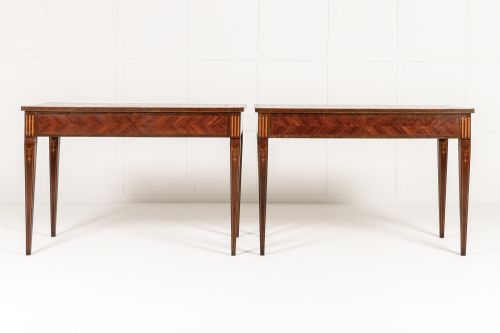


Italian Walnut Console Table
An italian walnut console table brings architectural presence and rich grain to a hallway or reception room.
Italian Walnut Console Table
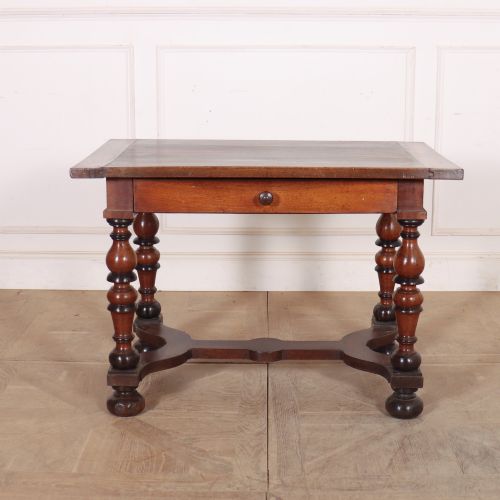
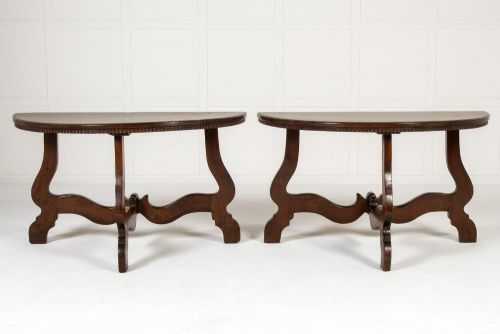
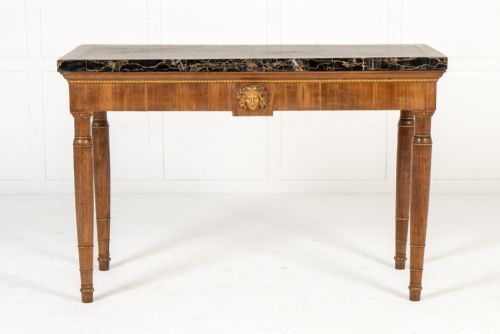
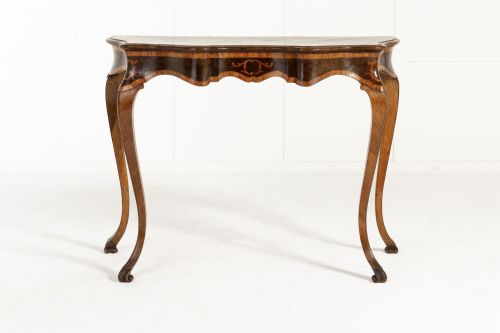
An italian walnut console table is a substantial furnishing designed to stand against a wall, frequently paired with matching mirrors or art. The examples gathered here span from the sixteenth century through the early twentieth century, taking forms such as demi-lune, serpentine, and long rectangular shapes.
The version most commonly encountered on this page originates from the eighteenth or nineteenth century, displaying the characteristic warm timber tones of European walnut. Alongside traditional console tables, the selection includes related side tables, centre tables, and occasional desks sharing similar aesthetic roots.
Materials and Construction Methods
Cabinetmakers built these pieces primarily using solid or veneered walnut, occasionally incorporating secondary timbers like fruitwood, satinwood, and burr yew. Marquetry inlay, bone, and ormolu mounts appear across various periods to embellish the primary wooden structure.
Many of the heavier examples incorporate imported marble tops in shades such as pink Salome, fitted directly to the wooden frame. Carving was executed by hand, yielding deep relief work particularly visible in pieces attributed to Baroque and Renaissance revival styles.
Bone inlay appears alongside fine European walnut in sixteenth-century examples, offering a striking pale contrast to the dark timber.
Distinctions in Execution and Age
The division between standard production and top-tier execution rests upon the depth of the carving and the selection of figured timber veneers. Exhibition-quality pieces display superior intricacy in their surface ornamentation and heavier, more substantial marble tops.
Originality of components also dictates the standing of a piece, particularly regarding the survival of early marble slabs and integrated marquetry. The crispness of the hand-carved details remains a primary indicator of workshop skill across both eighteenth-century antiques and later revival items.
Pietro Ferrario
The Italian Walnut Console Table Glossary
- Demi-lune
- Having a half-moon shape with a flat back designed to sit flush against a wall. This form is particularly common among the eighteenth-century console tables in this selection.
- Serpentine
- Describing a front edge or surface that curves inward centrally and outward at the ends in a continuous undulating line. It requires considerable skill from the woodworker to shape accurately.
- Ormolu
- Gilded bronze mounts applied as decorative ornaments to furniture during various periods. The technique involves creating a mercury-gilt finish on cast bronze elements.
- Marquetry inlay
- The art of applying decorative pieces of veneer to a structure to form geometric or pictorial designs. Different coloured woods and organic materials create the visual contrast.
- Pier table
- A table designed specifically to stand against the wall between two windows, often placed beneath a matching wall mirror. These share a similar structural format to standard console tables.
Italian Walnut Console Table: Frequently Asked Questions
Where should I place an italian walnut console table?
These pieces suit entrance halls, drawing rooms, or narrow reception spaces where surface area is required without blocking flow.
Because many feature finished backs or sit flush against walls, they anchor long corridors effectively when paired with a mirror.
How do I care for a marble top console?
Clean the stone surface using a damp cloth and mild, pH-neutral soap, avoiding acidic substances that can etch the polish.
Treat the walnut base with appropriate furniture wax periodically to nourish the grain without building up heavy residue.
Are these tables sturdy enough for daily use?
Most examples possess robust wooden frames designed for functional placement, though very heavy marble slabs require stable positioning.
Care should be taken not to overload fragile antique legs, particularly on slender eighteenth-century forms.
How can I tell an eighteenth-century table from a later revival?
Examine the construction joints, timber shrinkage patterns, and tool marks on the underside of the structural components.
Revival pieces from the nineteenth and twentieth centuries often exhibit different joinery standards and machine-assisted preparation.