
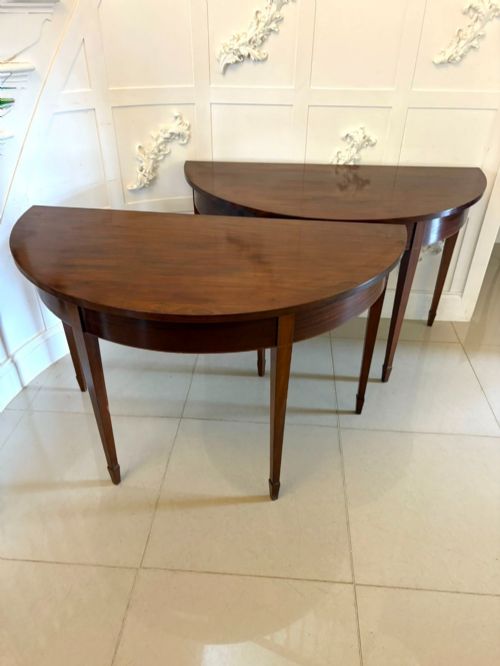

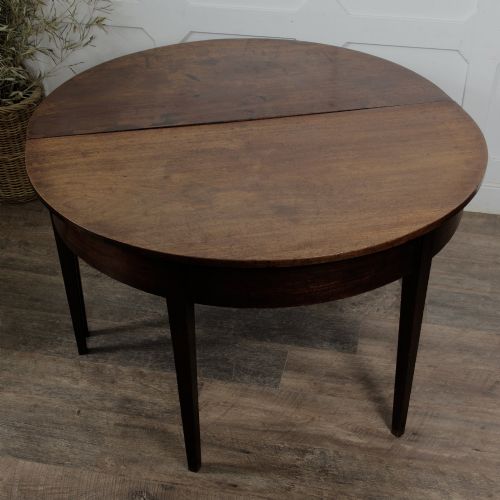
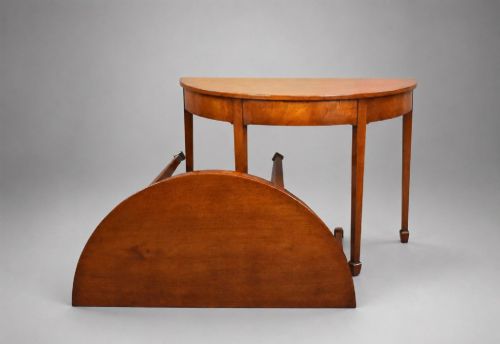
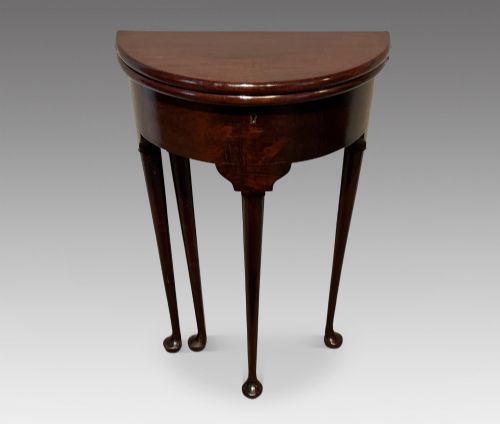
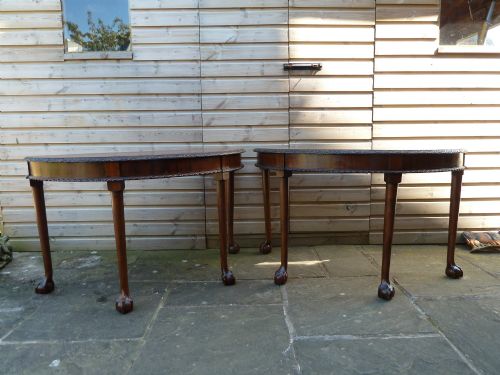


Half Round Side Tables
Half round side tables are semicircular items designed to stand flat against a wall, offering surface space in narrow rooms.
Half Round Side Tables
Half round side tables take the form of console tables, side cabinets, occasional tables, and commodes. They appear across the Georgian, Victorian, and later periods in various forms.
The version most likely to meet a buyer on this page is a mahogany or walnut console table dating from the nineteenth or eighteenth century. These pieces often feature a flat rear edge designed to sit against a wall while presenting a curved front.
Makers and workshops across England, Sweden, and Italy produced these half round side tables using woods such as satinwood, pine, elm, and maple, alongside painted finishes.
How they were made
Cabinet makers built these pieces using solid timbers and veneers, combining mahogany, walnut, satinwood, and maple over pine or secondary woods. Skilled joiners shaped the curved aprons and frames to follow the distinct semicircular perimeter.
Surface decoration involved polished timber grains, brass fittings, painted wood finishes, and red lacquer work. Certain items incorporate marquetry or fine inlay work across the top and frieze.
What varies in quality
The distinction between standard items and exceptional pieces lies in the choice of timber and the precision of the joinery. Figured mahogany or matched satinwood veneers indicate higher workshop standards.
Proportion and decorative restraint dictate the standing of a piece. Finer examples display balanced proportions, delicate carving, and well-executed painted or lacquered surfaces rather than heavy construction.
Pietro Ferrario
The Half Round Side Tables Glossary
- Demilune
- A term meaning half-moon, describing the curved semicircular shape typical of these tables. It is often used interchangeably with half round.
- Console table
- A table fixed to a wall or designed to stand against one, frequently supported by two or four legs. These pieces are intended for display rather than heavy freestanding use.
- Commode
- A low cabinet or chest of drawers designed for domestic rooms. In earlier periods, these items functioned as decorative storage units.
- Satinwood
- A durable, yellowish timber native to India and Ceylon, prized for its lustrous grain. Cabinet makers utilised it extensively during the eighteenth and nineteenth centuries for fine veneer work.
- Frieze
- The horizontal band running beneath the top surface of a table. On better pieces, this section carries carved details or inlaid veneers.
Half Round Side Tables: Frequently Asked Questions
Where do half round tables fit best?
These tables suit hallways, landings, and narrow reception rooms where a deep rectangular piece would obstruct movement. Their flat back allows them to sit flush against the wall while the curved front softens the transition in a tight space.
Placing one beneath a mirror or painting creates a traditional focal point in an entranceway. They also serve well in dining rooms as sideboards for serving dishes.
How do I date a half round table?
Dating relies on timber selection, construction methods, and stylistic cues from periods like the Georgian or Victorian eras. Earlier pieces from around eighteen hundred often feature solid mahogany or walnut with hand-cut joins, while later nineteenth-century examples may display different secondary woods and machine-sawn components.
Examining the underside and drawer linings reveals how the piece was constructed. Hand-planed boards and traditional fixings point to earlier craftsmanship.
Are these tables sturdy enough for daily use?
Most half round side tables are built to carry lamps, decorative objects, or books rather than heavy loads. Because many stand on slender legs, they benefit from being placed against a wall where they remain stable.
Some variants, such as games tables with folding tops, offer more versatility. However, everyday placement should still account for their lighter structural design compared to heavy dining furniture.
What is the difference between a console and an occasional table?
Console tables are specifically designed to stand against a wall, sometimes anchored or supported by brackets in addition to legs. Occasional tables are lighter, more portable pieces that can be moved around a room as needed.
In half round formats, both types share the semicircular top. The distinction usually rests on how fixed the piece is intended to be within the room layout.