


Italian Maritime Art
Italian maritime art brings the historic harbours, lagoons, and coastlines of the Mediterranean into your home through period paintings and model boats.
Italian Maritime Art
Italian maritime art encompasses oil paintings, watercolours, gouaches, and model boats depicting coastal scenes, harbours, and lagoons. These works range from seventeenth-century marine vistas to mid-twentieth-century townscapes and miniatures.
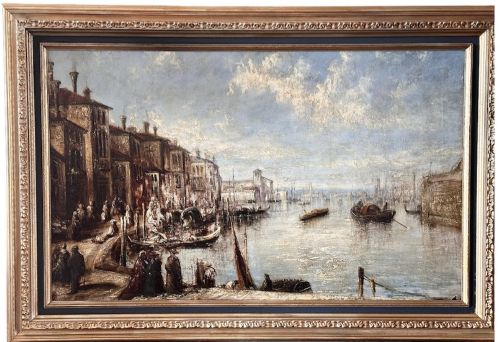
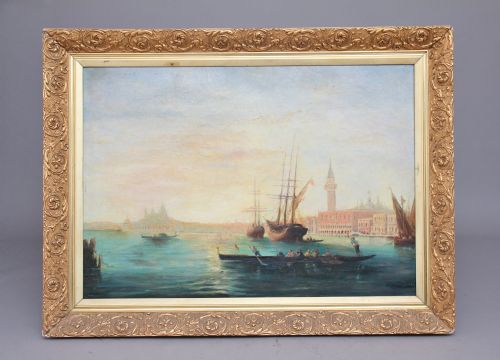
Venice and Naples dominate the selection, featuring views of the Venetian lagoon, the Grand Canal, and the Bay of Naples alongside Vesuvius. Buyers commonly encounter nineteenth-century canvas paintings and watercolours capturing these iconic coastal subjects.
The objects extend beyond canvas to include carved wood model boats such as gondolas and detailed pierhead paintings of steamships in heavy seas. Such pieces reflect the rich maritime history and bustling port life of the Italian peninsula.
How Italian maritime art was made
Artists painted primarily in oil on canvas or wood panel, applying pigment to capture the light and atmosphere of the Mediterranean. Watercolours and gouaches on paper also appear, offering finer linear detail for townscapes and architectural views.
One determined artisan carved an entire wooden gondola just to bring a slice of the Grand Canal into a parlour.
What varies in quality
Quality rests in the handling of light and atmospheric perspective, particularly in how an artist renders the reflective surface of water or distant coastal haze. Stronger works demonstrate confident brushwork and precise architectural proportions in complex settings like Venetian canals.
The preservation of the original paint layer and the condition of the supporting canvas or wood panel dictate the integrity of the piece. Frames featuring intact period giltwood and gesso further elevate the overall presentation.
Francis Moltino·Fernando Del Basso·Jane Vivian·Alfred Pollentine·Henry Wimbush·Arthur Joseph Meadows·Arthur Severn
The Italian Maritime Art Glossary
- Pierhead painting
- A specialised genre of marine art depicting ships entering or leaving a specific port, often commissioned by shipowners or captains. These works focus heavily on accurate vessel portraits.
- School of Posillipo
- A nineteenth-century group of artists based near Naples who focused on plein-air landscape and coastal painting. They emphasised naturalistic light and local topographical detail.
- Gouache
- An opaque water-based paint that provides solid, matte colour coverage on paper. It allows artists to build bright highlights in coastal townscapes and gouache pairs.
- Gesso
- A plaster-like mixture applied to wood frames before gilding. It provides a smooth base for gold leaf application in traditional framing.
Italian Maritime Art: Frequently Asked Questions
What subjects appear most often?
Venetian canals and the Bay of Naples form the primary subjects across these works. Artists frequently painted the Santa Maria della Salute, the Dogana, and local shipping.
Harbour scenes and coastal townscapes from locations like Sorrento, Rome, and Livorno also appear regularly.
How do I date these works?
Dating relies on stylistic markers, artist signatures, and framing methods associated with periods from the seventeenth to the mid-twentieth century. Nineteenth-century works often feature distinct Victorian framing and specific canvas stamps.
Subject matter and costume details within the paintings further help narrow the chronological window.
Are all these pieces original paintings?
The selection consists primarily of original oil paintings, watercolours, and gouaches created by nineteenth and twentieth-century artists. Model boats carved from wood also form part of the material record.
Each medium reflects the distinct technique and material choice of its period.
Where were these artists active?
Many painters worked on location in Italy, capturing the light of Naples, Venice, and the Gulf of Genoa. Others were British or European travellers who painted during extended tours of the Mediterranean.
Local Italian schools, such as the School of Posillipo, worked directly within their regional landscapes.