
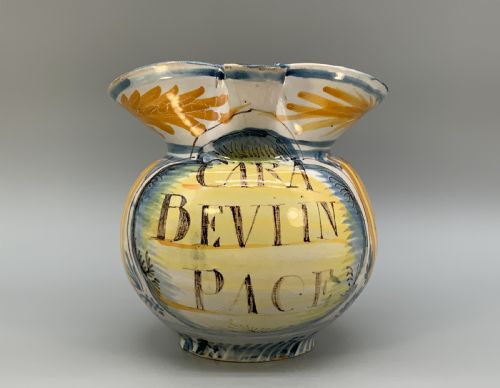
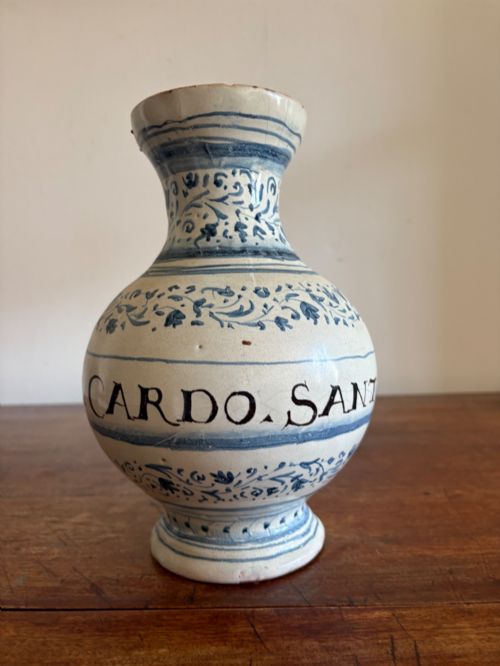


Italian Majolica Pharmacy Jar
An italian majolica pharmacy jar brings centuries of apothecary history into your home through vibrant tin-glazed earthenware and classic forms.
Italian Majolica Pharmacy Jar
When you search for an italian majolica pharmacy jar, you encounter vessels designed to hold medical ingredients, herbs, and syrups in historic dispensaries. The pieces available span the seventeenth, eighteenth, and nineteenth centuries, alongside early twentieth-century examples.
The primary forms you meet on this page are cylindrical albarelli, handled jugs, and water vessels. These containers reflect regional workshops from centres such as Savona and Naples, rendered in styles ranging from Italian Renaissance to Baroque and traditional faience.
Blue and white palettes sit alongside polychrome decorations featuring manganese and yellow pigments. Collectors frequently find pieces bearing remnants of old drug labels or painted inscriptions denoting specific contents.
Materials and construction methods
Potters formed these items from earthenware clay, shaping them on the wheel before applying a tin glaze to create an opaque white surface. This tin-glazed earthenware provided an ideal canvas for hand-painted mineral pigments.
Makers applied cobalt blue, manganese, and yellow pigments directly onto the unfired or raw glaze in a technique that demanded steady brushwork and botanical or heraldic precision. Firing in a kiln then fused the metallic oxides into the glossy white coating.
Materials recorded across the inventory include earthenware, tin glaze, ceramic, and mineral pigments.
Evaluating artistry and preservation
The quality of an italian majolica pharmacy jar rests upon the crispness of the hand-painted decoration and the harmony of the palette. Superior examples display confident brushstrokes, detailed figural or floral motifs, and an even tin glaze free from heavy pooling.
Proportion and form also dictate distinction, particularly in the balanced curve of an albarello waist or the clean pull of a jug handle. Pieces that retain their original covers and legible apothecary inscriptions command greater appreciation among collectors.
The Italian Majolica Pharmacy Jar Glossary
- Albarello
- A cylindrical earthenware jar used by apothecaries to store ointments, dry drugs, and botanical preparations. This distinct waisted shape allowed pharmacists to stack containers efficiently on shelves.
- Tin glaze
- An opaque white ceramic glaze containing tin oxide, applied to earthenware to create a smooth surface for painting. It forms the defining technical foundation of majolica pottery.
- Majolica
- A type of Italian tin-glazed earthenware decorated with metal oxide colours on an opaque white background. Artisans developed this technique extensively during the Renaissance and later revival periods.
- Polychrome
- Decoration employing multiple distinct colours, typically combining blues, yellows, oranges, and manganese purples on a single ceramic vessel. This style contrasts with monochrome blue and white wares.
- Faience
- A European term for tin-glazed earthenware, often associated with styles developed in Italy and later adopted across other regions. The glaze creates a tin-white background suitable for intricate brushwork.
Italian Majolica Pharmacy Jar: Frequently Asked Questions
What did they store inside these jars?
Apothecaries used these vessels to hold dried herbs, powdered roots, medicinal ointments, and liquid syrups. Each container kept ingredients secure and dry in traditional dispensaries.
Labels painted directly onto the body or applied later identified the specific medicinal contents for the pharmacist.
How can I tell an older jar from a later revival piece?
Examining the glaze, pigment depth, and clay body helps distinguish seventeenth and eighteenth-century items from nineteenth-century revival pieces. Earlier ceramics often show subtle irregularities from hand-throwing and wood-fired kilns.
Revival pieces from the nineteenth century typically display a more uniform industrial finish and brighter, standardised pigment mixes.
How do I care for antique majolica at home?
Display these ceramic vessels away from direct sunlight and areas prone to sudden temperature fluctuations. Dust them gently with a soft, dry cloth without using water or chemical cleaners.
Because the historic earthenware and tin glaze can be porous or brittle, handle them carefully by the base rather than rims or handles.