


Italian Mahogany Table
An italian mahogany table brings the warmth of dense timber and the precision of continental stonework straight into a room.
Italian Mahogany Table
An italian mahogany table brings together rich timber frames and contrasting decorative tops, most commonly seen in the form of console tables and side tables. These pieces date across the nineteenth century, including specific years such as eighteen-fifty, eighteen-seventy, and eighteen-ninety alongside broader Victorian and William IV periods.
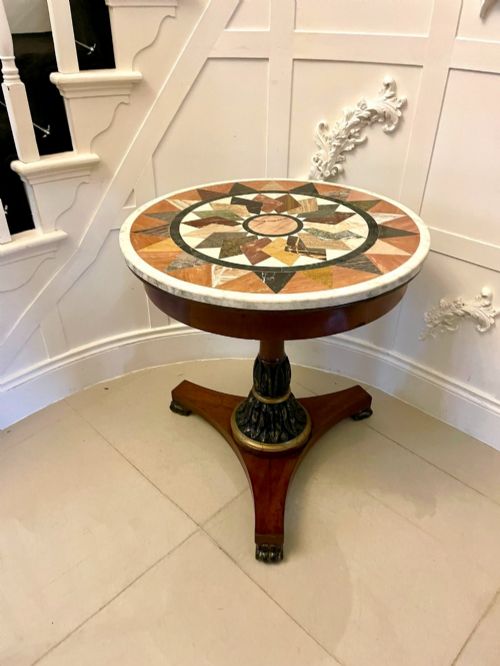
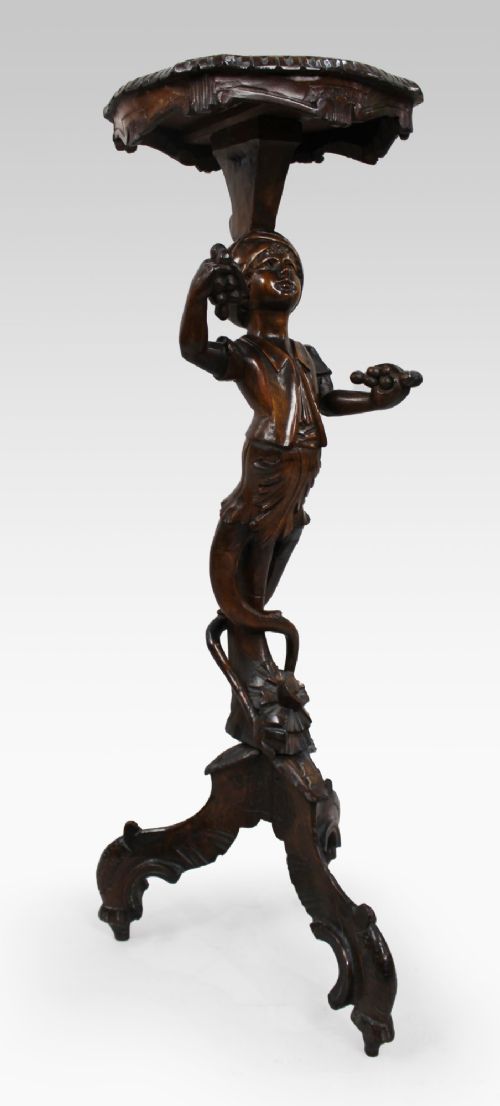
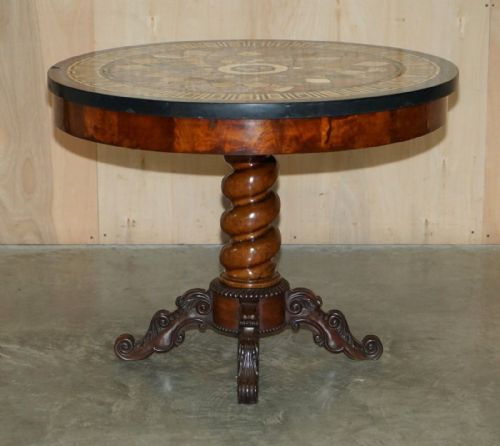
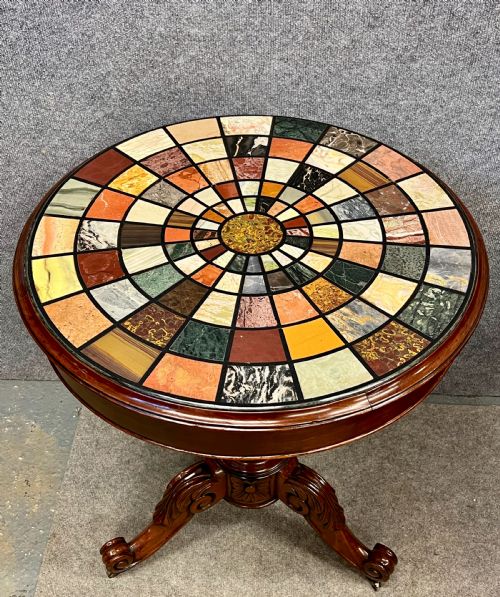
Makers often paired the dark grain of mahogany with elaborate supports, such as carved giltwood dolphins or figural pedestals. Surface decoration frequently takes the form of inset marble, pietre dure, and specimen marble panels brought back from continental travels.
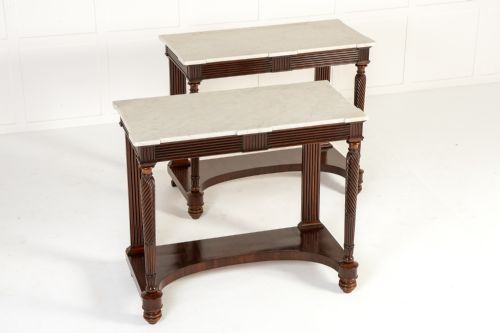
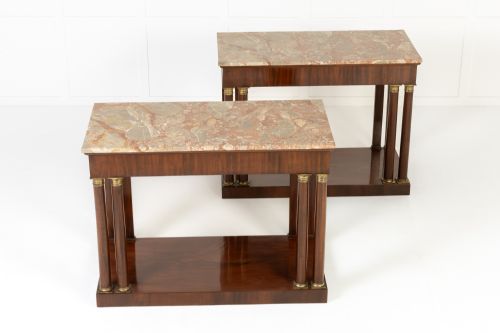
Console tables dominate the selection, designed to sit flat against a wall often beneath a mirror or architectural feature. Occasional and centre tables also appear, offering freestanding options with highly detailed inlaid or mosaic tops.
What varies in quality
Quality rests heavily on the ambition of the stonework and the crispness of the timber carving. A top featuring detailed pietre dura birds or complex specimen marble work elevates a piece above standard plain stone or timber slabs.
The sculptural quality of the base separates standard frames from exceptional examples. Hand-carved giltwood dolphins and figural pedestals demonstrate superior craftsmanship compared to simpler structural supports.
Listings show a strong presence of nineteenth-century pieces, incorporating mahogany alongside marble, pietre dura, brass, and giltwood.
The Italian Mahogany Table Glossary
- Pietra dura
- An artistic technique using cut and fitted polished coloured stones to create mosaic images. This painstaking method creates smooth, durable pictorial surfaces on table tops.
- Specimen marble
- A tabletop assembly composed of numerous small samples of different marbles arranged in geometric patterns. These were popular purchases during nineteenth-century continental travels.
- Console table
- A table designed to be fixed against a wall, traditionally supported by two front legs or brackets. They often feature elaborate front carving to balance the lack of rear support.
- Giltwood
- Wood that has been coated with a thin layer of gold leaf or powder. It provides a bright metallic contrast against dark mahogany frames.
- Flame mahogany
- Timber cut at the junction where branches meet the main trunk, producing a distinctive flickering flame pattern. Cabinet makers used this veneer on prominent surfaces for visual impact.
Italian Mahogany Table: Frequently Asked Questions
Where should I place a console table?
These tables sit best against a flat wall in a hallway, drawing room, or dining space. Their shallow depth allows them to occupy narrow walkways without obstructing movement.
Pairing a console table with a wall mirror or a piece of artwork creates a traditional focal point in a room.
How do I care for a marble top?
Wipe marble and specimen stone surfaces regularly with a soft, damp cloth to remove dust and grit. Avoid placing acidic liquids directly onto the stone to prevent staining.
Use coasters and protective mats beneath glasses and objects to keep the polished surface in good condition.
What is the difference between a centre table and a side table?
Centre tables are built to stand freely in the middle of a room, finished with detail on all sides. Side tables are generally meant to stand against a wall or beside seating.
Centre tables often feature grand pietre dura or specimen marble tops designed to be viewed from every angle.
How do I identify nineteenth-century work?
Nineteenth-century pieces often display specific revival styles, such as Italian Neoclassical, Venetian Baroque, or Grand Tour influences. The combination of flame mahogany with heavy marble or hardstone tops is characteristic of this era.
Examine the construction joints and timber patination to understand the age and manufacturing methods used.