
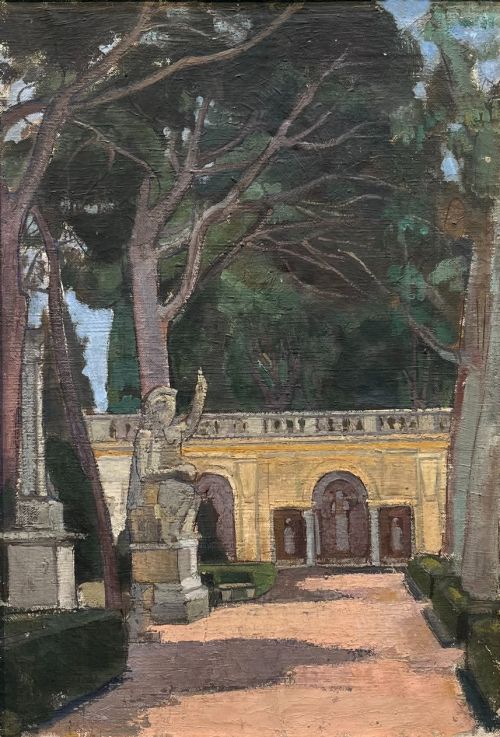


Italian Grand Tour Views
Italian grand tour views capture the classic landmarks, romantic canals, and sunlit ruins that wealthy travellers brought home from nineteenth-century Italy.
Italian Grand Tour Views
Italian grand tour views encompass paintings, watercolours, gouaches, and decorative plaques recording the notable sites of Rome, Venice, Naples, and the surrounding countryside. These pieces formed essential souvenirs for travellers undertaking the traditional European educational journey during the Victorian era and the nineteenth century.
Buyers encountering this selection will find framed artworks depicting specific locations such as the Spanish Steps, Lake Garda, the Medici Gardens, and the Venetian canals. The offerings range from single oil paintings and watercolours to coordinated sets of architectural prints or gouaches.
Materials and techniques
Artists working on these views employed oil on canvas, delicate watercolour, opaque gouache, and paper, frequently framing the finished works in giltwood or incorporating them into micro mosaic tablets. These varied media allowed creators to capture both the expansive light of coastal towns and the fine architectural detail of ancient ruins.
The physical construction relies on traditional nineteenth-century framing techniques, utilising wood, gold leaf, and glass to protect works on paper and canvas. The physical condition reflects the methods of the period, from firmly mounted micro mosaics to framed canvas and watercolour.
Materials in these listings span oil on canvas, watercolour, gouache, paper, glass, and micro mosaic set within giltwood and wood frames.
Distinctions in quality
Quality in these works rests upon the precision of the draughtsmanship, the handling of light in the medium, and the integrity of the original frame. Works by recorded artists or those executed with exceptional detail in gouache or oil distinguish themselves from simpler souvenirs.
The preservation of the paper, canvas, or micro mosaic surface further determines the standing of a piece. Original giltwood frames and well-preserved watercolours maintain their visual impact more effectively than those showing heavy wear.
Alfred Pollentine·Ettore Ascenzi·Thomas Brabazon Aylmer·J Vivian
The Italian Grand Tour Views Glossary
- Gouache
- An opaque watercolour paint that dries to a matte finish, frequently utilised for vibrant nineteenth-century topographical views. This medium allowed artists to achieve rich colour saturation on paper.
- Micro mosaic
- A meticulous decorative technique formed from tiny coloured glass tesserae to create detailed miniature pictures. These tablets were highly prized portable souvenirs from Italy.
- Giltwood
- Wood carved and coated with a thin layer of gold leaf, commonly used for nineteenth-century picture frames. It provides a reflective border that enhances the artwork.
- Neoclassical
- An artistic style inspired by the classical art and culture of ancient Greece and Rome, evident in architectural subjects. This aesthetic influenced many grand tour visual records.
- Watercolour
- A painting method in which pigment is suspended in a water-based solution, applied to paper to create luminous transparent washes. It was a preferred medium for travellers recording landscapes.
Italian Grand Tour Views: Frequently Asked Questions
What subjects appear in these views?
The artworks primarily depict recognisable Italian landmarks, ancient ruins, coastal towns, and bustling canals. Common subjects include Roman steps and gardens, Venetian waterways, and Neapolitan coastal scenes.
These depictions reflect the specific locations visited by travellers on the nineteenth-century grand tour. Artists catered to this demand by painting familiar vistas that served as personal records of travel.
How were these artworks displayed?
Travellers typically had their acquired watercolours, oils, or gouaches framed upon returning home or purchased them already framed abroad. They were hung in domestic interiors as a testament to European travel and classical education.
Smaller items like micro mosaic tablets might be displayed on tables or specialised stands. Larger framed paintings and sets of prints were positioned on walls within parlours and libraries.
How do I care for framed watercolours?
Works on paper, including watercolours and gouaches, require protection from direct sunlight to prevent fading of the pigments. Maintaining a stable indoor environment away from excessive moisture preserves both the paper and the accompanying historic frames.
Glass fronts protect the delicate painted surfaces from dust and accidental touch. Gentle dusting of the wooden or giltwood frames with a dry cloth keeps them in good condition.
How can I tell the period of a piece?
Dating relies on stylistic indicators, framing materials, and artist signatures linked to nineteenth-century production. Works often bear inscriptions or labels relating to the British School or specific Italian locations from the Victorian era.
The choice of medium, such as nineteenth-century gouache or oil on canvas, provides further chronological context. Comparing the subject matter to known travel routes of the period helps confirm the timeframe.