



Interior Tavern Genre Scene
These interior tavern genre scene paintings capture centuries of daily drinking houses and quiet alehouse life on canvas and panel.
Interior Tavern Genre Scene
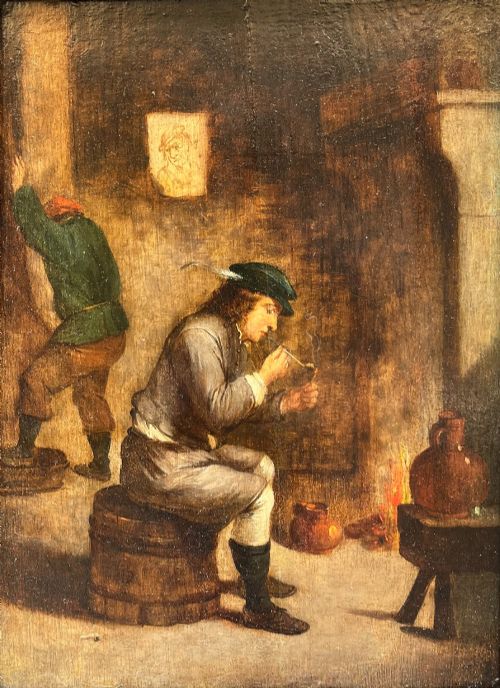
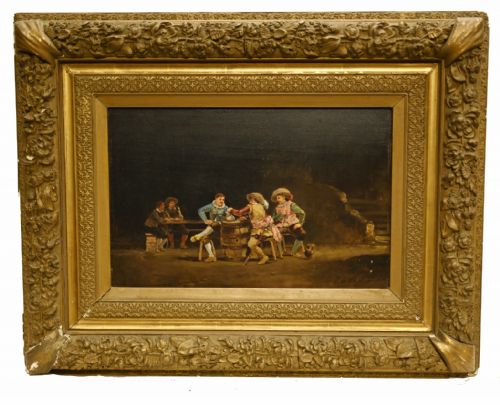
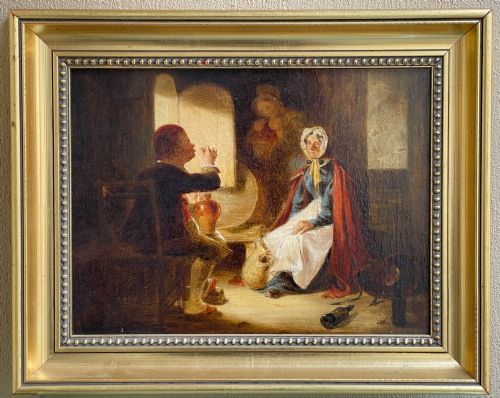
An interior tavern genre scene depicts figures drinking, smoking, and gathering inside alehouses, inns, and drinking dens. These works draw heavily from the Dutch Golden Age tradition and Flemish Baroque aesthetics, translating everyday social life into painted form. You will find compositions featuring peasants merrymaking, musketeers, and hunters interacting with landladies across various centuries.
The pieces on this page span from the seventeenth century through to the twentieth century, taking the form of oil paintings on canvas and oak panel, alongside framed prints. Works attributed to the Dutch School sit alongside nineteenth-century French and English interpretations, showing how later artists adopted earlier compositions. Many carry echoes of seventeenth-century masters like David Teniers and Jan Steen through direct copies or follower pieces.
The subjects range from solitary figures smoking on barrels to lively groups of peasants and hunters resting indoors. Painters utilise dark chiaroscuro lighting to focus attention on faces and tankards, creating intimate windows into past social customs. Whether handling an eighteenth-century panel or a Victorian canvas, each piece preserves a specific historical viewpoint of tavern interiors.
What varies in quality
The handling of light and shadow dictates the visual strength of an interior tavern genre scene. Superior works employ chiaroscuro effectively to model facial expressions and texture, whereas weaker examples lose detail in heavy, flat shadows.
Brushwork precision separates skilled hands from basic workshop output. Confident, fluent strokes render fabrics, wooden barrels, and glassware convincingly, while lesser pieces rely on stiff outlines and muddy pigment mixtures.
Materials across these listings include oil paint on canvas and oak panel, housed within giltwood and gold leaf frames.
David Teniers·John Arthur Lomax·Ludolf de Jongh·Reinier de la Haye·Francesco Bergamini·Jan Steen
The Interior Tavern Genre Scene Glossary
- Genre painting
- A branch of art depicting scenes from everyday life, ordinary people, and common settings rather than grand historical or mythological subjects.
- Chiaroscuro
- An artistic technique using strong contrasts between light and dark, usually bold contrasts affecting a whole composition to give a three-dimensional volume to figures.
- Oak panel
- A rigid wooden support made from oak boards, commonly used by artists before stretched canvas became the dominant medium.
- Giltwood
- Wood that has been thinly coated with gold leaf or gold paint to create a decorative metallic finish on frames and furniture.
Interior Tavern Genre Scene: Frequently Asked Questions
What is a tavern genre scene?
A tavern genre scene is a painting or print depicting everyday activities inside drinking establishments, focusing on ordinary people rather than historical events.
These works frequently show figures smoking, drinking, and gathering around tables or barrels within seventeenth-century and later settings.
How do I date an old painting?
Dating relies on examining the materials, such as oak panels or canvas types, alongside the style of clothing and framing choices.
Signatures, inscriptions on the reverse, and the handling of the oil paint also offer clues to the period of creation.
What is an oil painting on panel?
An oil painting on panel uses a rigid piece of wood, often oak, as the primary support instead of stretched fabric.
This technique was particularly common in earlier centuries before canvas became the standard surface for artists.
Who painted tavern scenes?
Numerous historical artists and subsequent followers painted these subjects, drawing inspiration from Dutch Golden Age traditions.
Masters like David Teniers and Jan Steen established compositional styles that later nineteenth-century painters frequently referenced or copied.