



Inlaid Walnut Captains Desk
An inlaid walnut captains desk brings Victorian writing furniture into a modern room with rich timber and crisp detail.

Inlaid Walnut Captains Desk
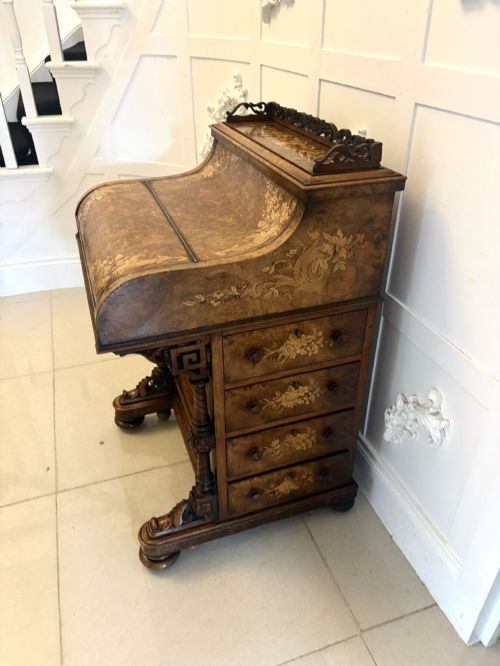
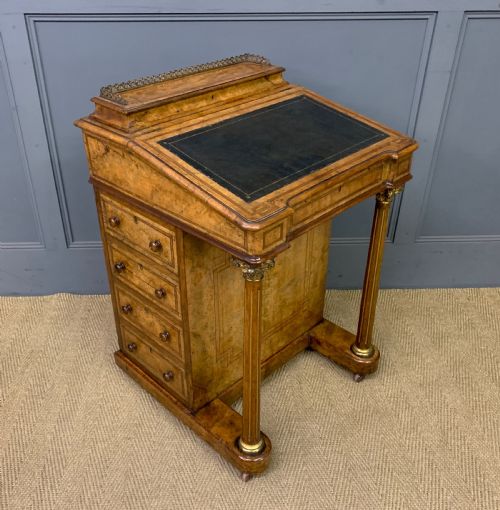
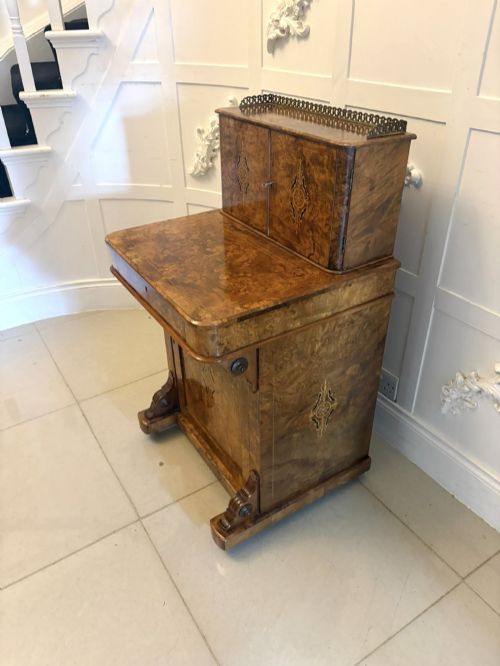
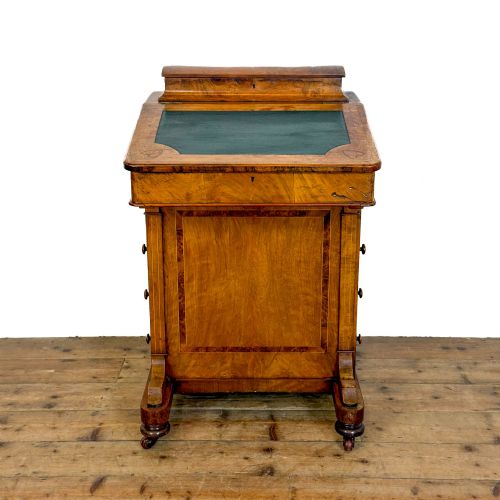
The inlaid walnut captains desk on this page is most frequently encountered as a Victorian Davenport desk, built during the nineteenth century. These compact writing surfaces combine a sloping top with banks of drawers and internal compartments designed for correspondence.
The evidence shows these pieces span from eighteen fifty to eighteen ninety, capturing the height of Victorian cabinet-making. Most examples utilise burr walnut timber combined with marquetry and boxwood inlay to create decorative surfaces.
Materials and construction methods
Makers selected burr walnut for its rich, swirling grain patterns, applying it as veneer over solid secondary timbers. Marquetry inlay and boxwood details were meticulously set into the walnut surfaces to create floral and geometric patterns.
Brass hardware such as handles and hinges provided robust functional support, while leather writing surfaces were fitted to the sloping desks. Freestanding variants demanded finished panelling on all sides to allow placement away from walls.
Inlaid Walnut Captains Desk Retail Price Guide 2026
Typical asking prices for inlaid walnut captains desk among the pieces listed under this phrase on Sellingantiques today, from the lower quarter to the upper quarter. They describe what is for sale here now, not the wider market.
Some models feature pop-up compartments that spring open like secret Victorian automata.
Assessing quality in Victorian desks
Quality rests on the depth of the burr walnut grain and the precision of the boxwood and marquetry inlay. Superior pieces feature crisp botanical motifs that integrate smoothly into the surrounding timber without gaps.
Construction details such as four working drawers, concealed stationery compartments, and pop-up mechanisms separate standard models from more elaborate piano top designs.
The Inlaid Walnut Captains Desk Glossary
- Davenport desk
- A compact Victorian writing desk featuring a sloping lid and a pedestal of drawers. It was originally designed for use on ships before becoming popular in domestic drawing rooms.
- Burr walnut
- A prized timber cut from the gnarled growths of walnut trees. It yields complex, highly figured grain patterns utilised for decorative veneer.
- Marquetry inlay
- The art of applying pieces of veneer to a structure to form decorative patterns and pictures. It often incorporates contrasting woods like boxwood.
- Boxwood inlay
- Fine linear detailing executed in pale boxwood. This technique creates crisp borders and geometric accents against dark walnut.
Inlaid Walnut Captains Desk: Frequently Asked Questions
What is a Davenport desk?
A Davenport desk is a compact form of Victorian writing furniture featuring a sloping, leather-lined writing surface above a pedestal of side drawers.
These pieces typically include internal stationery compartments and were designed to occupy minimal floor space while offering functional storage.
How do I date a walnut desk?
Dating relies on construction characteristics, timber selection, and decorative styles recorded across the nineteenth century. Victorian examples often display specific hardware types and characteristic marquetry patterns.
Examining the internal drawer construction and secondary woods provides further clues to the exact manufacturing period.
How do I care for burr walnut?
Burr walnut benefits from stable room temperatures away from direct sunlight and heat sources to prevent the veneer from drying out.
Regular dusting with a soft cloth preserves the polished finish without requiring heavy chemical treatments.