

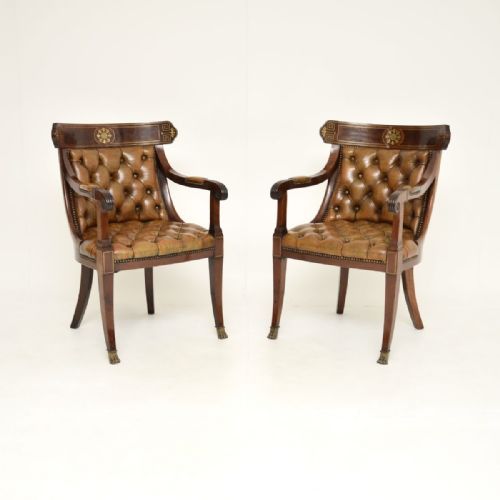


Inlaid Tub Chairs Pair
Inlaid tub chairs pair gatherings bring curved backs and delicate marquetry together, offering compact elegance for a traditional drawing room.
Inlaid Tub Chairs Pair
When you search for an inlaid tub chairs pair, you encounter graceful horseshoe-shaped seating designed for comfort and drawing room conversation. The evidence shows these pieces appear most frequently from the Edwardian period, constructed from rich mahogany and walnut with contrasting stringing.
Beyond standard salon models, the recorded pieces encompass diverse aesthetic movements including Moorish Revival, Art Nouveau, and Regency styles. Makers utilised exotic woods alongside bone and boxwood inserts to create intricate geometric and floral patterns along the curved backs.
How they were made
Craftsmen shaped solid timbers such as mahogany, rosewood, and teak into continuous curved backrests, often employing steam-bending techniques for the characteristic rounded frame. Artisans channelled the timber surfaces to recess contrasting stringing and marquetry motifs.
Inlays of boxwood, bone, and lighter veneers were meticulously hand-cut and fitted into the timber groundwork before polishing. Upholstery methods ranged from drop-in cane seats to sprung pads covered in fabric, leather, or silk.
Inlaid Tub Chairs Pair Retail Price Guide 2026
Typical asking prices for inlaid tub chairs pair among the pieces listed under this phrase on Sellingantiques today, from the lower quarter to the upper quarter. They describe what is for sale here now, not the wider market.
Materials noted across the archive include bone, brass, and teak alongside traditional cabinet woods like rosewood.
What varies in quality
The standard of an inlaid tub chairs pair depends upon the crispness of the marquetry and the selection of cabinet timber. Superior examples exhibit tightly fitted geometric or floral inlays without gaps or excessive filler, utilising dense, well-figured mahogany or walnut.
Structural integrity of the curved backrest dictates longevity, separating robust workshop output from weaker constructions. Fine items retain original show-wood finishes and tight joinery at the arm terminals where the curved rail meets the upright supports.
The Inlaid Tub Chairs Pair Glossary
- Tub chair
- An armchair featuring a continuous curved back and arms forming a single semi-circular enclosure. This form emerged to provide draught-free seating in nineteenth-century parlours.
- Marquetry
- Decorative patterns formed by the insertion of contrasting veneers into a wood surface. Artisans cut these precise pictorial or geometric designs by hand.
- Stringing
- Thin lines of contrasting wood or bone inlaid into channels cut into the furniture surface. It defines the borders of panels and highlights structural outlines.
- Moorish Revival
- A nineteenth-century architectural and decorative style incorporating Islamic geometric motifs. Pieces in this tradition often display dense bone and lighter wood inlays.
- Caning
- Woven rattan material utilised for lightweight seat panels. This technique provides flexible support within open wooden frames.
Inlaid Tub Chairs Pair: Frequently Asked Questions
Where were tub chairs placed originally?
These curved seats found their place near fireplaces or within the centre of formal drawing rooms to facilitate conversation without obstructing sightlines.
Their compact proportions allowed them to sit comfortably in smaller spaces where bulky armchairs proved impractical.
How do I identify Edwardian examples?
Edwardian specimens typically display lighter timbers such as mahogany or satinwood paired with restrained boxwood stringing and neoclassical motifs.
Makers working in this era drew inspiration from earlier eighteenth-century designs while prioritizing lighter, more slender proportions.
Are these chairs suitable for daily seating?
Most surviving pieces function well for occasional sitting when the internal frame and upholstery webbing remain sound.
Original frames benefit from careful weight distribution and placement away from direct heat sources to preserve the dry timbers.
What distinguishes Art Nouveau pieces?
Art Nouveau variants incorporate asymmetrical floral motifs, whiplash curves, and stylized plant forms into the marquetry panels.
Cabinetmakers departed from strict symmetrical geometry to embrace organic, flowing lines characteristic of the turn of the century.