
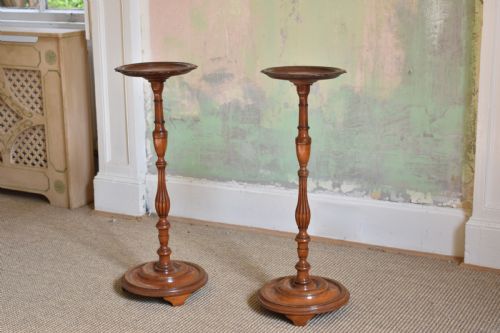
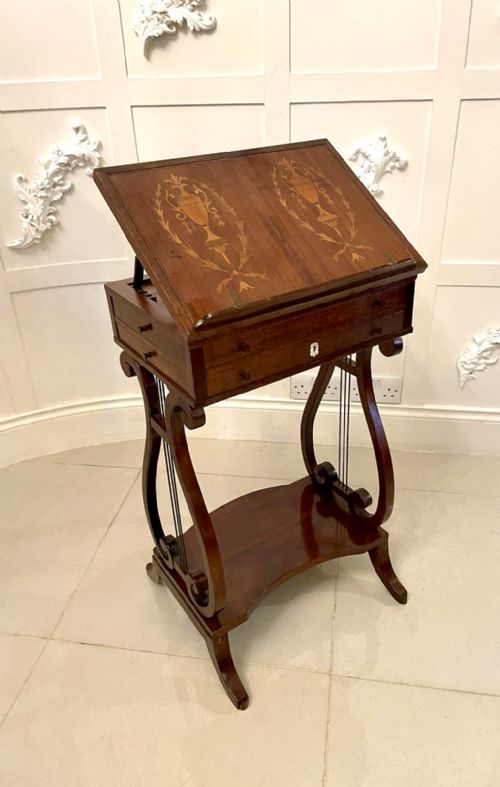
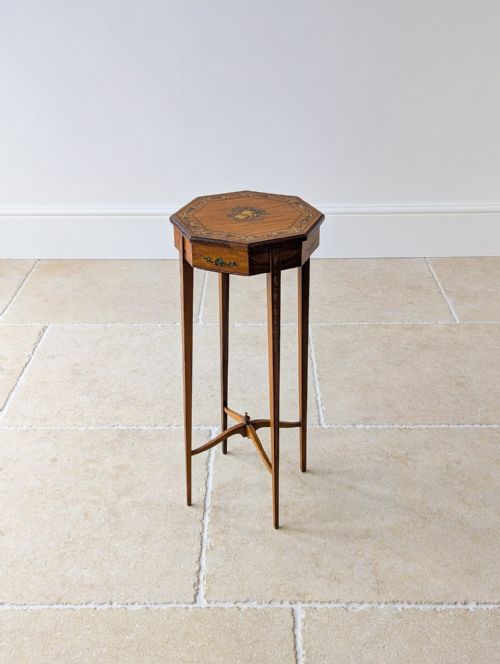
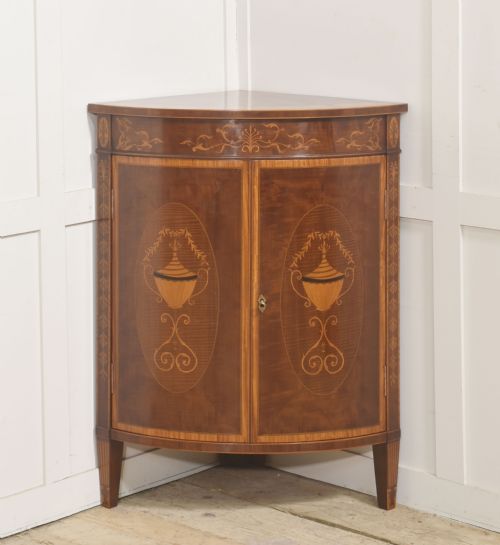


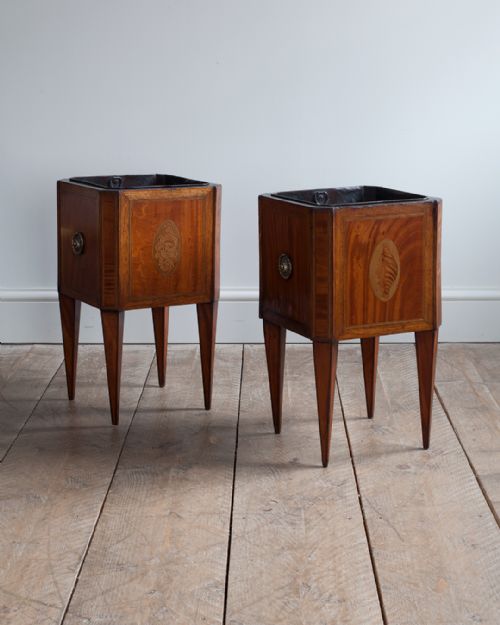


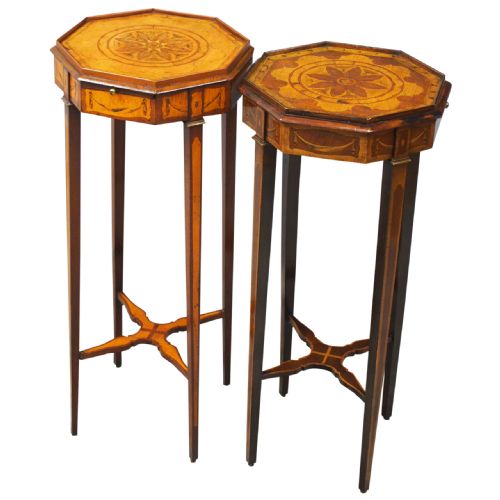
Inlaid Satinwood Urn Stand
These inlaid satinwood urn stand examples bring refined Georgian and Edwardian elegance to a room, offering a slender stage for decorative urns and plants.
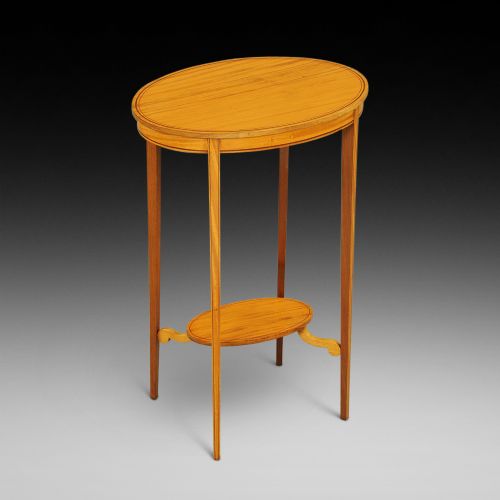
Inlaid Satinwood Urn Stand
An inlaid satinwood urn stand serves as a slender table designed to hold decorative vessels, kettle stands, or lamps in formal rooms. The listings show forms ranging from compact occasional tables to specific George III period kettlestands and Edwardian Sheraton Revival designs.
Buyers encounter pieces spanning the 18th century, the Victorian era, and the Edwardian period, often constructed with mahogany or satinwood timbers. The selection includes matched pairs and individual tables displaying classical revival motifs.
How they were made
Craftsmen utilised timbers such as satinwood, mahogany, rosewood, and boxwood, combining contrasting woods to create delicate inlaid patterns. Marquetry techniques often embellished the surfaces of Edwardian and Georgian pieces.
Makers integrated brass hardware where appropriate, and some examples incorporate painted timber elements alongside traditional wood construction.
Some versatile tables quietly double as both jardinières for indoor foliage and traditional lamp stands.
What varies in quality
The precision of the satinwood inlay and the crispness of the Sheraton Revival detailing separate standard examples from finer works. The selection of figured timber veneers and the harmony of contrasting wood borders dictate visual depth.
Structural integrity in slender legs and joints distinguishes pieces that retain their original proportion and balance from those showing wear or alteration over time.
The Inlaid Satinwood Urn Stand Glossary
- Satinwood
- A light-yellow timber with a natural sheen, frequently used for veneering and detailed cabinetwork.
- Inlay
- A technique where pieces of contrasting wood or other materials are inserted into a recessed surface to form a design.
- Sheraton Revival
- A late 19th and early 20th century design style drawing on the neoclassical furniture forms of Thomas Sheraton.
- Marquetry
- The art of applying pieces of veneer to a structure to form decorative patterns such as flowers or geometric motifs.
- Kettle stand
- A small occasional table historically used for holding a tea kettle during formal gatherings.
Inlaid Satinwood Urn Stand: Frequently Asked Questions
What is an inlaid satinwood urn stand used for?
These pieces function primarily as small display surfaces for decorative urns, lamps, or jardinieres within a room.
Historically, specific forms such as kettle stands supported tea equipment during social gatherings.
How do I date an Edwardian piece?
Edwardian examples often feature Sheraton Revival styling, employing light satinwood veneers and refined marquetry inlay typical of the early 20th century.
Comparison with documented 18th century George III pieces helps clarify stylistic evolution and construction methods.
Are these stands sturdy enough for daily use?
Most examples are built with slender legs and delicate frames intended to support moderate decorative weights rather than heavy loads.
Placing them in low-traffic areas protects the fine satinwood surfaces and intricate boxwood stringing from accidental knocks.
What is the difference between satinwood and mahogany?
Satinwood provides a pale, golden-yellow ground with a natural lustre suited for detailed contrasting inlay work.
Mahogany offers a darker, reddish-brown foundation that frequently serves as the primary structural timber beneath satinwood veneers.