
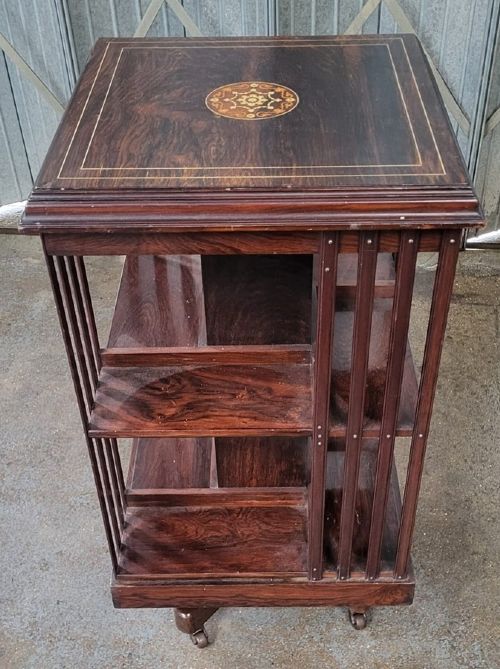
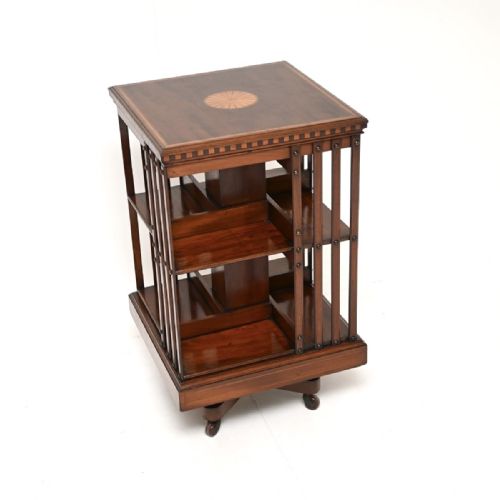
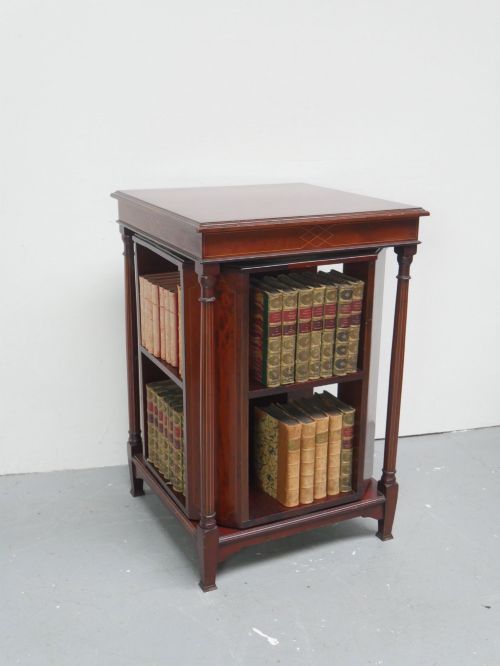
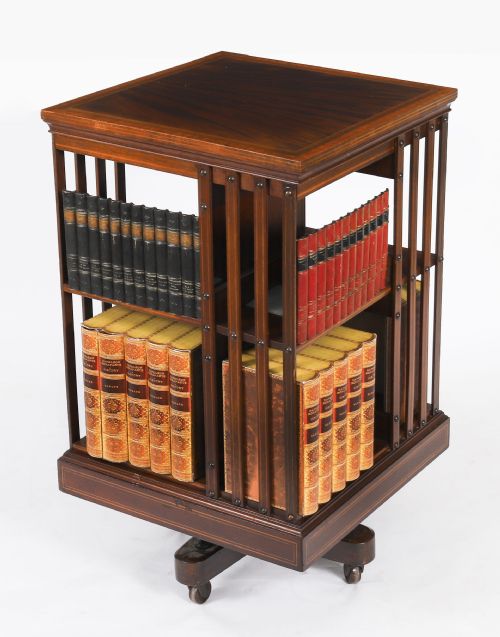


Inlaid Rotating Bookcase
An inlaid rotating bookcase is a clever spinning stand that keeps volumes close at hand while adding rich timber tones to a room.
Inlaid Rotating Bookcase
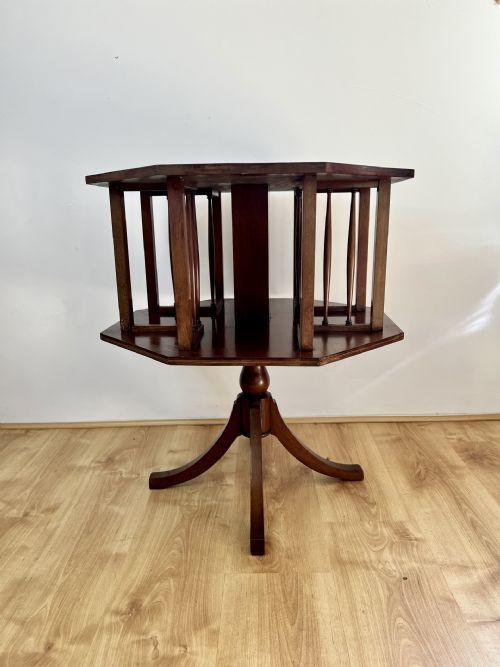
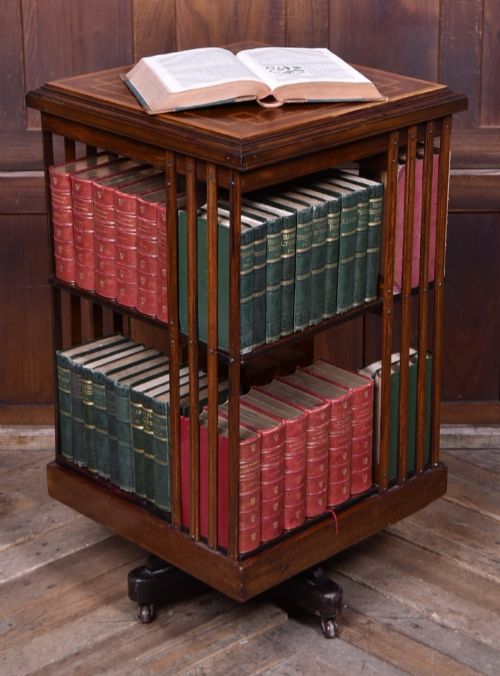
When you search for an inlaid rotating bookcase, you are looking at clever timber furniture designed to sit beside a desk or chair and turn smoothly on a hidden mechanism. These pieces belong chiefly to the Edwardian period and the late nineteenth century, taking the form of low stands or compact table-top versions.
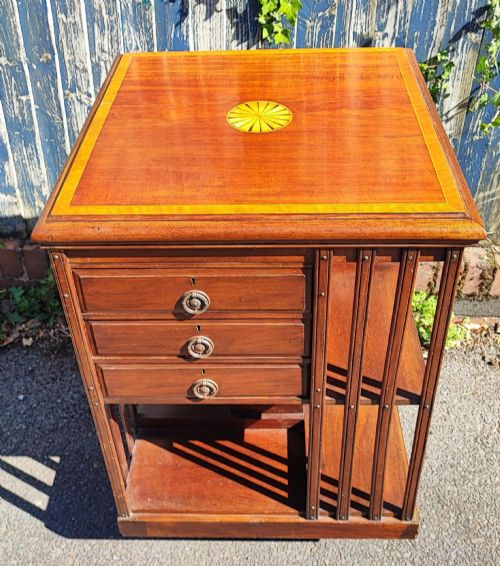
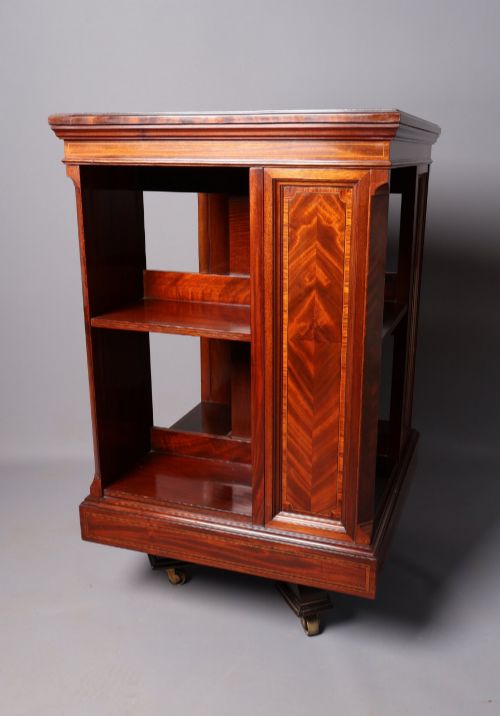
The construction typically relies on mahogany or flame mahogany, often embellished with satinwood, boxwood, or general wood inlay to create contrasting borders and decorative motifs. While standard revolving bookcases serve a purely utilitarian purpose, these inlaid examples bring a distinct decorative flair to studies and drawing rooms.
How they were made
Cabinetmakers built these revolving stands using solid timbers and veneers of mahogany, often selecting flame mahogany for the primary surfaces to create a figured grain pattern. Inlays of satinwood and boxwood were carefully hand-cut and fitted into recessed channels to form geometric lines, classic banding, or floral motifs.
Beneath the visible woodwork, an internal mechanism of iron or cast iron supports the turning action, allowing the loaded tiers to spin freely without friction. Brass components sometimes appear in the hardware or decorative mounts, while specific variants incorporate stone surfaces such as marble tops.
Listings for this phrase are dominated by Edwardian pieces, with occasional Victorian examples featuring brass inlay and marble tops.
What varies in quality
The distinction between standard pieces and the finest examples rests on the crispness of the timber selection and the precision of the inlay work. Flame mahogany with rich depth commands attention, while meticulously cut satinwood and boxwood stringing demonstrates superior cabinetmaking skill.
Mechanics also define the grade of the piece, as a smooth, silent rotation reveals careful alignment of the internal iron or cast iron pivot. Detail such as crossbanded borders and balanced proportions separate ordinary stands from exceptional creations.
Maple and Co
The Inlaid Rotating Bookcase Glossary
- Inlay
- A technique where contrasting materials are set into the surface of a base wood to form decorative patterns. This method defines the primary ornamentation on these rotating stands.
- Flame mahogany
- A highly figured timber cut from the branch junction of the mahogany tree, showing a distinctive flickering pattern. It appears frequently on the top surfaces of Edwardian bookcases.
- Satinwood
- A luminous yellowish timber used extensively for contrasting stringing and decorative panels. It provides a bright visual counterpoint to darker mahogany.
- Boxwood
- A dense, pale wood employed for fine stringing and delicate inlay work. Its pale tone allows for sharp definition against darker background veneers.
- Sheraton Revival
- A style popular in the Edwardian era that draws upon the lighter, classical furniture designs of the eighteenth century. Pieces in this manner often feature refined tapering forms and restrained inlay.
Inlaid Rotating Bookcase: Frequently Asked Questions
How do these rotating bookcases work?
These pieces operate on a concealed internal pivot mechanism, typically constructed from iron or cast iron, which allows the upper tiers to spin freely in either direction.
This design lets a reader access multiple shelves of books from a single seated position without needing to walk around the furniture.
What periods do these pieces come from?
The vast majority of these rotating stands originate from the Edwardian era and the late Victorian period, spanning the late nineteenth and early twentieth centuries.
During this time, cabinetmakers combined functional shelving with decorative wood inlay and rotating technology to serve domestic libraries and studies.
Where should I place a table top version?
Table top variants are designed to rest securely on larger pieces of furniture, such as side tables, desks, or chests of drawers.
They elevate a smaller collection of frequently referenced volumes within arm's reach while utilising vertical space efficiently.
What woods are commonly used?
Mahogany serves as the primary structural timber, often selected in figured varieties like flame mahogany to give the exterior panels natural movement and warmth.
Satinwood and boxwood are then introduced as contrasting inlay materials to form geometric borders and decorative highlights.