




Inlaid Rolltop Desk
An inlaid rolltop desk offers private workspace and intricate marquetry, pairing historical cabinet-making with functional surface design.
Inlaid Rolltop Desk
An inlaid rolltop desk combines a curved, sliding cylinder shutter with detailed surface ornamentation, providing a secure writing surface and hidden compartments. These pieces span multiple eras including the Georgian, Victorian, and Edwardian periods, as well as the Sheraton Revival style.
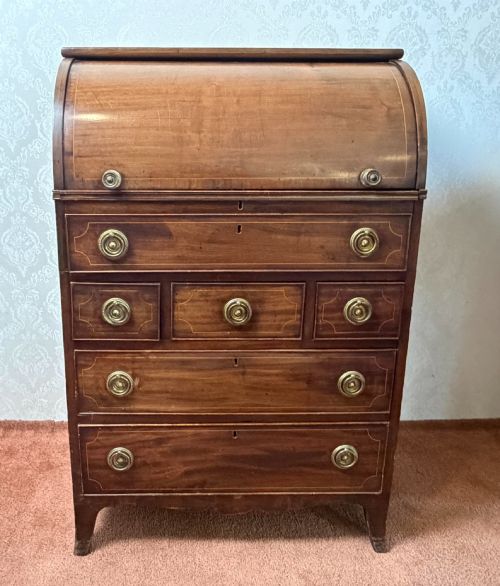
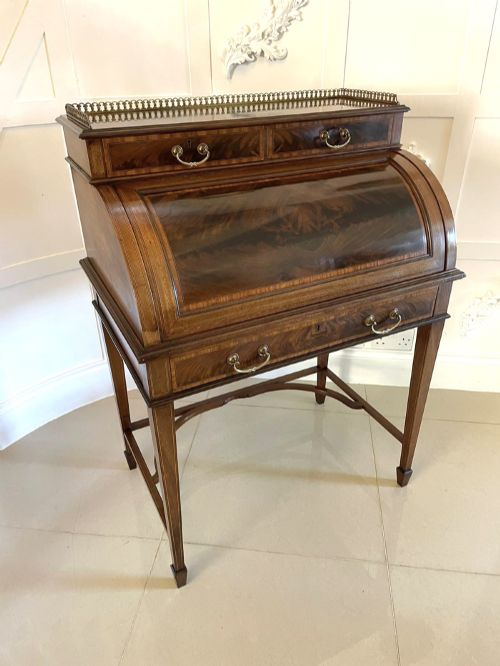
The versions most frequently encountered on this page are Edwardian and late Victorian mahogany cylinder desks, often accented with lighter wood inlays and standing on slender legs. Alongside these, distinct Dutch bombe fronted examples showcase elaborate floral marquetry.
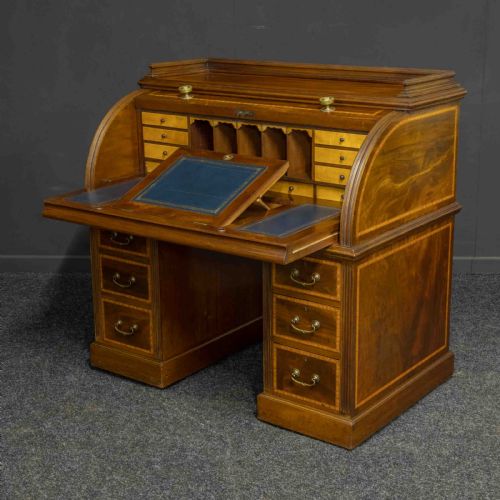
Cabinet forms vary from compact freestanding desks to larger bureau cabinets with fitted upper sections. The underlying structure typically manifests as a bureau or desk designed for domestic study use.
Materials and construction
Makers constructed these desks primarily from mahogany, walnut, and oak carcasses, applying finer veneers of satinwood and fruitwood for visible surfaces. Boxwood often provided contrasting stringing lines to outline panels and drawers.
Surface decoration relied on marquetry and floral inlay techniques, embedding contrasting timbers into the primary wood grain. Brass hardware such as escutcheons and handles completed the construction, alongside fitted leather writing surfaces.
Some cylinders roll away to reveal secret compartments hidden behind tiny decorative drawers.
Evaluating quality and execution
Quality rests upon the precision of the cabinet-making and the complexity of the wood selection. Finer pieces display seamless operation of the rolling cylinder mechanism and crisp, flush execution of the marquetry.
The choice of secondary woods and the depth of the floral or geometric inlay separate standard production from master workshops. Well-figured mahogany and carefully matched satinwood indicate higher standards of construction.
Maple & Co London
The Inlaid Rolltop Desk Glossary
- Rolltop desk
- A writing desk featuring a flexible tambour or solid cylinder shutter that slides backward to conceal the writing surface and pigeonholes. This mechanical cover provides security for correspondence.
- Marquetry
- Decorative veneer work formed by fitting together pieces of various woods, metals, or shells to create pictorial or floral patterns. Craftsmen apply this directly to the primary carcase.
- Cylinder desk
- A desk with a rounded, quarter-circle wooden shutter that rolls back into the body when opened, distinguishing it from flat-topped writing tables.
- Stringing
- Thin lines of contrasting wood inlay used to outline drawers, panels, and borders on cabinet furniture. It accentuates the structural geometry of the piece.
- Bombe
- A bulging, outward-curving swell on the front and sides of furniture typical of continental European design. This contour requires advanced woodworking skill.
Inlaid Rolltop Desk: Frequently Asked Questions
How do cylinder desks work?
A cylinder desk uses a curved wooden shutter that runs in recessed tracks to cover the interior pigeonholes and drawers. Pulling the writing flap forward or sliding the cylinder back reveals the fitted interior.
This mechanism conceals paperwork while keeping the writing materials organised and accessible within the desk body.
What is the difference between Edwardian and Georgian models?
Georgian models tend to feature heavier proportions, solid mahogany construction, and understated inlay work characteristic of eighteenth-century design. Edwardian pieces often display lighter framing, satinwood veneers, and Sheraton Revival influences.
These later Edwardian variants frequently incorporate refined stringing and smaller footprints suited to domestic interiors.
How should I care for the leather writing surface?
The leather writing insert requires gentle dusting and occasional conditioning with appropriate wax-free balms to prevent drying and cracking. Avoid using harsh chemical cleaners on the surrounding wood veneer.
Keep the desk away from direct sunlight and strong heat sources to protect both the leather and the underlying timber.
Are these desks suitable for daily use?
These pieces function well for modern writing and laptop use, provided the sliding cylinder mechanism is operated with care. The internal compartments remain practical for stationery and small items.
Routine use benefits from placing protective pads on the leather surface to prevent indentation from modern writing implements.