
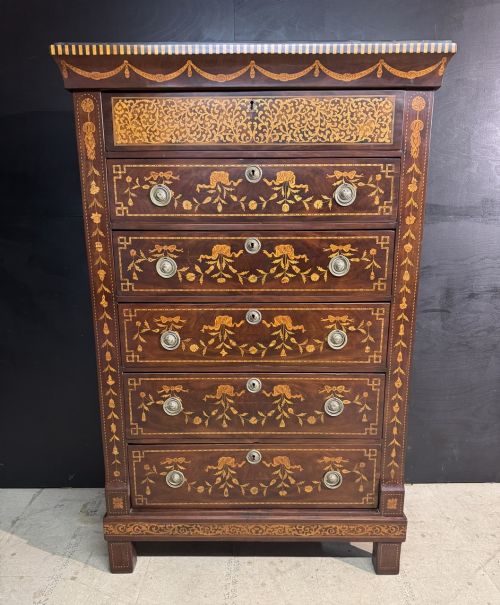


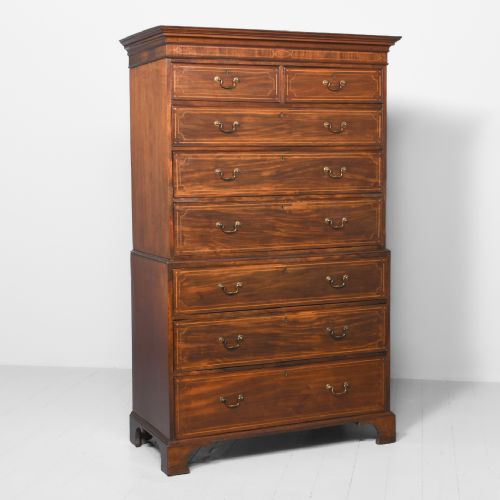


Inlaid Mahogany Highboy
These inlaid mahogany highboy examples are tall storage chests built in sections, bringing refined timber grain and crisp linear banding to any room.
Inlaid Mahogany Highboy
An inlaid mahogany highboy unites deep cabinet timbers with lighter contrasting stringing across eighteenth-century and nineteenth-century forms. The tall proportions stack multiple drawers within tallboy, chest on chest, and chest on stand formats.
Georgian and George III origins dominate the selection alongside American Federal and Dutch interpretations. Pieces arrive as golden, flame, or standard mahogany surfaces enriched by fruitwood, boxwood, and satinwood detailing.
Tall storage structures split horizontally into upper and lower carcases, resting either on bracket feet or elevated stands. Buyers frequently encounter tallboys and chests on chests bearing refined stringing and brass hardware.
How they were made
Cabinetmakers constructed these carcases using dense mahogany timber, frequently selecting flame grain veneers for primary drawer fronts and panel surfaces. Timber selection governed the visual rhythm of each tall elevation.
Craftsmen inlaid contrasting lines of boxwood, fruitwood, and satinwood into the primary surfaces to create geometric borders and panels. Marquetry techniques also surface on specific continental European interpretations within the selection.
Several chests on stand manage to look remarkably poised on their slender legs, despite holding enough cedar-scented drawers to swallow a winter wardrobe.
What varies in quality
The sophistication of the timber figure and the crispness of the inlay define the upper tier of these pieces. Select examples display carefully matched flame mahogany veneers paired with precisely executed satinwood and boxwood banding.
Proportional harmony between the upper and lower sections distinguishes finer cabinet work from simpler utilitarian storage. Original brass hardware and well-preserved structural framing elevate the standing of a piece within its period.
The Inlaid Mahogany Highboy Glossary
- Tallboy
- A tall chest of drawers constructed in two stacked sections, placing a smaller carcase atop a larger base. This form maximises vertical storage capacity whilst maintaining floor space.
- Chest on Stand
- A drawer chest raised upon an open frame or low stand with legs. This configuration lightens the visual weight of tall storage furniture.
- Line Inlay
- Narrow strips of contrasting timber inserted into shallow channels cut into the primary surface. It creates crisp linear borders around drawer fronts and panels.
- Flame Mahogany
- A veneer cut from timber where the branch meets the trunk, producing a rippling, flame-like grain pattern. Cabinetmakers reserved this decorative wood for prominent exterior surfaces.
- Satinwood
- A durable, light-yellow timber utilised for fine stringing and inlay work. Its pale tone contrasts sharply against dark mahogany.
Inlaid Mahogany Highboy: Frequently Asked Questions
What is an inlaid mahogany highboy?
An inlaid mahogany highboy is a tall, stacked chest of drawers featuring contrasting timber banding and decorative veneers. These pieces provide substantial vertical storage while displaying refined period cabinetmaking.
The selection spans eighteenth-century Georgian designs to nineteenth-century American Federal and Dutch interpretations. Each piece combines functional capacity with decorative marquetry or stringing.
How do tallboys differ from standard chests?
Tallboys are built in two separate sections placed one on top of the other, creating a much taller profile than a standard single-carcase chest of drawers. This stacked construction allowed easier transport of large furniture within homes.
Lower sections often incorporate drawer arrangements or rest upon distinct stands with legs. The resulting proportions give these storage pieces a commanding presence in a room.
What woods are used for the inlay?
Cabinetmakers utilised pale timbers such as boxwood, fruitwood, and satinwood to create sharp visual contrast against dark mahogany surfaces. These lighter woods were cut into thin strips for line inlay or shaped for geometric marquetry panels.
The quality of the inlay depends on the precision of the fit and the retention of natural colour variations over the centuries. Such details highlight the skill involved in the original construction.
How do I place a tallboy in a room?
Tallboys require adequate vertical clearance and benefit from being positioned against solid walls where their height anchors the room's proportions. Because these pieces are top-heavy by nature due to their stacked construction, stable placement on level flooring is essential.
Pairing them with low furniture balances the vertical lines of the interior. Adequate lighting nearby also helps reveal the grain patterns of the flame mahogany and the detail of the inlay.