
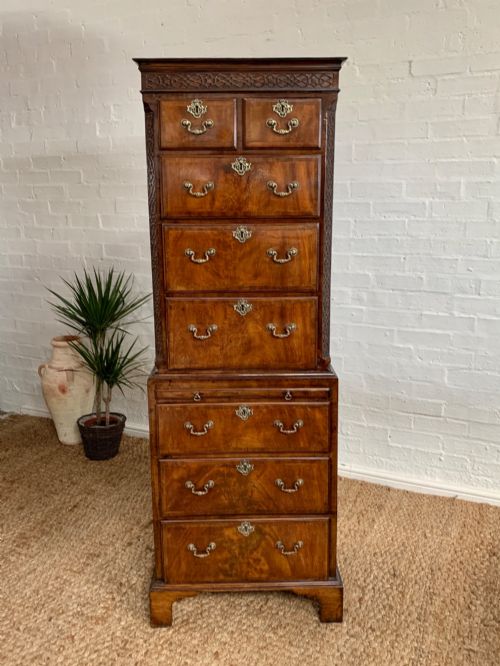


19th Century Highboy
A 19th century highboy brings vertical presence and stately storage to a room, offering multiple stacked drawers in rich mahogany, walnut, or burr walnut.
19th Century Highboy
A 19th century highboy takes the form of tall chests of drawers, tallboys, and chests on stand or chests on chest. These substantial pieces rise vertically to maximise storage whilst maintaining a narrow footprint in a room.
The pieces seen here span the 19th century, Victorian, and Regency periods, drawing on George III style, American Federal, Georgian, and Regency Egyptian Revival designs. English and American influences shape the forms, ranging from serpentine fronts to structured chests on stands.
Buyers meet variations including burr walnut tallboys, flame mahogany chests, and walnut tall chests of drawers. Boxwood inlay, ormolu mounts, and brass hardware frequently accent these tall case pieces.
How they were made
Cabinetmakers constructed these tall case pieces using solid timbers and choice veneers, applying flame mahogany, burr walnut, and standard walnut across the drawer fronts and carcasses. Boxwood inlay provided sharp linear contrast against the dark woods.
Metal mounts and hardware completed the construction, utilising brass handles and escutcheons alongside cast ormolu mounts on select Regency and neoclassical pieces.
Listings feature walnut, mahogany, burr walnut, and oak, often accented with boxwood inlay, brass, and ormolu mounts across the 19th century, Victorian, and Regency periods.
What varies in quality
The selection of timber veneer dictates much of the visual impact, with highly figured burr walnut and vibrant flame mahogany marking out the most ambitious workshops. Grain matching across stacked drawer tiers shows the hand of a skilled maker.
Decorative detailing ranges from simple bracket feet and restrained cockbeading to elaborate boxwood inlay and cast ormolu mounts. The precision of the joinery in tall stacked carcasses ensures the upper and lower sections align harmoniously.
The 19th Century Highboy Glossary
- Tallboy
- A tall chest of drawers made in two sections, typically stacking a smaller chest upon a larger base chest. This form provides generous storage within a compact floor area.
- Chest on stand
- A chest of drawers elevated on an open frame or low stand with legs. This configuration lightens the visual weight of tall case furniture.
- Flame mahogany
- A tropical hardwood veneer exhibiting a flickering, flame-like grain pattern. Cabinetmakers prized this cut for primary display surfaces.
- Burr walnut
- Timber taken from a walnut tree growth, showing intricate, swirling grain patterns. It serves as a decorative veneer on high-status case pieces.
- Ormolu
- Gilt bronze mounts applied for decorative effect on furniture. These accents appear on neoclassical and Regency pieces.
- Serpentine front
- A furniture front curved with a convex centre flanked by concave ends. This contour adds movement to tall chests.
19th Century Highboy: Frequently Asked Questions
Where did people place a highboy?
These tall chests of drawers found their natural home in bedrooms and dressing rooms where vertical storage was essential.
Their elevated profile allowed owners to store extensive wardrobes without occupying excessive floor space in smaller chambers.
How do tallboys differ from standard chests?
A tallboy stacks two distinct cabinet sections or incorporates many graduated tiers of drawers to reach a much greater height.
This vertical construction distinguishes them from lower, single-section chests of drawers intended for different wall spaces.
How should I care for mahogany surfaces?
Maintain the timber by keeping the piece away from direct sunlight and sudden temperature shifts that dry the wood.
Apply natural wax polish sparingly and buff gently with a soft cloth to preserve the sheen of the grain.
What distinguishes Regency pieces from Victorian ones?
Regency pieces often incorporate neoclassical motifs, architectural lines, and ormolu mounts inspired by classical antiquity.
Victorian examples tend toward heavier proportions and rich figured veneers like burr walnut without the same strict adherence to classical revival canons.