
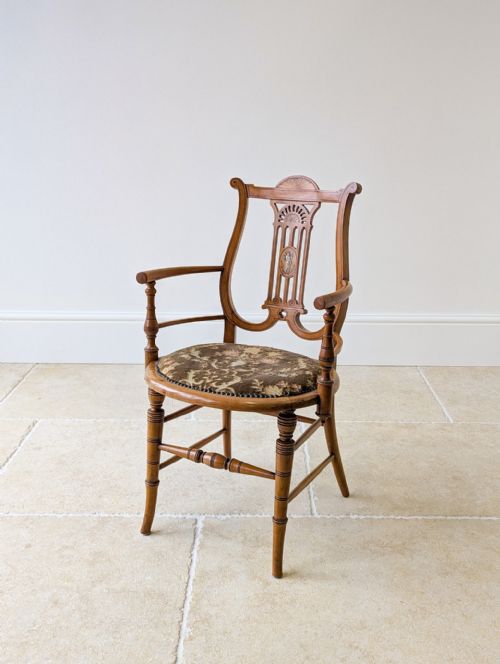


Inlaid Leg Armchair
These inlaid leg armchair examples combine structural timber and contrasting veneer work, offering sturdy seating with decorative panel detail.
Inlaid Leg Armchair
An inlaid leg armchair unites a supportive seating frame with contrasting wood or brass decorative motifs worked into the lower supports. Buyers examine these pieces for their combination of comfortable upholstery and refined surface decoration.
The selections span multiple eras including the Regency, Victorian, and Edwardian periods, alongside eighteenth-century Dutch examples. Mahogany and satinwood form the primary structural timbers across these various iterations.
Forms range from simple salon chairs to library elbow chairs, desk chairs, and carver chairs. Many incorporate marquetry or fruitwood inlay to accent the legs and backrests.
Materials and construction methods
Cabinetmakers constructed the frames using solid timbers such as mahogany and fruitwood, selected for their density and stability. Craftsmen then shaped the legs and arms by hand before applying decorative veneers.
Inlay work involved cutting precise recesses into the primary wood to receive contrasting pieces of satinwood or brass. Artisans finished the surfaces with traditional polish to highlight the grain and secure the inlaid details.
Listings feature mahogany and satinwood timbers across nineteenth and twentieth-century periods.
Markers of quality and execution
Quality rests upon the precision of the inlay work and the tightness of the timber joints. Crisp junctions between the contrasting woods and the base timber indicate superior workshop practice.
The fluidity of the carved elements and the preservation of the original surface patination distinguish finer examples from standard production. Well-executed marquetry retains sharp edges without gaps around the perimeter of the design.
Howard & Son's·Henry Maxwell·William Morris
The Inlaid Leg Armchair Glossary
- Inlay
- A decorative technique where small pieces of contrasting material are set into the surface of a base timber. This method creates flat ornamental patterns across legs and back panels.
- Marquetry
- An elaborate form of inlay that forms pictorial or geometric designs using various coloured wood veneers. Craftsmen assemble these veneers like puzzles before pressing them onto the furniture frame.
- Elbow Chair
- A traditional term for an armchair featuring open wooden arms designed to support the sitter's elbows. These chairs frequently serve as dining carvers or desk seating.
- Satinwood
- A hard, durable tropical timber with a natural golden sheen and smooth grain. Cabinetmakers favored it during the Sheraton Revival and Edwardian periods for contrasting inlay work.
Inlaid Leg Armchair: Frequently Asked Questions
What is an inlaid leg armchair?
An inlaid leg armchair is a seating piece featuring decorative wood or metal veneer insertions along the lower structural supports. These chairs combine utilitarian seating with ornamental surface detailing from various historical periods.
Craftsmen utilised materials like satinwood, brass, and fruitwood to create contrast against primary timbers such as mahogany. They appear in forms ranging from library chairs to dining carvers.
How do I date an inlaid armchair?
Dating relies on examining the timber species, construction joints, and the specific style of the inlay work. Edwardian and Sheraton Revival pieces often display lighter satinwood veneer, while Regency examples favor brass stringing.
Archive records and stylistic markers help narrow the period down from eighteenth-century Dutch marquetry to the early twentieth century. Secondary woods inside the frame also provide clues to the manufacturing era.
Where were these armchairs used?
Historically, these chairs served multiple domestic functions in drawing rooms, libraries, and formal dining spaces. Desk chairs and carver chairs provided comfortable seating for specific household tasks.
Salon armchairs were positioned for entertaining, while library variants offered upholstered support for extended periods of reading. Their decorative legs suited visible placement in principal rooms.
How do I care for wood inlay?
Wood inlay requires stable indoor humidity levels to prevent the veneer from lifting or shrinking away from the base timber. Regular dusting with a dry cloth maintains the surface without introducing moisture.
Harsh chemical cleaners can damage traditional finishes and loosen the adhesive holding the inlay in place. Applying microcrystalline wax periodically helps protect the timber and retain the natural sheen.