




Inlaid Half Moon Table
These inlaid half moon table pieces bring graceful semicircular form and fine period marquetry directly into a room.
Inlaid Half Moon Table
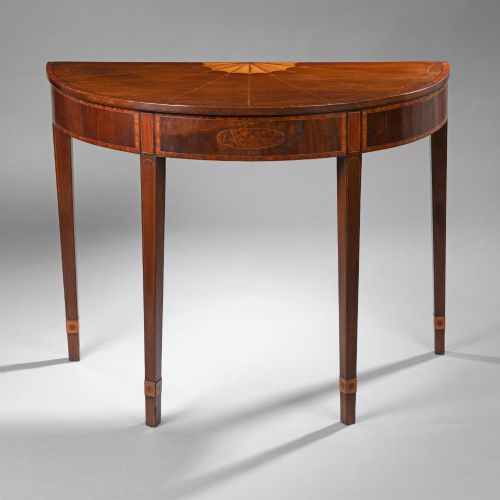
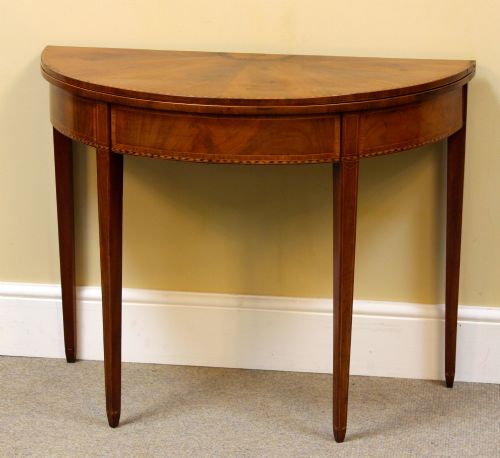
An inlaid half moon table takes the form of a semicircular console, card, or tea table designed to sit flat against a wall. When searching for this furniture, a buyer encounters Georgian and George III originals alongside Edwardian and later revivals.
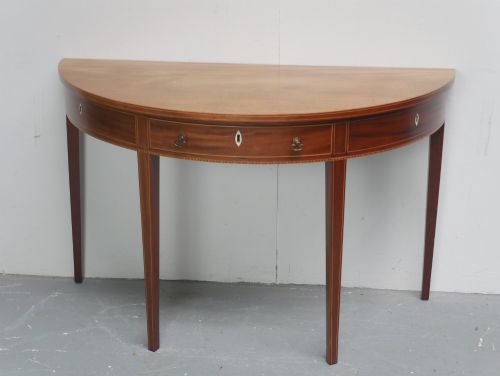
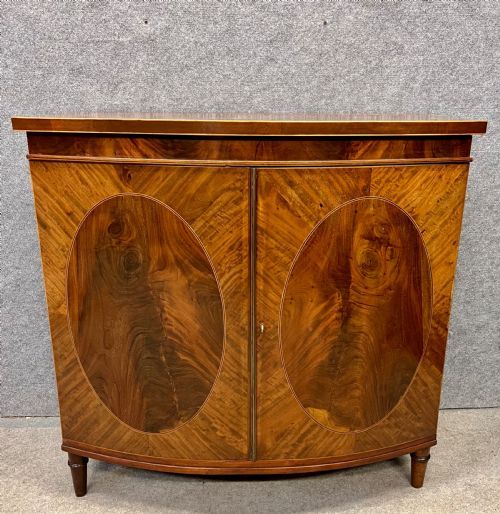
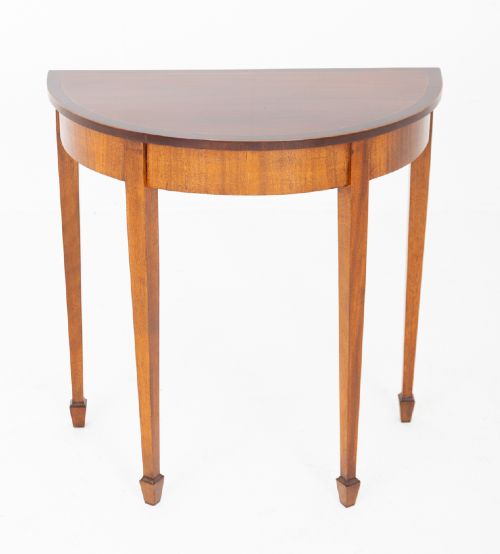
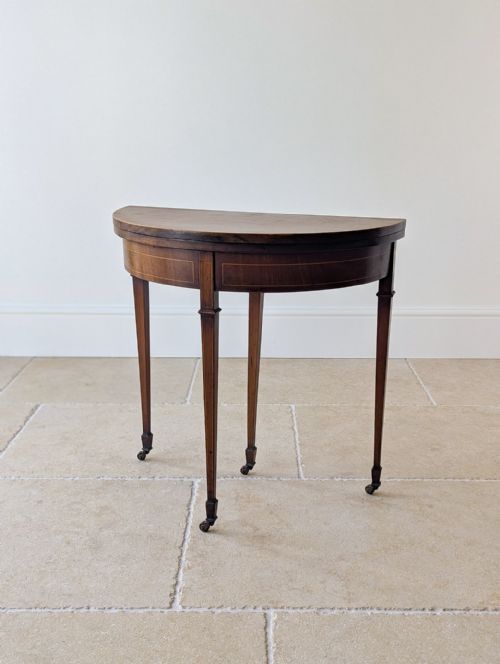
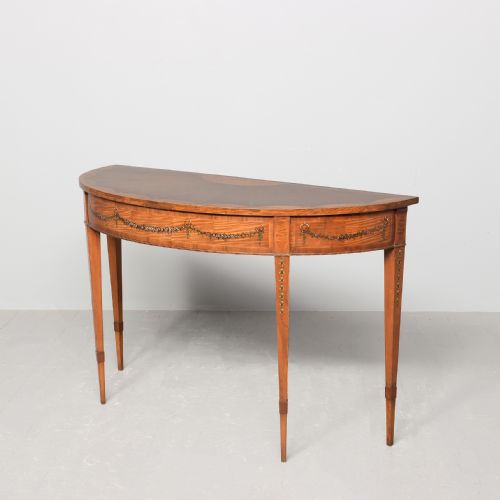
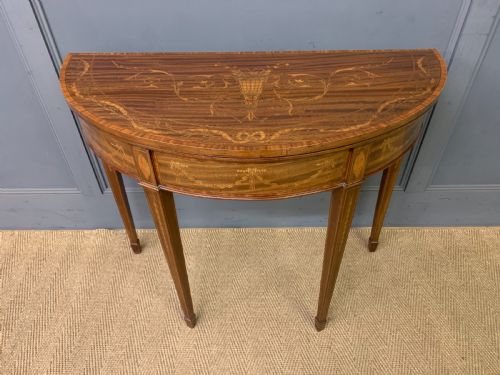
The pieces on this page appear as fold-over card tables, tea tables, side cabinets, and console tables. Mahogany forms the primary structural timber, often enriched with satinwood, rosewood, and fruitwood.
Georgian examples show crisp neoclassical proportions, while Edwardian and Sheraton Revival pieces utilise lighter satinwood inlay and delicate crossbanding. The half moon silhouette serves hallways and drawing rooms without protruding far into the floor space.
Materials and construction
Cabinetmakers built these tables using solid mahogany or fruitwood frames, applying fine veneers of satinwood and rosewood to the curved tabletops. Boxwood inlay creates crisp linear stringing and geometric borders around the perimeter.
Marquetry inlay depicts floral motifs and neoclassical urns, cut from contrasting timber veneers and set directly into the primary surface. Fold-over mechanisms on card and tea tables rely on hinged leaves supported by pivoting rear legs.
Listings feature mahogany, satinwood, and rosewood timbers decorated with boxwood inlay and marquetry.
Judging quality and execution
Quality rests in the precision of the boxwood inlay and the integration of the marquetry across the curved surface. Superior examples maintain tight veneer joints and crisp hand-cut stringing that follows the semicircular radius without buckling.
The choice of timbers dictates the visual depth, with dense mahogany bases paired with finely figured satinwood and rosewood. Maker attribution and the crispness of neoclassical carving elevate specific console and card tables above standard production.
Edward and Roberts·Pietro Ferrario
The Inlaid Half Moon Table Glossary
- Demi-lune
- A French term meaning half-moon, describing any semicircular table or cabinet designed to stand against a wall.
- Marquetry
- Decorative patterns formed by fitting together thin slices of various coloured wood veneers onto a structural surface.
- Crossbanding
- A border of veneer laid around the edge of a tabletop with the grain running perpendicular to the central panel.
- Stringing
- Thin lines of contrasting wood inlay used to outline drawers, borders, and tabletops.
- Console table
- A wall-mounted or freestanding table supported by front legs, designed primarily for decorative display.
Inlaid Half Moon Table: Frequently Asked Questions
Where should I place a demi-lune table?
These semicircular tables fit naturally into narrow hallways, entryways, and reception rooms where floor space is limited. Their flat backs sit flush against the wall while providing a useful surface for lamps or decorative objects.
Fold-over variants can also stand against a living room wall until needed as a card or tea table for guests.
How do I use a fold-over card table?
The hinged top unfolds to double its surface area, revealing a baize or polished wood interior intended for traditional card games. Pivoting rear legs swing out from the frame to support the opened leaf securely.
When closed, the table returns to its compact half-moon shape against the wall.
How do I tell an 18th century table from a revival piece?
Georgian and 18th century pieces exhibit authentic timber oxidation, hand-cut joinery, and natural wear patterns accumulated over centuries of use. Edwardian and Sheraton Revival examples from the late nineteenth and early twentieth centuries often feature brighter satinwood and machine-cut stringing.
Examining the underside and secondary woods clarifies the manufacturing period.