

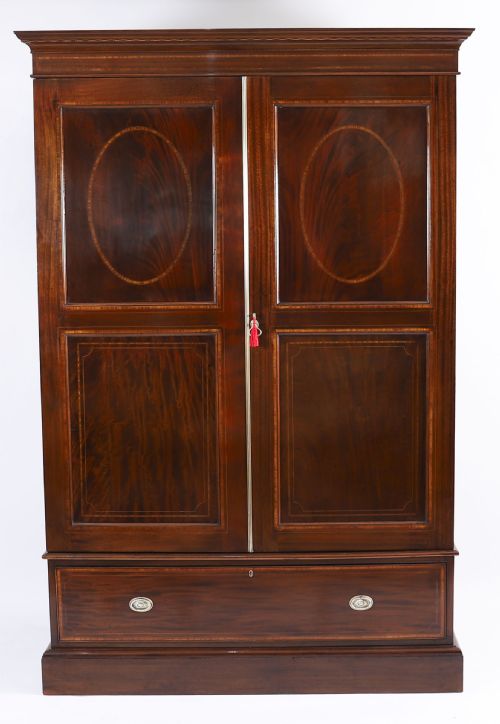
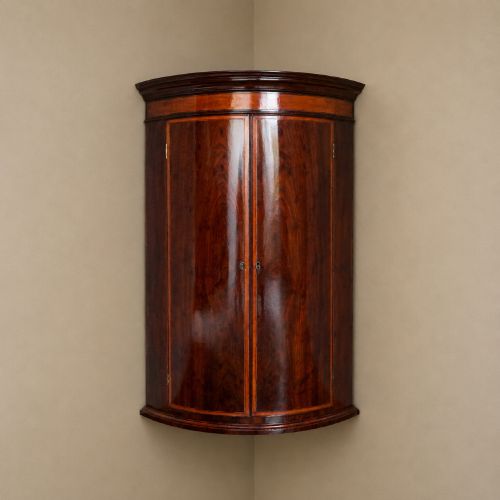


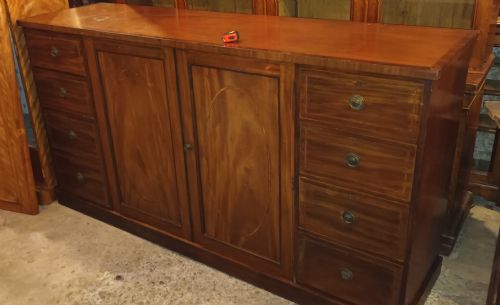


Inlaid George III Wardrobe
An inlaid george iii wardrobe combines architectural presence with fine cabinet-making, offering generous storage through fitted trays and hanging space.
Inlaid George III Wardrobe
Buyers seeking an inlaid george iii wardrobe encounter substantial case furniture originating primarily from the Georgian period, alongside later revival interpretations from the nineteenth century. These pieces commonly manifest as linen presses, gentleman's presses, and traditional wardrobes, often combining upper cupboard sections with lower drawer configurations.
The domestic forms appearing in this category span bow front hanging corner cabinets, dwarf cupboards, and impressive breakfront armoires topped with swan-neck pediments. Walnut, flame mahogany, and plain mahogany serve as the primary foundational timbers for these substantial storage items.
Surviving examples reflect a range of production dates, from eighteenth-century originals to late Victorian revivals marked by characteristic stringing and banding. The layout typically balances deep internal storage trays with lower chest space, serving the original purpose of linen and garment preservation.
Materials and construction methods
Makers utilised solid and veneered mahogany, frequently selecting highly figured flame mahogany and warm walnut to cover large structural surfaces. Secondary framing timbers such as oak provide the robust internal skeleton required for heavy linen presses and wardrobes.
Surface enrichment relies on contrasting timber inlays, specifically boxwood and satinwood, worked into delicate stringing, banding, and marquetry panels. Heavy brass hardware, including escutcheons and handles, secures the doors and drawers while punctuating the dark timber grain.
Inlaid George III Wardrobe Retail Price Guide 2026
Typical asking prices for inlaid george iii wardrobe among the pieces listed under this phrase on Sellingantiques today, from the lower quarter to the upper quarter. They describe what is for sale here now, not the wider market.
Channel Islands workshops occasionally contributed distinctive regional variations to the standard English linen press form.
Distinctions in craftsmanship
The grade of an inlaid george iii wardrobe rests upon the selection of timber veneers and the precision of the contrasting inlay work. Finer examples display symmetrical flame mahogany figures matched across door panels, flanked by crisp boxwood and satinwood banding rather than simple painted lines.
Structural integrity and the retention of original interior fittings, such as sliding linen trays and brass hanging fixtures, separate standard utility pieces from master-built furniture. The subtlety of the carving around cornices and the crispness of the joinery further define the upper tier of these items.
The Inlaid George III Wardrobe Glossary
- Linen Press
- A tall case piece featuring upper doors enclosing sliding trays for folded textiles, mounted over a chest of lower drawers. This form dominated elite dressing rooms before full-length hanging wardrobes became standard.
- Satinwood
- A dense, light-coloured tropical timber utilised for contrasting crossbanding and decorative marquetry panels. Its lustrous grain catches the light effectively against darker primary woods.
- Boxwood Inlay
- Narrow strips of pale boxwood embedded into channels cut into the carcase surface to create geometric borders and stringing lines. This technique defines the crisp linear decoration of the Sheraton style.
- Flame Mahogany
- Timber cut from the fork of the mahogany tree to reveal a rippling, feather-like grain pattern. Cabinet-makers reserved these prized veneers for the most prominent surfaces.
- Swan-neck Pediment
- A broken arch pediment curving upwards to terminate in inward-scrolling volutes, often centred on a decorative plinth. This architectural feature crowns the tallest eighteenth-century presses.
- Gentleman's Press
- A specialised storage cabinet designed for male attire, combining shirt slides, drawers, and hanging space. These pieces reflect the formal dressing requirements of the Georgian period.
Inlaid George III Wardrobe: Frequently Asked Questions
What is a linen press?
A linen press is a tall storage cabinet designed with upper doors that enclose sliding wooden trays for folded garments and household textiles. These internal trays predated the widespread use of full-length vertical clothes hangers in domestic interiors.
The lower section typically incorporates a chest of drawers, creating a hybrid piece of furniture that offers both shelf and drawer storage within a single architectural facade.
How do I spot a revival piece?
Nineteenth-century revival pieces often exhibit timber choices, internal construction details, and secondary woods that differ subtly from eighteenth-century standards. Cabinet-makers working during the Victorian era adopted earlier styles while utilising machine-sawn veneers and different locking mechanisms.
Examining the backboards, interior drawer linings, and the crispness of the boxwood inlay helps distinguish a later interpretation from an original Georgian artefact.
How were these wardrobes used?
These large case pieces served as the primary storage units for household linens, shirts, and garments in wealthy domestic settings. The sliding trays kept folded textiles flat and accessible in an era before modern closet spaces existed within bedroom architecture.
Over subsequent generations, many of these presses underwent internal conversion to accommodate vertical clothes rails while retaining their traditional external appearance.
What distinguishes Sheraton design?
Sheraton style furniture is characterised by restrained neoclassical geometry, straight tapering legs, and contrasting satinwood or boxwood stringing. This design ethos favoured light, elegant proportions over the heavier carved ornament of earlier decades.
On these wardrobes, the influence appears in precise geometric banding around drawer fronts and rectangular panels that frame the figured mahogany.