




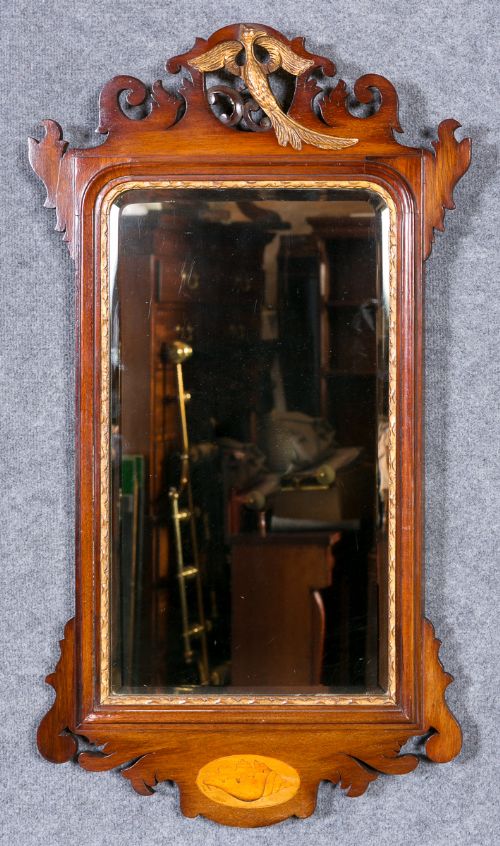
Inlaid Fretwork Mirror
An inlaid fretwork mirror brings crisp fret-cut silhouettes and warm timber tones to a wall, offering the geometric precision of revival craftsmanship.
Inlaid Fretwork Mirror
When you search for an inlaid fretwork mirror, you encounter wall-hanging pieces defined by pierced wooden frames and contrasting veneer details. These decorative looking glasses span the Victorian and Edwardian eras, alongside revival pieces drawing on earlier Georgian forms. The common thread is a fret-cut outline combined with marquetry or stringing.
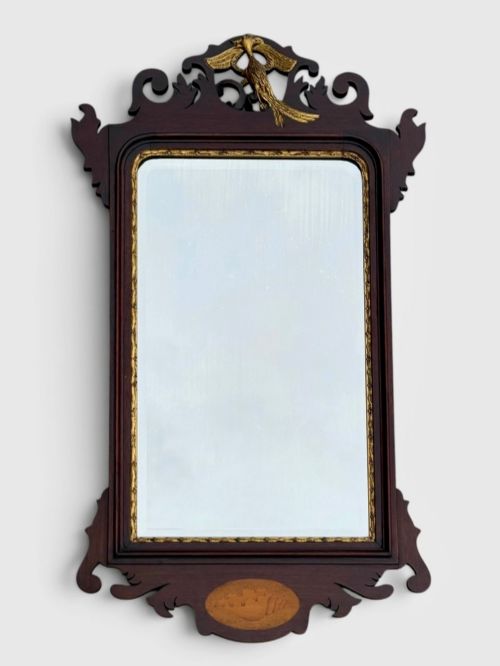
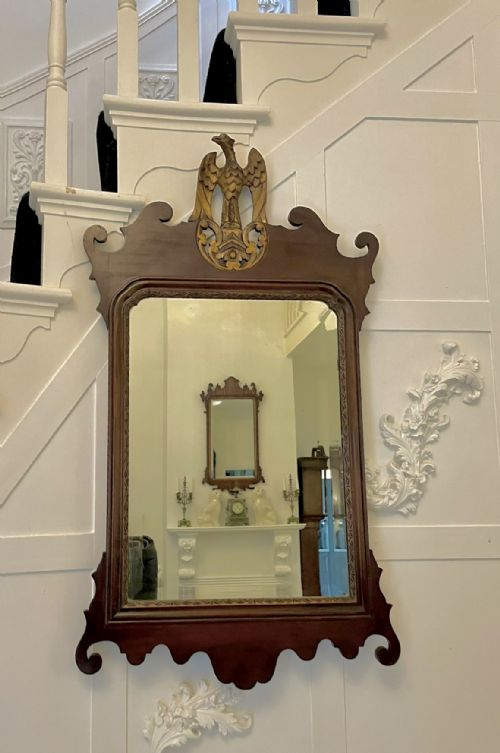
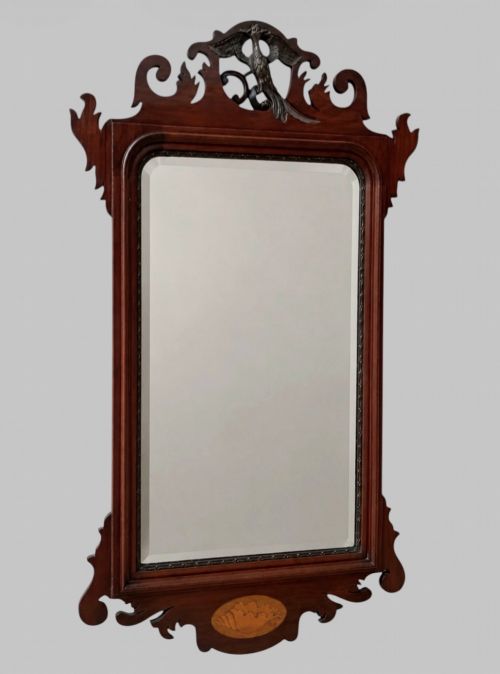
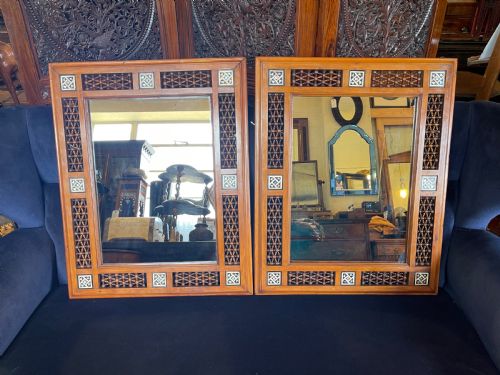
On this page, the pieces you meet most often take the form of Edwardian or late Victorian mahogany and walnut wall mirrors. Many follow Chippendale or George II revival styles, occasionally featuring traditional carved motifs such as ho ho birds or gilt accents. Alongside standard wall mirrors, the selection includes related timber wall furniture and occasional pairs.
Materials and construction
The makers of these mirrors relied primarily on dense hardwoods like mahogany and walnut, frequently enhanced by fine veneers and contrasting string inlay. Frames were shaped using fret-cutting techniques to create intricate pierced scrolls and borders around the glass plate. Gilding and parcel-gilding often highlighted specific carved sections, such as crests and inner mouldings.
Glass plates vary between simple bevelled mirrors and older sheet glass, held within rebated timber frames backed by protective wooden panels. Brass hanging loops and fixings secured the structure for wall display, while marquetry panels introduced floral or geometric motifs directly into the wooden surround.
Listings feature mahogany, walnut, rosewood, and giltwood frames spanning the Victorian and Edwardian eras, alongside Anglo-Indian brass inlaid pieces.
Distinctions in quality
Quality in an inlaid fretwork mirror lies in the crispness of the pierced fretwork and the precision of the timber joints. Finer examples show sharp internal corners and clean scrollwork without splintering or clumsy repairs to the delicate fret arms. The integration of the inlay work, whether simple stringing or complex marquetry, demonstrates the maker's hand.
The choice of timber grain and the depth of the finish also separate standard production from superior pieces. Well-figured mahogany or burr walnut provides a rich background for the inlaid details, whilst original bevelled mirror glass adds clarity and depth to the overall composition.
The Inlaid Fretwork Mirror Glossary
- Fretwork
- Ornamental pattern work pierced through thin wood using a fretsaw. This technique creates the light, intricate silhouettes characteristic of the style.
- Marquetry
- Decorative veneer work forming pictures or patterns by assembling different coloured pieces of wood. It provides the detailed surface decoration seen on the frames.
- Pier Glass
- A tall, narrow mirror designed to hang on the wall between windows. These pieces often feature detailed fretwork crests and gilt highlights.
- Stringing
- Thin lines of contrasting wood inlaid into grooves in the primary timber. This linear detail defines the outer and inner borders of the frame.
- Ho Ho Bird
- A stylized phoenix motif frequently carved onto the crests of mid-eighteenth-century revival mirrors. It forms a traditional focal point at the top of the frame.
Inlaid Fretwork Mirror: Frequently Asked Questions
How do I hang a fretwork mirror safely?
These frames are often delicate due to their pierced wooden construction, so they require secure wall fixings distributed evenly. Use professional mirror plates or appropriate picture wire attached to the structural timber backing rather than the fretwork itself.
Ensure the wall anchor matches the weight of the hardwood frame and glass plate. Checking the stability of the joints before hanging prevents undue stress on the antique timber.
Are these mirrors genuinely eighteenth century?
The majority of pieces found in this category date from the Victorian and Edwardian periods, or the late nineteenth century. Makers during these decades frequently produced revival pieces inspired by Georgian and Chippendale designs.
Examining the construction methods, timber backing, and condition of the glass helps determine the exact period. Revival pieces offer the aesthetic of earlier eras with the manufacturing standards of the late nineteenth and early twentieth centuries.
What is the difference between an Edwardian and a Victorian mirror?
Victorian examples often lean towards heavier proportions and deep walnut or mahogany tones, sometimes incorporating revival styles like George II or heavy fretwork. Edwardian pieces can exhibit lighter framing, refined string inlay, and occasionally gilt highlights.
Both periods drew heavily on eighteenth-century design vocabulary, but Edwardian workshops often favoured a cleaner, brighter finish on the wood. Examining the secondary timbers and backboards helps distinguish between the two eras.
How should I clean the wood and glass?
Maintain the timber frame with a soft, dry cloth to remove dust from the intricate fretwork crevices. Avoid modern liquid polishes that can build up in the recessed inlay and soften the antique finish.
Clean the mirror glass sparingly using a cloth dampened slightly with water or a mild glass cleaner, taking care not to let moisture seep behind the silvering or into the wooden frame joints.