


Inlaid Corner Armchair
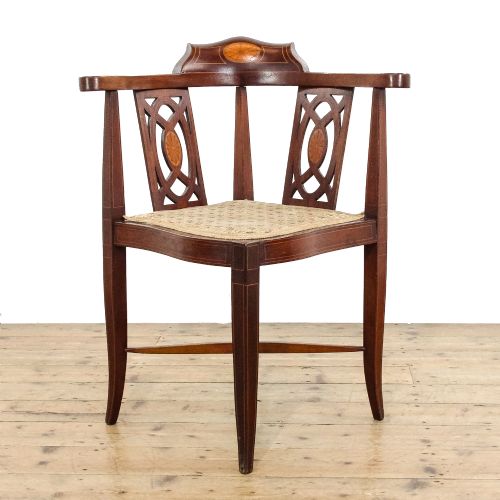
These inlaid corner armchair examples combine dense architectural timberwork with decorative surface ornament, offering a compact seating option designed for the angles of a room.
Inlaid Corner Armchair
When you search for an inlaid corner armchair, you encounter seating designed specifically to fit into room angles while providing a supportive backrest across the diagonal. The evidence shows these pieces surface frequently from the Edwardian period and the late nineteenth century, often constructed as mahogany corner chairs or salon seating.
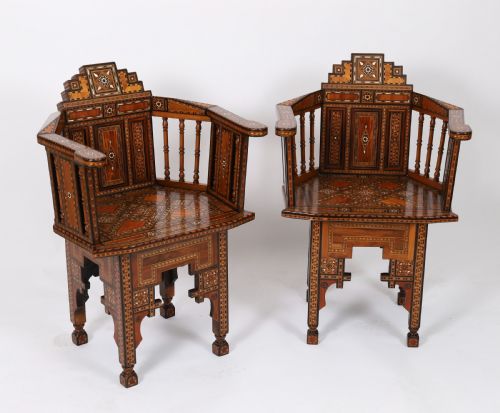
Many examples take the form of tub chairs or occasional chairs, incorporating curved backs supported by multiple spindles. Variants span different cultural styles, ranging from Sheraton Revival mahogany models to Moorish Revival, Levantine, and Anglo-Moorish items featuring intricate geometric parquetry.
The selection ranges from standard parlour seating to pairs and sets, reflecting the diverse domestic settings these chairs originally inhabited. Their defining characteristic remains the angled seat plan coupled with decorative surface embellishment.
Materials and Methods of Construction
Makers relied primarily on mahogany and walnut as the foundational timbers for framing these chairs, supplemented occasionally by rosewood and Syrian hardwood. These woods provided the structural integrity needed for the sweeping curved rails and load-bearing corner posts.
Decoration relied heavily on contrasting elements, utilising satinwood, boxwood, mother-of-pearl, and bone for detailed wood inlay and marquetry patterns. Specific regional pieces integrated carved wooden panels such as Mashrabiya work to achieve intricate geometric screens.
Some corner chairs double as intellectual observation posts, offering a commanding view of the entire room while keeping your back securely to the wall.
Distinctions in Execution and Detail
Quality separates simple production items from superior pieces through the precision and variety of the materials embedded in the frame. Finer examples display meticulous marquetry using diverse elements like mother-of-pearl, bone, and contrasting light woods rather than simple painted lines.
Structural rigidity and the crispness of carved details, such as turned spindles or pierced panels, dictate the standard of the piece. Well-preserved joinery in the complex angled joints ensures the chair remains stable during daily use.
Liberty and Co
The Inlaid Corner Armchair Glossary
- Corner Chair
- A seat designed with a diagonal orientation to fit snugly into the corner of a room, typically featuring a continuous curved backrest supported on turned columns.
- Marquetry
- The art of applying pieces of veneer to a structure to form decorative patterns, utilising materials like satinwood, boxwood, and bone.
- Mashrabiya
- An architectural element of projecting oriel windows enclosed by carved wood lattice-work, occasionally found incorporated into imported regional seating.
- Parquetry
- Geometric mosaic woodwork used for patterned surfaces, commonly seen on Levantine and Syrian pieces.
- Tub Chair
- An armchair with a circular or curved back that envelops the sitter, often integrated into corner chair designs from the Edwardian era.
Inlaid Corner Armchair: Frequently Asked Questions
Where did people place these chairs?
These chairs were typically positioned in corners or used as occasional salon seating where space economy was valued.
Their diagonal design allowed them to occupy room angles that standard rectangular furniture could not easily fill.
How do I identify an Edwardian example?
Edwardian pieces generally feature lighter mahogany frames combined with delicate satinwood or boxwood inlay work.
They reflect the revival styles popular around the turn of the twentieth century, favouring lighter proportions than earlier Victorian furniture.
What is the difference between marquetry and inlay?
Inlay involves inserting contrasting materials into depressions carved directly into the solid wood base of the chair.
Marquetry employs assembled sheets of veneer applied to the surface to create pictorial or geometric designs.
Are these chairs suitable for daily seating?
While structurally sound when properly maintained, many of these pieces function best as accent or occasional furniture.
Their intricate joinery and delicate surface embellishments require careful handling compared to modern utilitarian seating.