
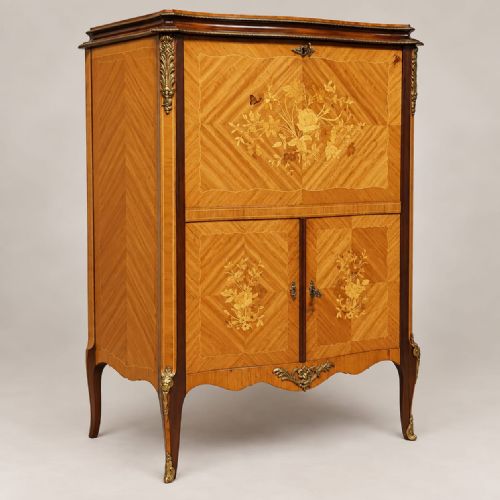
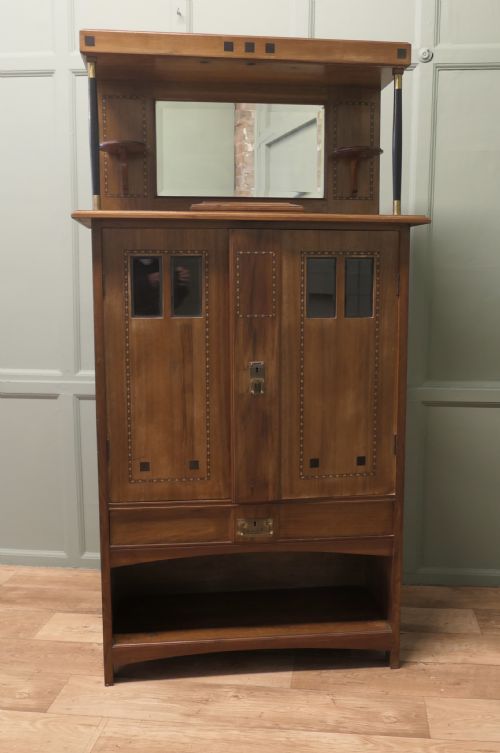
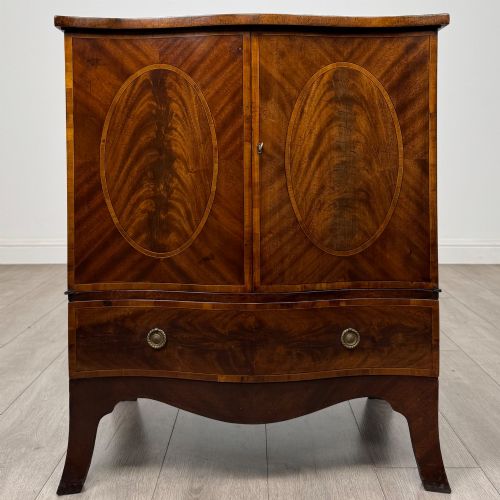
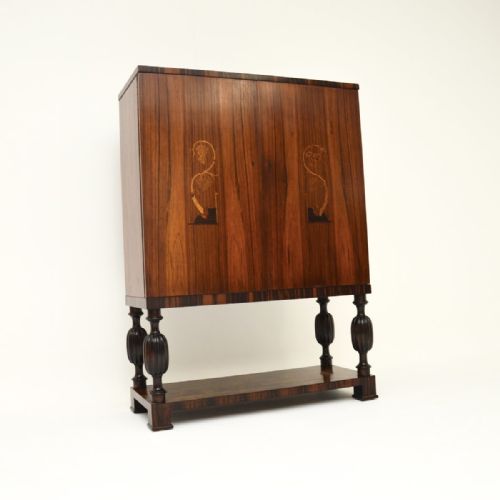
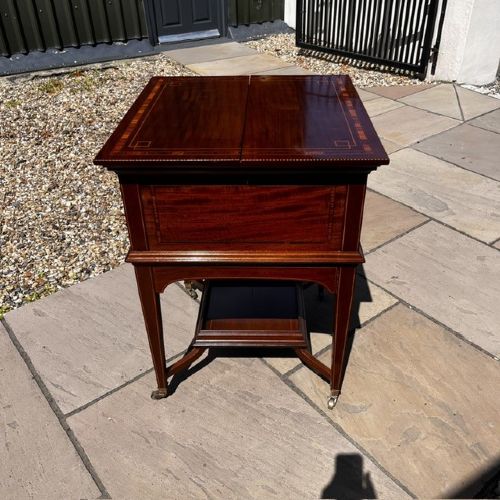
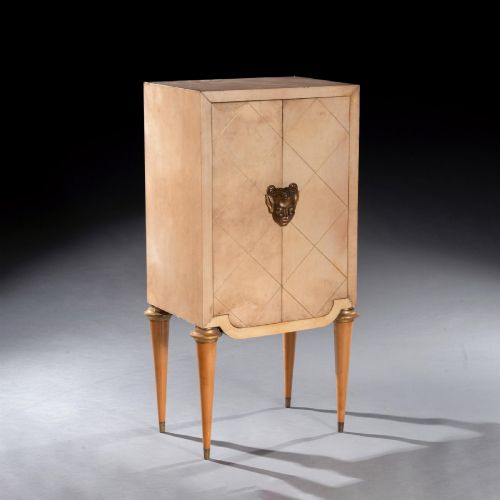


Inlaid Cocktail Cabinet
An inlaid cocktail cabinet brings serious presence to a room, combining clever storage for glassware with exceptional decorative woodwork.
Inlaid Cocktail Cabinet
An inlaid cocktail cabinet is a specialised piece designed for hosting, appearing across periods from the Regency era through to the 1940s. These pieces function as drinks cabinets, side cabinets, and cocktail cabinets, offering fitted interior spaces for bottles and glasses.
The version most commonly met on this page combines a wooden carcase with marquetry, stringing, or parquetry decoration. They emerge in styles ranging from Art Deco and Secessionist to Louis XV Revival, Louis XVI Revival, and Georgian Revival.
Makers and workshops construct these items in forms such as serpentine fronts, bow fronts, and cabinets on stands. The structural shapes vary from compact proportions to larger display pieces suited to formal reception rooms.
How they were made
Cabinet makers construct the carcases using timbers such as walnut, mahogany, oak, rosewood, and kingwood. Surfaces receive intricate marquetry or contrasting stringing in satinwood and other decorative woods.
Interiors often incorporate mirror glass to reflect light and bottles. Mounts and hardware cast in brass and ormolu provide structural accents and decorative hinges or handles.
Specialised examples integrate parchment or soapstone inlay alongside traditional lacquered finishes. Joinery methods adapt to the specific era, supporting curved serpentine fronts and bow-fronted designs.
Periods represented across the inventory span from the Regency era and Edwardian times through to 1930s Art Deco and Secessionist designs.
What varies in quality
The refinement of the marquetry and the precision of the timber matching separate standard examples from finer works. Master craftsmen select veneers that create harmonious grain patterns across curved serpentine or bow fronts.
Interior execution and the integration of specialised mechanisms, such as surprise opening actions or fitted glass shelving, mark the upper tier of production. The quality of cast ormolu and brass mounts further distinguishes individual pieces.
The integrity of the structural carcase and the condition of original mirror glass and internal fittings influence the overall standard. Pieces bearing attribution to known makers or distinctive design movements carry notable distinction.
Maurice Jallot·Epstein
The Inlaid Cocktail Cabinet Glossary
- Marquetry
- Decorative patterns formed by the insertion of pieces of veneer into a master wood structure. This technique allows for elaborate pictorial or geometric designs across cabinet doors.
- Serpentine front
- A furniture shape featuring a double-curved front that bulges outward in the centre and concaves inward at the sides. This profile requires high skill in woodworking and veneer application.
- Ormolu
- Gilded bronze mounted onto furniture as decorative feet, handles, or corner accents. The technique involves applying a mercury and gold amalgam to bronze.
- Secessionist
- A stylistic movement focusing on simplified geometric forms and rejection of historical excess. Pieces from this tradition favour clean lines alongside controlled inlay.
- Stringing
- Thin lines of contrasting wood inlaid into grooves on the surface of a cabinet. It creates delicate borders around drawer fronts and panel edges.
Inlaid Cocktail Cabinet: Frequently Asked Questions
What is an inlaid cocktail cabinet?
An inlaid cocktail cabinet is a dedicated piece of furniture designed to store and serve drinks, featuring decorative wood veneers or contrasting stringing. These pieces incorporate fitted interiors for glassware and bottles.
They appear across various periods, including Edwardian, Art Deco, and mid-century styles, combining practical hosting functions with high decorative artistry.
How were these cabinets used?
These cabinets served as the centrepiece for entertaining guests during the home cocktail hour, keeping bottles, shakers, and glassware concealed behind decorative doors. Drop-down flaps often doubled as mixing surfaces.
Owners placed them in reception rooms, drawing rooms, or dining spaces where hospitality took place.
How do I date an inlaid cocktail cabinet?
Dating relies on identifying the underlying style, timber choices, and construction methods. Edwardian and 1900 examples frequently utilise mahogany with delicate stringing, while 1930 Art Deco versions lean towards walnut, parchment, and geometric marquetry.
Hardware details and interior mirror glass configurations also provide strong chronological indicators.