

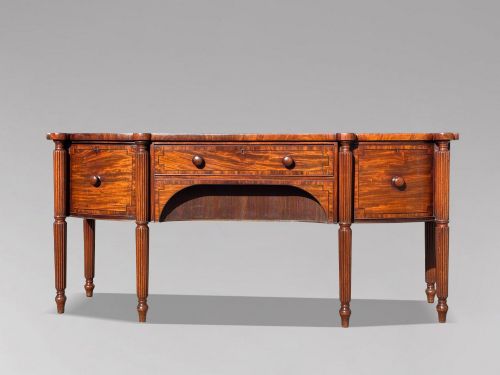
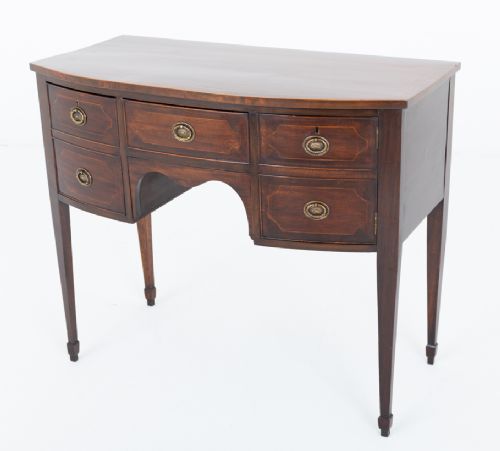
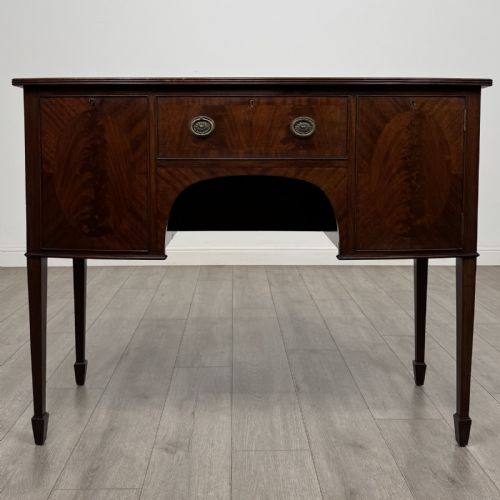
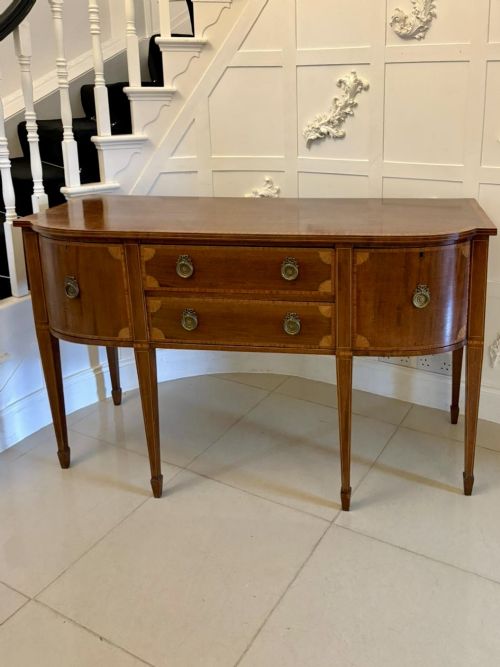

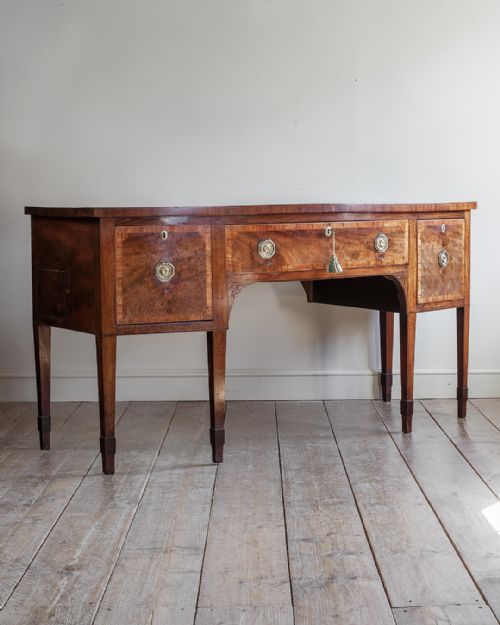
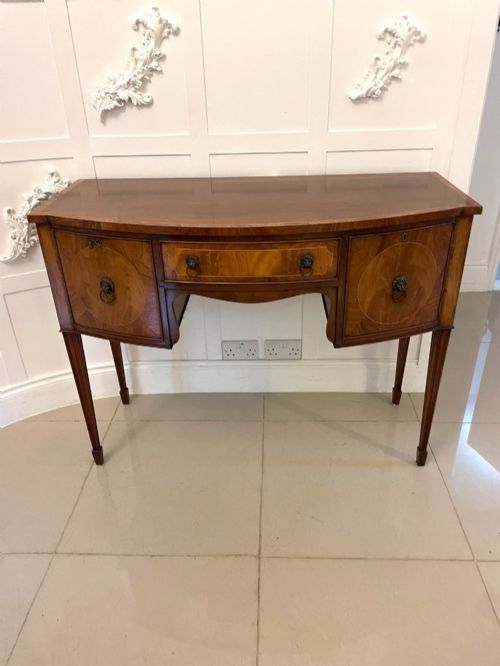
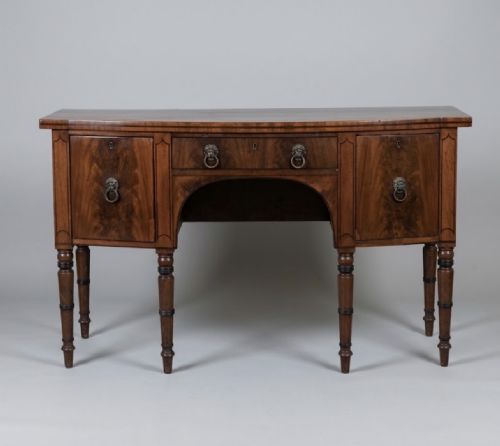
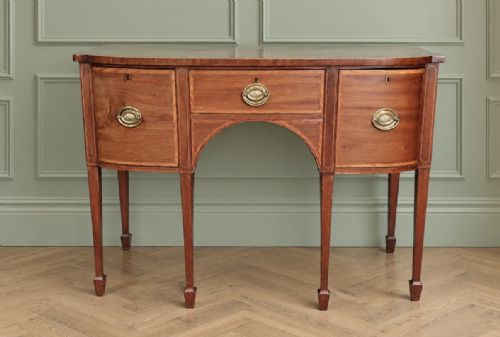
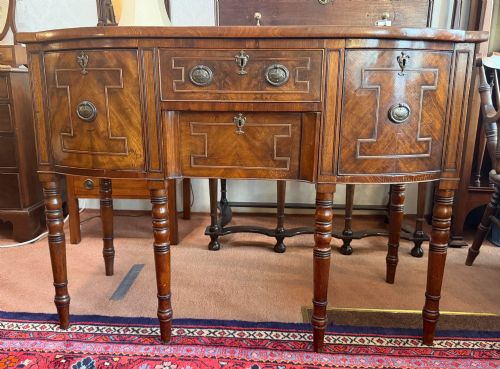
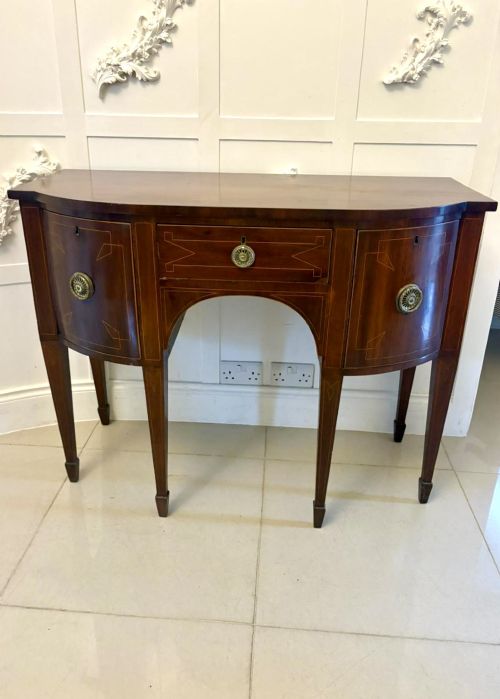
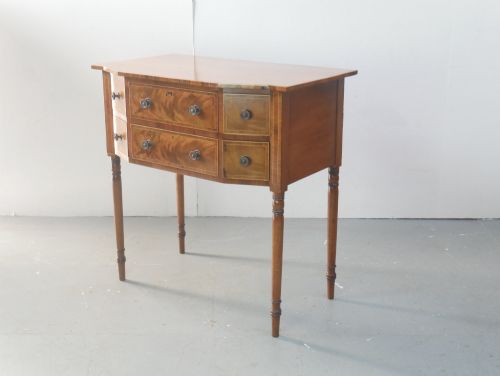
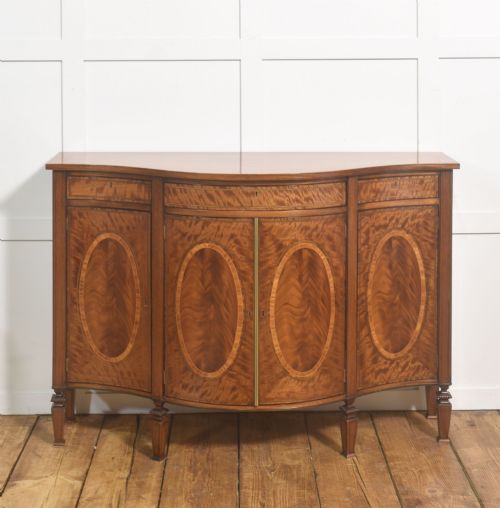
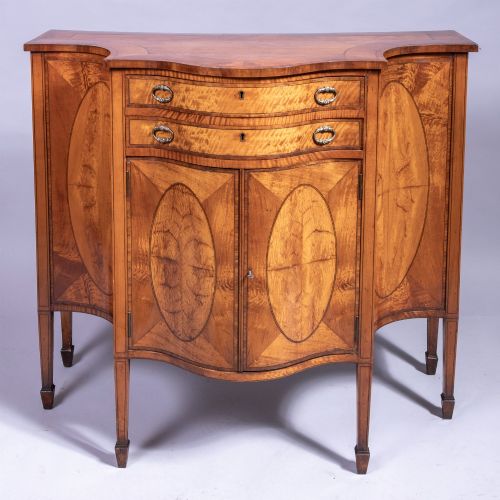
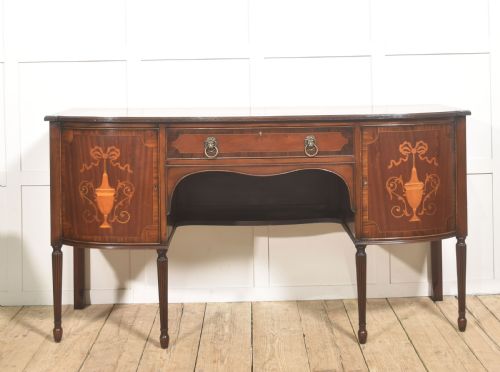
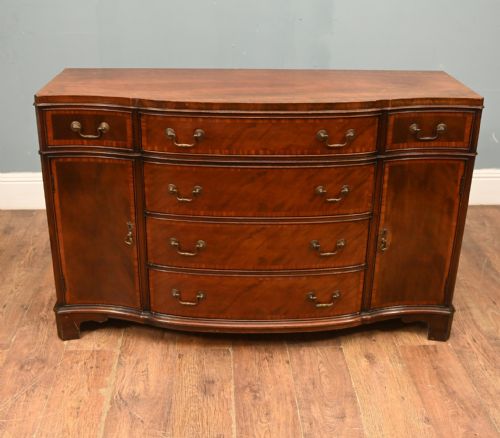
Inlaid Bowfront Server
An inlaid bowfront server brings curve and contrast to a dining room, offering deep storage beneath a graceful sweep of timber.
Inlaid Bowfront Server
An inlaid bowfront server is a substantial dining room piece designed to hold silver, linen, and service wares behind curved cupboard doors and drawers. When exploring this selection, buyers encounter formats spanning the Georgian, Regency, and Edwardian periods, alongside later revival pieces.
The characteristic curved front and decorative stringing appear across forms designated as sideboards, side cabinets, and dressers. Pieces range from grand George III examples to compact Sheraton Revival tables dating to the early twentieth century.
Originating primarily from eighteenth and nineteenth century workshops, these items utilise timber veneers and stringing to frame the sweeping curved facade. The most frequently met versions combine mahogany carcases with satinwood and boxwood details.
How they were made
Cabinet makers utilised figured mahogany as the primary timber, applying thin veneers over solid secondary woods to achieve rich grain patterns on the sweeping curved doors and drawer fronts. Delicate contrasting borders of boxwood and satinwood inlay were meticulously let into channels along the edges and legs.
Stringing and marquetry work required steady hand-cutting of light and dark woods, which were then fitted flush into the principal carcase before polishing. Brass hardware, including drop handles and escutcheons, was fitted to complete the functional storage compartments.
Inlaid Bowfront Server Retail Price Guide 2026
Typical asking prices for inlaid bowfront server among the pieces listed under this phrase on Sellingantiques today, from the lower quarter to the upper quarter. They describe what is for sale here now, not the wider market.
Some six-legged examples ensure the buffet stays firmly anchored even when heavily laden with roast joints.
What varies in quality
The refinement of the timber selection dictates the visual impact, with figured mahogany and carefully matched veneers marking out superior examples from plainer stock. Crispness in the execution of boxwood inlay and the precision of the mitres reveal the competence of the original workshop.
Proportion and scale distinguish finer iterations, particularly where the curved bowfront integrates harmoniously with tapered or reeded legs. The integration of secondary woods and the retention of original brass hardware further separate standard production from exceptional cabinet work.
The Inlaid Bowfront Server Glossary
- Bowfront
- A curved cabinet front that swells outward in a convex arc. This shape softens the room and distinguishes the form from flat-fronted sideboards.
- Inlay
- The technique of embedding contrasting strips or pieces of wood into the primary timber surface to create decorative borders and geometric motifs. Boxwood and satinwood are typical contrasting choices.
- Crossbanding
- A border of veneer laid with the grain running perpendicular to the main panel. This frames the drawer fronts and top surfaces.
- Stringing
- Thin, linear inlay used to create delicate contrasting borders around panels and drawer edges. It defines the structural lines of the cabinet.
- Marquetry
- Elaborate decorative patterns formed from fitted wood veneers depicting pictorial or floral motifs. It elevates the visual complexity of the surface.
Inlaid Bowfront Server: Frequently Asked Questions
What is the difference between a sideboard and a server?
Sideboards and servers both provide dining room storage, though servers often present a slightly lighter or more compact footprint with varied drawer and cupboard layouts.
Cabinet makers produced these forms across the Georgian and Regency eras to assist with serving meals and storing tableware.
How do I identify a Georgian piece?
Georgian pieces display construction methods typical of the eighteenth and early nineteenth centuries, including solid drawer linings and hand-cut dovetails.
Timber choice tends toward dense mahogany with subtle boxwood stringing rather than the heavier marquetry seen in later revival eras.
Where were these pieces used?
Dining rooms were the primary home for these cabinets, where they held heavy ceramics, silver, and linens close to the dining table.
Their curved profiles allowed servants to move past them easily in crowded formal rooms.
What does Sheraton Revival mean?
Sheraton Revival furniture dates to the late nineteenth and early twentieth centuries, copying the lighter, neoclassical styles popularised by Thomas Sheraton a century earlier.
These later pieces frequently feature satinwood veneers and intricate marquetry inlay.