

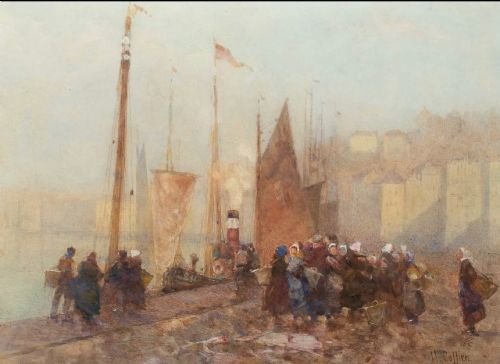



Impressionist Watercolour Seascape Painting
Impressionist watercolour seascape painting captures the shifting light and movement of coastal water through fluid washes.
Impressionist Watercolour Seascape Painting
An impressionist watercolour seascape painting records coastal scenes, harbours and open water through rapid brushwork and translucent pigment. These works focus on the play of light upon the sea, often depicting fishing boats, tidal shores and bustling quaysides.
The pieces available span from the late nineteenth century into the mid-twentieth century, capturing maritime subjects across British and European shores. Common locations include Cornish fishing ports like St Ives and Polperro, alongside continental destinations such as Normandy and Venice.
Makers represented in these coastal works include notable names associated with British Impressionism and regional schools, applying loose, expressive techniques to paper. Buyers meet framed examples that preserve the immediacy of the original watercolour execution.
Materials and Technique
These works are executed using watercolour paint on paper, sometimes supplemented with ink or bodycolour to define highlights on water and vessel sails. The pigment is applied in fluid washes that allow the white of the underlying paper to shine through as light.
Framing typically involves glass protection paired with wood or gilt wood moulding to preserve the delicate paper surface from atmospheric moisture and damage. The combination of transparent washes and direct observation gives these marine scenes their characteristic atmospheric quality.
Impressionist Watercolour Seascape Painting Retail Price Guide 2026
Typical asking prices for impressionist watercolour seascape painting among the pieces listed under this phrase on Sellingantiques today, from the lower quarter to the upper quarter. They describe what is for sale here now, not the wider market.
Several artists preferred painting the smell of salt in the air while standing precariously on slippery harbour stones.
Assessing Quality and Execution
Quality rests upon the artist's handling of tone and the economy of brushstrokes used to suggest movement in water and sky. Stronger examples display a confident grasp of light that defines the atmosphere of the harbour or open sea without overworking the paper.
The skill of the composition and the preservation of the pigment's vibrancy distinguish the finest watercolours from more formulaic topographical views. Original framing and the provenance associated with recognised painters also contribute to the standing of an individual piece.
William Banks Fortescue·Hector Caffieri·Frank Kelsey·William Lee Hankey·Frederick William Hattersley·Ernest F. Hill·Frederick Stuart Richardson·Frank Wasley·Fred Mayor·Eugene Boudin·S. J. Lamorna Birch·Henry Wimbush·Frances E Nesbitt·Edward Aubrey Hunt
The Impressionist Watercolour Seascape Painting Glossary
- Watercolour
- A paint consisting of pigment suspended in a water-soluble vehicle, applied to paper to create transparent washes of colour. This medium allows artists to capture transient effects of light on the sea swiftly.
- Gilt wood
- Wood that has been coated with a thin layer of gold leaf or gilt paint, commonly used for traditional picture frames. It adds a warm metallic border that complements marine subjects.
- Impressionism
- An art movement characterised by relatively small, thin yet visible brush strokes and an open composition focusing on accurate depiction of light. In these watercolours, it manifests as a lively rendering of coastal atmosphere.
- Provenance
- The chronology of the ownership, custody or location of a historical object. Documented history often links these maritime pieces to specific exhibitions or collections.
Impressionist Watercolour Seascape Painting: Frequently Asked Questions
Where were these seascapes painted?
The works record coastal scenes from British fishing ports such as St Ives, Polperro and Looe, alongside continental locations including Normandy, Boulogne and Venice. Artists travelled to active harbours to capture maritime life directly from observation.
Specific regional schools, particularly in Cornwall, formed around these coastal hubs, drawing painters who specialised in capturing local fishing vessels and tidal conditions.
How should these watercolours be displayed?
Watercolours require careful placement away from direct sunlight to prevent the pigments and paper from fading over time. They are best housed behind glass within stable indoor environments that avoid excessive humidity.
Proper framing preserves the paper support and protects the delicate washes from atmospheric pollutants while allowing the luminosity of the scene to remain visible.
What distinguishes these from oil paintings?
Watercolour relies on the reflective quality of the white paper shining through translucent washes of pigment, whereas oil paint is opaque and builds up in layers. This transparency gives seascapes executed in watercolour a distinct lightness and fluidity.
The medium encourages a rapid, direct approach suited to recording fleeting atmospheric conditions on the coast without the lengthy drying times associated with oils.
How do I identify the period?
Dating relies on stylistic evidence, artist signatures, framing methods and occasionally inscriptions on the reverse of the paper. Works from the late nineteenth century often feature traditional Victorian detailing, while early twentieth-century pieces adopt looser impressionistic brushwork.
Comparing the handling of light and subject matter to documented works by the same artists helps narrow the timeframe of creation.