





Impressionist Watercolour Scene
An impressionist watercolour scene captures transient light and everyday life on paper, offering buyers a vivid window into past coastal and urban communities.
Impressionist Watercolour Scene
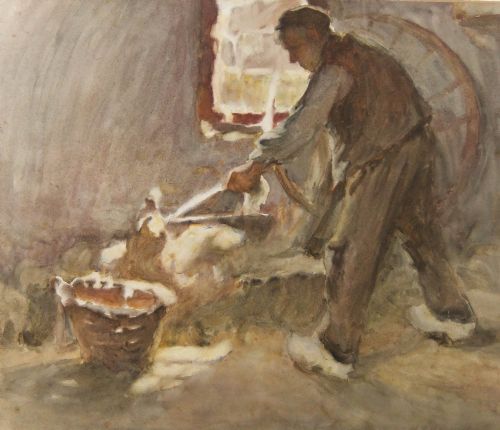
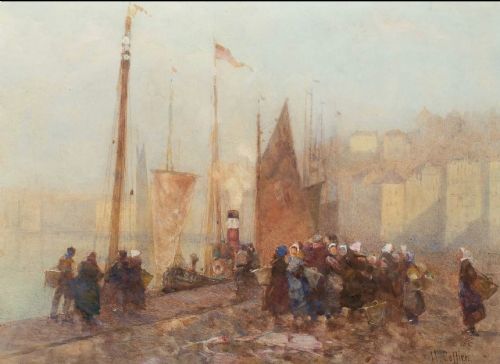
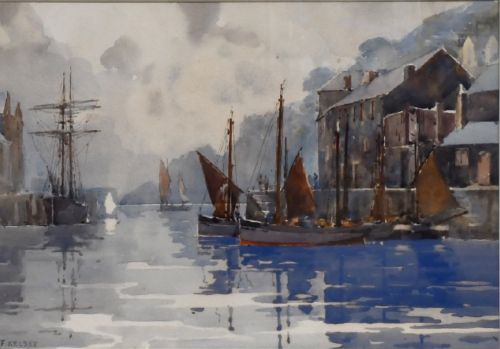
When you search for an impressionist watercolour scene, you are looking at works that record the fleeting effects of weather, harbour activity and rural labour. These pieces range from Victorian street views to early twentieth-century coastal depictions from established regional artists.
You are most likely to meet British and French examples dating from the nineteenth century through to the mid-twentieth century. The subjects lean heavily toward maritime harbours, country fields, and townscapes rendered with loose brushwork.
The selections span distinct regional groups, including the Newlyn School and northern coastal colonies. They present scenes painted on paper, often preserved behind glass within timber and gilt frames.
How they were made
These works rely primarily on watercolour pigment applied to paper, occasionally augmented with gouache to build opaque highlights. The handling captures immediate atmospheric conditions rather than tight, academic detail.
Artists mounted their sheets on paper or card, working outdoors or recording preliminary sketches in situ. Framing typically involves wood and gilt moulding protecting the face under glass.
Listings feature works spanning the nineteenth century through to the post-war period, rendered on paper support.
What varies in quality
Quality rests in the economy of the brushwork and the sureness of the hand, where a few confident marks convey movement and weight. Stronger compositions balance negative space with washes of pigment to establish depth and light.
Condition plays a major role, particularly the preservation of the paper support and the vibrancy of the pigments against fading. The harmony between the original frame and the artwork also elevates the standing of a piece.
William Banks Fortescue·Henry Silkstone Hopwood·Hector Caffieri·Albert Ludovici Jnr·Gaston Cornil·William Lee Hankey·Fred Lawson·Arthur Tucker·Charles James Lauder·Ernest Pile Bucknall·James Watson·John Atkinson·George Soper·Lilian Stannard·Frederick William Hattersley·Ernest F. Hill·Rowland Henry Hill·Frederick Stuart Richardson·Vittore Zanetti Zilla·Joseph W. Milliken·Emil John Hess·Roland Batchelor·John D. Walker·W. Tatton Winter·Ralph Todd
The Impressionist Watercolour Scene Glossary
- Watercolour
- A painting method in which the paints are made of pigments suspended in a water-based solution. It relies on the white of the paper to provide luminosity through translucent washes.
- Gouache
- A water-based paint consisting of pigment and other inert material designed to be opaque. It is frequently added to watercolour work to create solid highlights and dense areas of tone.
- Newlyn School
- An art colony based in Cornwall during the late nineteenth and early twentieth centuries. Artists gathered here to paint en plein air, focusing on local fisherfolk and coastal life.
- Gilt frame
- A wooden protective border coated with gold leaf or metallic paint. It gives a traditional finish that isolates the paper sheet from the surrounding wall.
- Provenance
- The documented history of a work of ownership and exhibition. It provides context for authenticity and connects the piece to its period of creation.
Impressionist Watercolour Scene: Frequently Asked Questions
What defines an impressionist watercolour?
An impressionist watercolour relies on visible brushstrokes, fluid washes, and a focus on light rather than strict academic precision. Artists captured fleeting moments in nature, busy ports, and urban streets.
These pieces use the white of the paper itself to create luminosity. The approach prioritises mood and atmosphere over minute topographical accuracy.
How should I frame and hang these works?
Watercolours on paper require protection from direct sunlight to prevent the pigments from fading over time. Standard framing involves acid-free mounts and glass to shield the fragile surface.
Keep them away from damp environments like kitchens or unheated rooms. Stable indoor temperatures ensure the paper support does not warp or develop foxing spots.
Where were most of these scenes painted?
Many works originate from coastal fishing ports and rural farming communities across Britain and France. Locations such as St Ives, Whitby, and various European waterways were especially popular among plein air painters.
Artists travelled to these specific spots to record local industries, harbourside trade, and open landscapes. The resulting pictures document regional trades and architectural styles of the era.
How do I distinguish between periods?
Nineteenth-century examples often display tighter academic control and heavier narrative elements in the subjects. By contrast, early twentieth-century pieces embrace looser brushwork and brighter palettes influenced by French movements.
Signatures, artist registry dates, and framing styles also offer clues to the decade of creation. Examining the paper texture and backing materials helps confirm the historic era.