




Impressionist Valley Landscape Painting
Impressionist valley landscape painting captures wide river basins and steep hillsides through loose brushwork and direct observation.
Impressionist Valley Landscape Painting
When you search for impressionist valley landscape painting, you encounter works recording rural river settings, riverbanks, and agricultural dales across the early decades of the twentieth century. These canvases and panels focus on specific regional topography, notably Yorkshire dales, Welsh valleys, and French river scenes, rendered through the lens of British and French Impressionism, Post-Impressionism, and Fauvism.
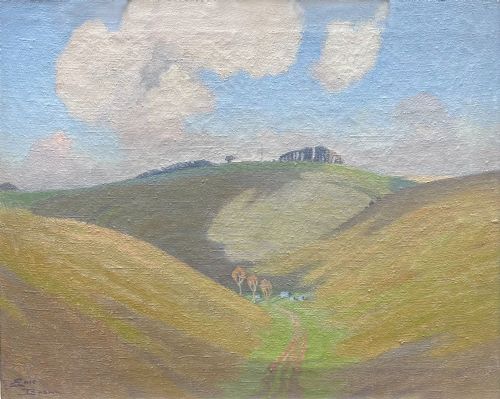
The version you are most likely to meet on this page is an oil painting on canvas or wood panel dating from the nineteen-twenties or nineteen-thirties. Painters such as Reginald Grange Brundrit, Herbert Royle, and Ernest Higgins Rigg dominate the selection, bringing an atmospheric treatment of light to northern English valleys and rural retreats.
Watercolours on paper also appear, offering a lighter touch on Thameside villages and Welsh river valleys from earlier in the twentieth century and late Victorian periods. These pieces balance observational precision with fluid washes, documenting specific geographical locations from Cardiganshire to Salcombe.
Materials and methods
Artists painted primarily in oil paint upon prepared canvas or sturdy wood panel, applying pigment with confident, visible strokes. This medium allowed painters to work plein air, capturing shifting light and weather conditions directly before the landscape.
Watercolour on paper forms another strand of the making process, utilising fluid pigments to render softer atmospheric effects in riverside scenes. Many surviving examples retain their original gilded frames, which complement the tonal range of the painted surface.
Listings feature works from the 1900s to the 1940s, executed in oil and watercolour on canvas, wood panel, and paper.
Assessing quality
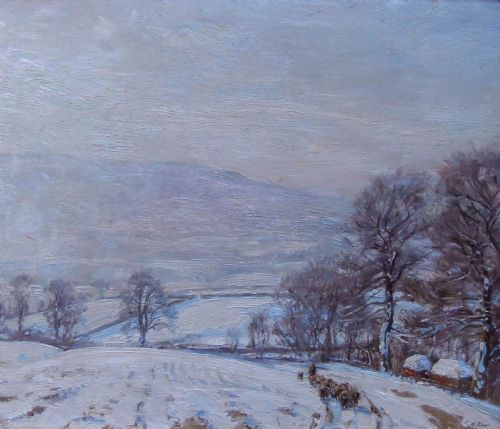
The distinction between standard decorative works and superior examples rests upon the confidence of the brushwork and the artist's command of light. Stronger paintings demonstrate a distinct handling of shadow and atmosphere, particularly in depictions of evening light or winter conditions in northern dales.
Provenance and documentation elevate individual pieces, especially when signed by recognised Royal Academicians or exhibited members of regional art societies. The relationship between the painted surface and its original gilded frame also influences the overall integrity of the piece.
The Impressionist Valley Landscape Painting Glossary
- Plein air
- Painting outdoors in direct natural light to capture the immediate visual conditions of a landscape. This method defined much twentieth-century valley landscape work.
- Wood panel
- A rigid support base utilised by artists for oil paintings, offering a stable alternative to stretched canvas. Panels frequently survive from the early twentieth century.
- Watercolour
- A paint consisting of pigment suspended in a water-based solution, applied to paper. It yields translucent washes well suited to river and dusk scenes.
- Fauvism
- An early twentieth-century style characterised by strong, non-naturalistic colours and expressive brushwork. Examples here apply this bold palette to Mediterranean landscapes.
Impressionist Valley Landscape Painting: Frequently Asked Questions
What periods do these paintings date from?
The available selection spans the early twentieth century, with particular concentration in the nineteen-twenties and nineteen-thirties. Pieces also extend back to the nineteen-hundreds and forward into the nineteen-forties.
These dates align with the active periods of British Impressionism and related modern movements, reflecting regional topography across England, Wales, and France.
Where were these valley scenes painted?
The works depict specific regional valleys, including Yorkshire dales like Wharfedale and Swaledale, Cardiganshire, the Dysynni Valley in Wales, and the River Loire in France. Other locations encompass Thameside villages and Devon estuaries.
Artists frequently returned to familiar rural terrain to record seasonal shifts, evening light, and local waterways.
How should I care for an oil painting on panel?
Keep the painting away from direct sunlight and sources of extreme heat to protect the wood support and oil pigments. Stable indoor humidity prevents the panel from warping.
Dust the surface gently with a soft, dry brush and avoid chemical cleaning agents on both the paint layer and the gilded frame.
What distinguishes an oil painting from a watercolour?
Oil paintings utilise thick, opaque pigments on canvas or wood panel, allowing for rich texture and layered brushwork. Watercolours employ translucent washes on paper, producing a lighter, more delicate visual effect.
Both mediums capture atmospheric river and valley views but require different framing and conservation approaches.